
What Technology Powers the Modern BFSI Industry
August 26, 2026 By Yodaplus
The modern BFSI industry runs on five core technology layers: cloud-native core banking systems, AI for fraud detection and decisioning, open banking APIs, RegTech for compliance automation, and cybersecurity infrastructure protecting all of it. Global financial services technology spending reached 650 billion dollars in 2025, with AI, cloud-native core banking, and embedded finance attracting the largest share of new investment. That level of spend shows technology has moved from a support function to the core of how banks, insurers, and NBFCs operate.
Understanding what powers this shift matters for any leader deciding where to invest next.
Why the Technology Stack Changed So Fast
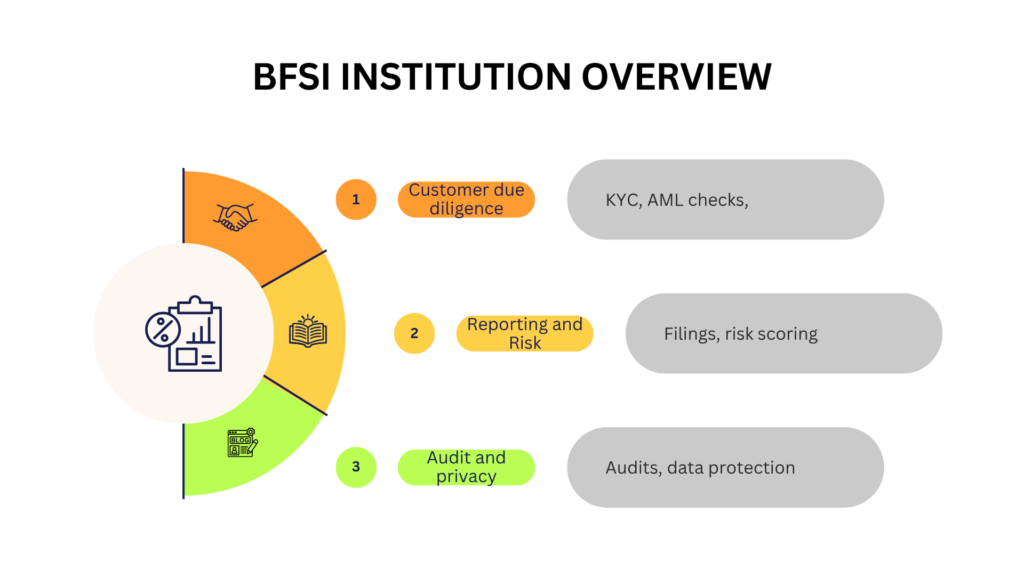
Traditional core banking systems were built for batch processing and periodic updates. Customer expectations and real-time payment demand made that model obsolete.
Neobanks built on modern architecture forced traditional institutions to rethink aging systems that could not support instant payments, API access, or continuous fraud monitoring. That pressure created the current wave of modernization spending.
The Core Technologies Powering BFSI Today
Cloud-native core banking platforms
The global core banking software market is expected to grow from around 16.79 billion dollars in 2024 to nearly 65 billion dollars by 2032. Cloud-native platforms reduce the cost of running core infrastructure by 40 to 60 percent compared to legacy systems, while giving institutions the flexibility to launch new products faster.
AI for fraud detection and decisioning
AI fraud detection systems now catch 40 to 60 percent more fraudulent transactions than rule-based systems at the same false-positive rate. This shift is why AI has been named the most significant banking technology trend for three years running in industry surveys.
Open banking APIs
Open banking has created new revenue streams for early-adopting banks, with third-party product revenue growing 25 percent year over year in markets with mature open banking frameworks. APIs let banks share account data securely with fintech partners, enabling embedded finance products that were not possible under closed systems.
RegTech and compliance automation
RegTech platforms automate regulatory reporting and reduce regulatory operations headcount requirements by 20 to 35 percent. This is a direct response to the rising cost of manual compliance work across BFSI institutions.
Cybersecurity infrastructure
The security market tied to BFSI is projected to grow past 82 billion dollars, reflecting how central protection has become as digital transaction volumes and cyber threats both continue climbing.
Hybrid and multi-cloud infrastructure
Around 75 percent of banks are expected to operate in hybrid cloud environments, keeping sensitive workloads on private infrastructure while running customer-facing applications and AI experimentation on public cloud for speed and scale.
Common Challenges in Adopting Modern BFSI Technology
- Cloud spend inefficiency remains significant, with a large share of enterprise cloud budgets wasted due to poor resource management
- Many institutions increase technology budgets but direct the spend toward incremental fixes on legacy platforms instead of real modernization
- Integration between new AI and RegTech tools and existing core banking systems remains a common bottleneck
- Regulatory bodies are increasing oversight of third-party technology vendors, adding new compliance layers to cloud adoption
- Talent shortages in AI, cloud architecture, and cybersecurity slow down implementation timelines
- Smaller institutions often lack the budget to modernize at the same pace as larger banks, widening the technology gap
Best Practices for Building a Modern BFSI Technology Stack
- Prioritize core system modernization before layering AI or automation on top of legacy infrastructure
- Adopt a hybrid cloud strategy that matches workload sensitivity to the right infrastructure environment
- Build API-first architecture so new products and fintech partnerships can launch without a full system rebuild
- Invest in AI fraud detection that works alongside existing rule-based systems rather than replacing them abruptly
- Automate regulatory reporting workflows to reduce manual compliance headcount needs over time
- Review cloud resource usage regularly to avoid unnecessary spend on underutilized infrastructure
- Align technology modernization budgets with operational efficiency goals, not just feature additions
- Strengthen third-party vendor oversight as more workloads move to cloud and API-based systems
- Train internal teams on AI and cloud tools before scaling deployment across departments
- Benchmark technology spend and outcomes against similar institutions to identify where investment is falling short
Future Outlook
Total global IT spending is projected to reach 6.15 trillion dollars, with BFSI remaining a primary driver of that growth as institutions shift capital toward intelligence, resilience, and autonomous operations. Gartner projects that 90 percent of banking workloads will run on the cloud by 2030, a clear signal that hybrid infrastructure is a transition phase, not a permanent state.
AI is moving from experimentation to production at scale, with a growing share of institutions giving AI systems actual transactional authority rather than advisory roles only. RegTech spending is expected to keep growing near 20 percent annually, closing the gap between compliance requirements and the technology built to meet them.
As real-time payment systems expand, demand for API management, transaction authentication, and instant fraud analytics will keep pushing institutions toward more connected, cloud-based architecture.
Conclusion
The technology powering the modern BFSI industry, cloud-native core banking, AI-driven fraud detection, open banking APIs, RegTech, and strong cybersecurity, works best when these layers are connected rather than built in isolation. Institutions that treat modernization as a full architecture shift, not a patchwork of point solutions, are the ones seeing measurable gains in speed and cost.
Yodaplus supports BFSI institutions in connecting these technology layers through Agentic AI, enterprise AI, and intelligent automation, with ERP integration, document processing, and secure system integrations that bring core banking, compliance, and operational data together. For institutions modernizing their technology stack without disrupting existing operations, this connected approach helps turn fragmented systems into a coordinated enterprise technology foundation.
FAQs
AI has been named the most significant banking technology trend for three consecutive years in industry surveys, ahead of cloud migration and cybersecurity, though all three remain closely connected priorities.
A hybrid cloud lets institutions keep sensitive workloads on private infrastructure for security and compliance reasons while using the public cloud for customer-facing applications and AI experimentation that need scalability.
Open banking requires banks to build secure API infrastructure that allows third-party fintech providers to access account data with customer consent, which is a different technical requirement than traditional closed banking systems.
Not usually. Most institutions run AI fraud detection alongside existing rule-based systems, since AI improves detection accuracy while rules still provide predictable baseline coverage for known fraud patterns.
RegTech specifically automates regulatory reporting, monitoring, and audit preparation tasks, reducing the manual workload compliance teams would otherwise need to handle through traditional compliance software alone.