
What Core Technologies Power Modern BFSI Operations?
August 26, 2026 By Yodaplus
Modern BFSI operations run on five technologies that touch every transaction: digital onboarding and identity verification, real-time payments infrastructure, workflow automation for service delivery, data analytics for decisioning, and hybrid cloud systems connecting it all together. UPI alone processed over 17,000 crore transactions worth more than 246 lakh crore rupees in a single financial year, making India the largest real-time payments market in the world. That volume shows why operational technology, not just core banking software, has become the backbone of daily BFSI activity.
Where the previous conversation around BFSI technology often centers on infrastructure and market size, this piece looks at what actually powers day-to-day operations, onboarding a customer, processing a payment, resolving a service request, and detecting fraud in real time.
Why Operations-Level Technology Matters As Much As Core Systems
A modern core banking platform means little if the customer-facing and back-office processes running on top of it are still manual. Operations technology is where customers and staff experience the institution directly.
Institutions that combine intelligent automation with human expertise in service delivery see the clearest results. AI-powered virtual assistants have helped some banks cut customer service wait times by up to 20 percent, while automated pre-approval models have sharply reduced the manual work behind mortgage and loan processing.
The Core Technologies Running Modern BFSI Operations
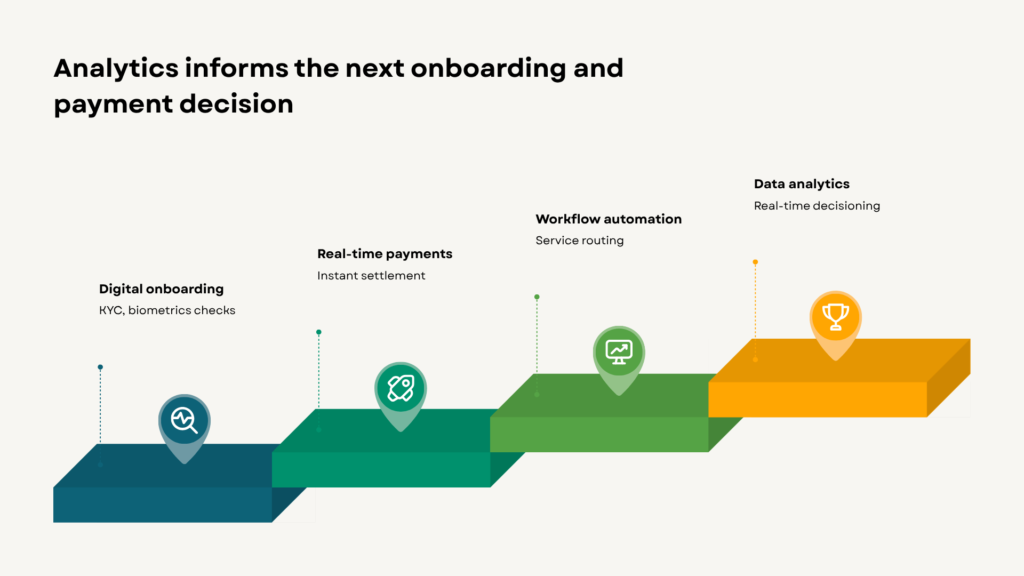
Digital onboarding and identity verification
OTP, video KYC, and biometric verification have replaced manual document checks at account opening. In markets with strong digital identity infrastructure, this has cut onboarding time from days to minutes while improving verification accuracy.
Real-time payments infrastructure
Instant payment rails now handle the bulk of transaction volume in many markets. This requires fraud analytics and transaction routing systems fast enough to clear payments in seconds without slowing down settlement.
Workflow automation across service delivery
Modern contact centers have become the operational hub for onboarding, verification, and ongoing customer engagement, powered by workflow automation that routes requests to the right process or team without manual triage.
Data analytics for decisioning
Credit decisions, fraud flags, and personalized product recommendations increasingly run on analytics models that process customer data in real time rather than relying on periodic batch reviews.
Account aggregation and open data frameworks
Frameworks that let customers securely share financial data across institutions, similar to account aggregator models with well over 100 million linked accounts in some markets, are reshaping how lending and advisory services access customer information.
Hybrid cloud infrastructure
Institutions that migrate customer-facing and analytics workloads to public cloud while keeping core transaction systems on secure infrastructure report substantial reductions in infrastructure cost and much faster time-to-market for new digital products.
Common Challenges in Modernizing BFSI Operations
- Legacy core systems built decades ago were not designed to support real-time, API-driven operations
- Talent shortages in AI, cyber-risk, and automation roles are driving up hiring costs and slowing rollout timelines
- Data privacy regulations require explicit consent handling, adding complexity to onboarding and analytics workflows
- Institutions often modernize customer-facing operations faster than the back-office systems that support them, creating new bottlenecks
- Fraud and cyber threats are increasing in parallel with digital transaction growth, requiring constant investment just to maintain current protection levels
- Coordinating automation across onboarding, payments, and service delivery requires integration work that many institutions underestimate
Best Practices for Strengthening BFSI Operational Technology
- Automate onboarding verification steps first, since this delivers the fastest visible improvement in customer experience
- Build fraud detection models that work in real time on payment rails, not as a post-transaction review step
- Route routine service requests through workflow automation and reserve staff time for complex or sensitive cases
- Keep core transaction systems on secure, regulated infrastructure while moving analytics and customer-facing workloads to cloud
- Invest in staff training for AI and automation tools alongside the technology rollout itself
- Align data consent and privacy handling with regulatory requirements before scaling analytics-driven decisioning
- Monitor operational technology performance continuously rather than through periodic manual audits
- Prioritize integration between onboarding, payments, and back-office systems to avoid data silos
- Benchmark customer service response times and resolution rates before and after automation to measure real impact
- Build cyber-risk capacity in step with digital transaction growth, not after volume has already scaled
Future Outlook
Institutions are moving away from monolithic legacy architectures toward modular, cloud-native systems built to support real-time processing and agentic automation. A significant share of BFSI leaders already report giving AI systems some transactional authority rather than advisory roles only, a shift that is expected to expand further through the rest of the decade.
Digital lending and neo-banking platforms built on modern, API-first architecture are demonstrating lower customer acquisition costs than traditional distribution models, pushing established institutions to adopt similar operational technology to stay competitive. As account aggregation and open data frameworks mature, expect operational decisioning to rely even more on data shared securely across institutions rather than data held in isolation.
Conclusion
The technologies powering modern BFSI operations, digital onboarding, real-time payments, workflow automation, data analytics, and hybrid cloud, work best when they are connected across the full customer journey rather than deployed as separate initiatives. Institutions that treat these as one operational system, not five disconnected tools, see the strongest gains in speed and service quality.
Yodaplus helps BFSI institutions connect these operational layers through Agentic AI, intelligent automation, and enterprise AI, with ERP integration, document processing, and secure system integrations that bring onboarding, payments, and service workflows together. For institutions modernizing day-to-day operations without disrupting core systems already in place, this connected approach turns fragmented operational technology into one coordinated enterprise capability.
FAQs
Core banking technology handles the underlying systems of record for deposits, loans, and transactions, while operational technology covers the day-to-day processes built on top of it, such as onboarding, service delivery, and fraud monitoring.
Instant settlement leaves little time for manual fraud review, so institutions need automated fraud analytics capable of flagging suspicious transactions within seconds rather than through post-transaction checks.
Contact centers now handle onboarding, verification, and ongoing engagement together, using workflow automation to route requests efficiently, which makes them a central point where multiple operational technologies intersect.
Hybrid cloud generally supports compliance better than full public cloud migration, since institutions can keep sensitive transaction data on regulated, controlled infrastructure while using public cloud for less sensitive workloads.
Automating digital onboarding and identity verification typically shows the fastest visible improvement, since it directly reduces the time customers wait to open an account or access a product.