What Does AI Readiness Actually Mean for Capital Markets Firms?
October 13, 2026 By Yodaplus
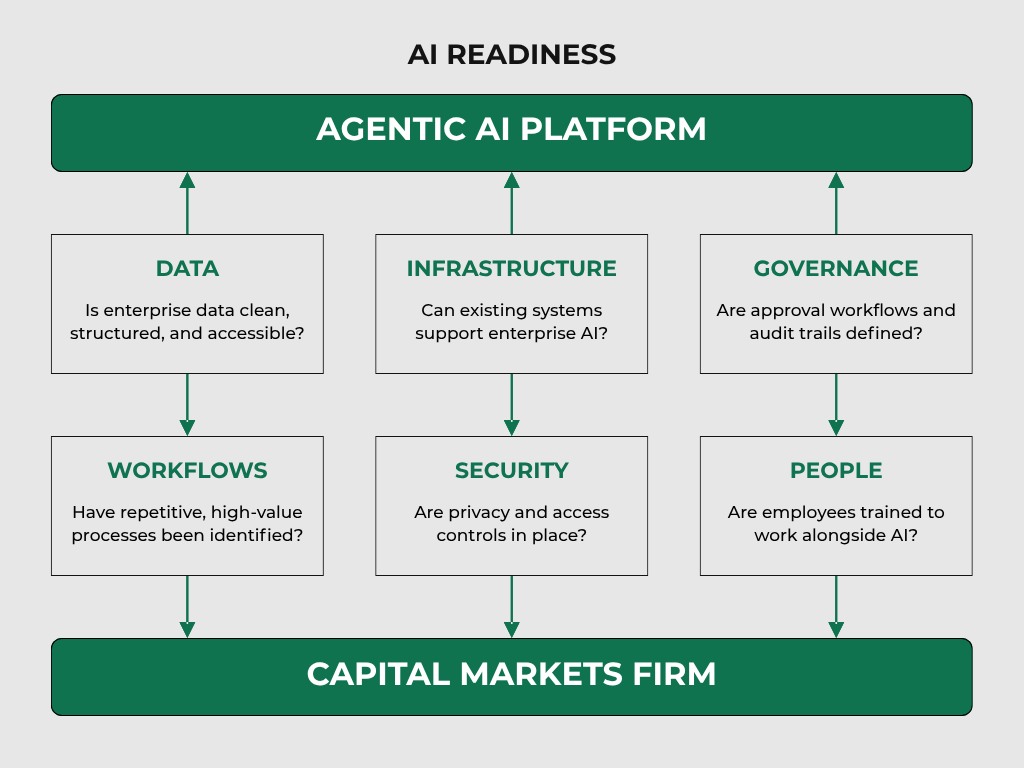
AI readiness is an organisation’s ability to successfully adopt, deploy, and scale artificial intelligence across its business operations. For a capital markets firm, AI readiness means much more than purchasing an AI platform or experimenting with large language models. It means having the right data, infrastructure, governance, security, and business processes in place so AI can deliver measurable value.
Many firms invest in AI technology expecting immediate results. However, AI performs only as well as the environment in which it operates. Poor data quality, disconnected systems, unclear workflows, and weak governance can limit the impact of even the most advanced AI models.
As Agentic AI becomes more capable of automating complex financial workflows, assessing AI readiness has become one of the most important steps before implementation.
Why AI Readiness Matters
Capital markets generate enormous volumes of information every day.
Investment professionals work with:
- Equity research reports
- Financial reports
- Company filings
- Macroeconomic data
- Market news
- Trading activity
- Analyst reports
- Regulatory disclosures
Processing this information manually consumes significant time and resources.
AI can accelerate these activities, but only when it has access to reliable enterprise data and clearly defined business processes.
Organisations that assess AI readiness before implementation typically experience smoother deployments, faster adoption, and stronger business outcomes.
AI Readiness Is More Than Technology
Many organisations assume AI readiness is simply about having the right software.
In reality, successful AI adoption depends on multiple business capabilities working together.
A capital markets firm should evaluate:
- Data maturity
- Technology infrastructure
- Workflow design
- Security controls
- AI governance
- Employee readiness
- Regulatory compliance
If any one of these areas is weak, AI projects become more difficult to scale.
Data Readiness Is the Foundation
Data is one of the most valuable assets within capital markets.
Financial institutions manage information across multiple sources, including:
- Financial statements
- Earnings transcripts
- Investment research
- Portfolio data
- Market feeds
- Regulatory filings
- Internal documents
Before deploying AI, firms should ask:
- Is our data accurate?
- Is information standardised?
- Can AI access the required datasets?
- Are documents properly categorised?
- Do duplicate records exist?
High-quality data improves the accuracy of AI-generated insights while reducing operational risk.
Infrastructure Determines Scalability
Enterprise AI depends on modern infrastructure.
Organisations should evaluate whether their systems support:
- Secure APIs
- Cloud computing
- Enterprise databases
- Identity management
- Monitoring platforms
- High-performance computing
Many firms continue to operate legacy systems that limit AI integration.
Modern infrastructure allows AI agents to access information securely while supporting enterprise-scale workloads.
Workflow Readiness Matters
Not every business process should be automated immediately.
Organisations should identify workflows that are repetitive, time-intensive, and well documented.
Examples include:
- Equity research analysis
- Financial report summaries
- Earnings comparisons
- Compliance documentation
- Portfolio risk assessment
- Financial forecasting
- Market sentiment analysis
Starting with structured workflows helps organisations demonstrate value before expanding AI across additional business functions.
Governance Builds Trust
Capital markets operate under strict regulatory requirements.
AI systems should produce transparent, explainable, and auditable results.
Strong AI governance includes:
- Approval workflows
- Audit trails
- Model monitoring
- Role-based permissions
- Documentation
- Risk management policies
Governance helps organisations maintain confidence in AI-generated outputs while supporting regulatory compliance.
Security Cannot Be an Afterthought
Capital markets firms handle confidential financial information.
Before deploying AI, organisations should review:
- Data encryption
- Access controls
- Authentication
- Model security
- Information privacy
- Regulatory obligations
AI should only access information required to complete assigned tasks.
Strong security protects both organisations and their clients.
People Remain Central to AI Success
AI supports professionals. It does not eliminate the need for human expertise.
Investment analysts, compliance officers, portfolio managers, and technology teams all play important roles during AI adoption.
Organizations should invest in:
- AI education
- Change management
- Prompt engineering
- Governance training
- Cross-functional collaboration
Employees who understand AI capabilities are more likely to adopt the technology successfully.
Measuring AI Readiness
AI readiness should be evaluated using measurable indicators rather than assumptions.
Useful metrics include:
- Percentage of structured enterprise data
- Number of AI-ready workflows
- API availability
- Data quality scores
- Compliance accuracy
- Research turnaround time
- Manual effort reduction
- User adoption
- AI accuracy
- Security compliance
These indicators provide a clear baseline before implementation begins.
Common AI Readiness Challenges
Many organisations encounter similar obstacles during AI adoption.
Common challenges include:
- Legacy systems
- Data silos
- Poor documentation
- Limited AI skills
- Weak governance
- Security concerns
- Unclear business priorities
Identifying these challenges early allows organisations to develop practical implementation plans instead of reacting after deployment.
The Role of Human in the Loop
Capital markets require accountability.
Many investment decisions involve significant financial and regulatory consequences.
A human-in-the-loop approach allows AI to automate repetitive work while experienced professionals review important recommendations before action is taken.
Examples include:
- Investment decisions
- Compliance approvals
- Research validation
- Portfolio recommendations
- Financial reporting
This approach balances efficiency with oversight.
Building an AI-Ready Capital Markets Firm
Organisations should approach AI adoption gradually.
A practical roadmap includes:
- Assess current readiness.
- Improve data quality.
- Modernise infrastructure.
- Identify high-value workflows.
- Establish AI governance.
- Launch pilot projects.
- Measure business outcomes.
- Scale successful implementations.
This phased approach reduces implementation risk while delivering measurable improvements.
Conclusion
AI readiness is not simply about deploying new technology. It is about preparing an organisation to use AI safely, effectively, and at scale. Capital markets firms that invest in high-quality data, modern infrastructure, secure integrations, governance, and employee readiness are better positioned to benefit from intelligent automation.
As Agentic AI continues to transform financial services, readiness will become a competitive advantage rather than a technical exercise. Yodaplus Agentic AI for Financial Operations helps financial institutions assess AI readiness, integrate enterprise systems, automate financial workflows, and deploy secure AI solutions that improve operational efficiency while maintaining governance and regulatory compliance.
FAQs
AI readiness refers to a firm’s ability to successfully deploy and scale AI using the right data, infrastructure, governance, security, and business processes.
It helps organisations reduce implementation risk, improve AI performance, and achieve measurable business outcomes.
Most organisations begin by assessing their data quality, infrastructure, workflows, and governance before selecting AI technologies.
Yes. Strong governance, audit trails, and human oversight help organisations deploy AI while meeting regulatory and compliance requirements.
Yodaplus Agentic AI for Financial Operations helps financial institutions evaluate readiness, integrate enterprise systems, automate workflows, and deploy secure, scalable Agentic AI solutions.