Agentic AI Readiness in Capital Markets: A Complete Enterprise Guide
October 13, 2026 By Yodaplus
Agentic AI is changing how financial institutions operate. Unlike traditional automation, which follows predefined rules, Agentic AI can reason, plan, make decisions, and complete multi-step tasks with minimal human intervention. For capital market firms, this opens opportunities to automate research, improve compliance, accelerate reporting, strengthen risk management, and support investment professionals with intelligent workflows.
However, adopting Agentic AI is not simply about selecting a large language model or deploying an AI assistant. Organisations need the right data, technology infrastructure, governance, workflows, and people before autonomous AI systems can operate effectively.
This is where Agentic AI readiness becomes important. It measures whether an organisation is prepared to deploy AI agents securely, responsibly, and at scale. Institutions that invest in readiness are more likely to achieve successful AI implementations, while those that skip preparation often struggle with poor data quality, integration challenges, compliance risks, and limited business impact.
What Does Agentic AI Readiness Mean?
Agentic AI readiness refers to an organisation’s ability to successfully deploy, manage, and scale AI agents across business operations.
Readiness goes far beyond technology. It considers every component required for enterprise AI adoption, including:
- Data quality
- Enterprise infrastructure
- Business workflows
- AI governance
- Security controls
- Employee readiness
- Regulatory compliance
An organisation may have access to advanced AI models, but without clean data or well-defined workflows, those models cannot deliver reliable business outcomes.
In capital markets, readiness also means ensuring AI systems can work with highly regulated financial data while maintaining transparency and human oversight.
Why Capital Markets Need Agentic AI
Capital markets generate enormous volumes of structured and unstructured information every day.
Financial institutions process:
- Earnings reports
- Annual reports
- Regulatory filings
- Economic indicators
- Company announcements
- Market news
- Trading data
- Research reports
- Analyst notes
Investment professionals must evaluate this information quickly while maintaining high levels of accuracy.
As markets become increasingly global, the amount of information continues to grow faster than human teams can process manually.
Agentic AI helps solve this challenge by automating repetitive analytical work while allowing investment professionals to focus on higher-value decisions.
Some common applications include:
- Equity research
- Investment research
- Financial modelling
- Portfolio risk assessment
- Compliance monitoring
- Market intelligence
- Financial report analysis
- Earnings summaries
- Investment memo generation
Instead of replacing analysts, Agentic AI enables them to process significantly more information in less time.
Why Traditional Automation Is No Longer Enough
Many financial institutions already use automation.
Traditional automation works well for repetitive tasks with clearly defined rules.
Examples include:
- Sending notifications
- Updating databases
- Processing predefined workflows
- Generating scheduled reports
However, capital market operations rarely follow predictable rules.
Analysts frequently need to:
- Interpret financial statements
- Compare companies
- Assess risks
- Evaluate market events
- Combine information from multiple systems
- Make judgement-based decisions
Traditional automation struggles with these activities because it cannot reason beyond predefined instructions.
Agentic AI introduces a different approach.
Rather than executing fixed workflows, AI agents can:
- Plan multiple actions
- Choose appropriate tools
- Retrieve enterprise knowledge
- Interact with business systems
- Generate recommendations
- Adapt to changing conditions
This makes Agentic AI suitable for more sophisticated financial workflows that involve reasoning rather than simple task execution.
The Seven Pillars of Agentic AI Readiness
Organisations preparing for enterprise AI should evaluate readiness across seven key areas.
These pillars determine whether AI agents can operate reliably within complex financial environments.
1. Data Readiness
Data is the foundation of every AI system.
Without accurate, complete, and accessible information, AI cannot generate reliable outputs.
Financial institutions typically manage data across multiple formats, including:
- Financial statements
- Equity research reports
- Market data
- Economic indicators
- Corporate filings
- Regulatory documents
- Internal research
- Historical performance data
Before deploying AI agents, organisations should evaluate:
- Data quality
- Data consistency
- Missing information
- Document structure
- Metadata availability
- Data ownership
Poor-quality data increases the likelihood of inaccurate recommendations and unreliable analysis.
Well-prepared data significantly improves AI performance.
2. Infrastructure Readiness
Enterprise AI depends on strong technical infrastructure.
Organisations should assess whether their existing environment can support AI workloads.
Infrastructure considerations include:
- Cloud platforms
- Secure computing resources
- APIs
- Enterprise databases
- Vector databases
- Identity management
- Monitoring systems
Scalable infrastructure enables AI agents to access enterprise information efficiently while maintaining performance and security.
Without proper infrastructure, AI adoption often becomes fragmented and difficult to scale.
3. Workflow Readiness
Not every business process should be automated immediately.
Organisations should first identify workflows that are:
- High volume
- Repetitive
- Time-consuming
- Data intensive
- Well documented
Examples within capital markets include:
- Equity research report preparation
- Earnings call summaries
- Regulatory reporting
- Portfolio monitoring
- Risk analysis
- Compliance reviews
- Investment research
- Financial report comparisons
Selecting the right workflows allows organisations to demonstrate value early while minimising implementation risk.
4. Governance Readiness
AI governance is essential in highly regulated industries such as financial services.
Organisations should establish policies covering:
- Human approvals
- Audit trails
- Model transparency
- Version control
- Responsible AI usage
- Risk management
- Compliance monitoring
Governance helps ensure AI decisions remain explainable and accountable.
Financial institutions increasingly require AI systems that can justify outputs, record decision histories, and support regulatory reviews.
Strong governance also improves stakeholder confidence and reduces operational risk.
5. Integration Readiness
Enterprise AI cannot operate in isolation. AI agents need access to the systems employees already use every day.
Before implementation, organisations should evaluate whether AI can securely connect with:
- Portfolio Management Systems (PMS)
- Order Management Systems (OMS)
- Customer Relationship Management (CRM) platforms
- Enterprise Resource Planning (ERP) systems
- Market data providers
- Document repositories
- Internal knowledge bases
- Compliance systems
Many financial institutions still rely on legacy applications that were never designed for AI integration.
APIs, middleware, and modern integration frameworks allow Agentic AI to access enterprise information without disrupting existing operations.
Successful integration ensures AI agents work alongside existing systems instead of creating additional silos.
6. Security Readiness
Financial institutions manage highly confidential information.
Investment research, customer portfolios, trading strategies, and financial reports require strong protection.
Before deploying Agentic AI, organisations should evaluate:
- Role-based access controls
- Encryption standards
- Authentication mechanisms
- Data privacy policies
- Secure API access
- Model permissions
- Audit logging
Security should remain a priority throughout the AI lifecycle.
Organisations must ensure AI agents only access information required for their assigned tasks while maintaining regulatory compliance.
7. People Readiness
Technology alone does not determine AI success.
Employees must understand how AI fits into existing workflows and how they should collaborate with intelligent systems.
Organisations should prepare:
- Investment analysts
- Compliance teams
- Portfolio managers
- IT departments
- Risk teams
- Business leaders
Training should cover:
- AI capabilities
- AI limitations
- Prompt design
- Human oversight
- Governance policies
- Responsible AI practices
Organisations that invest in employee readiness typically experience faster adoption and stronger business outcomes.
Agentic AI Readiness Checklist
Organisations can use the following checklist before beginning enterprise AI implementation.
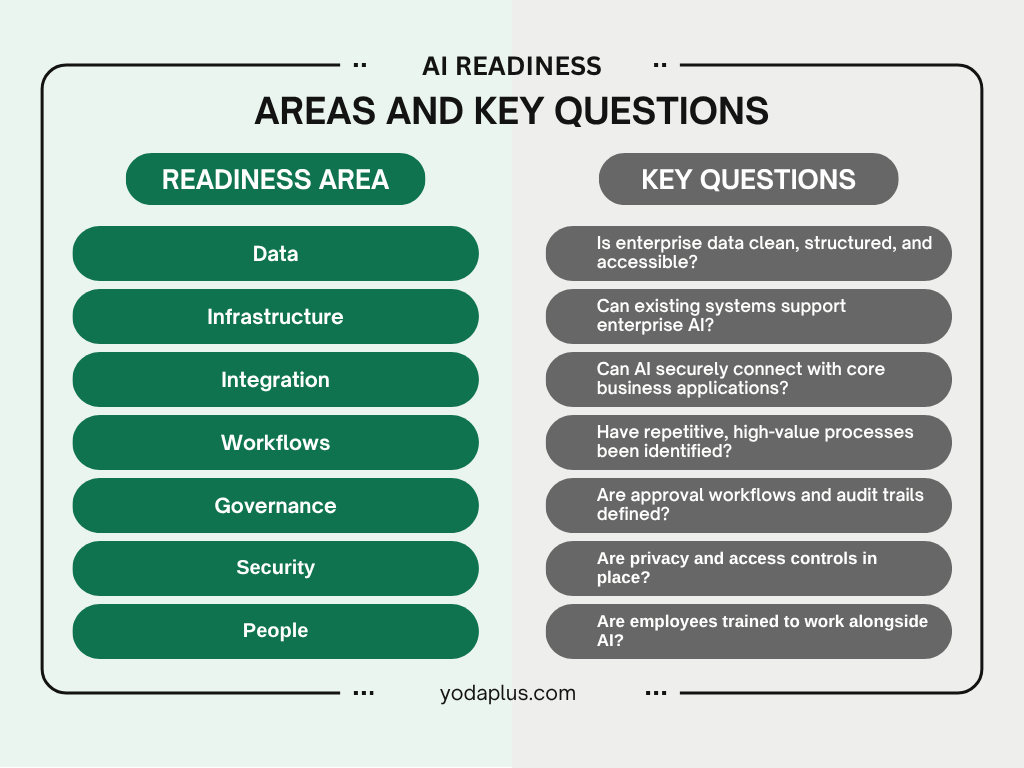
A readiness assessment helps identify gaps before large-scale deployment begins.
Common Agentic AI Readiness Gaps
Many AI projects struggle because organisations underestimate preparation.
Some of the most common challenges include:
- Poor data quality
- Siloed information
- Legacy systems without APIs
- Inconsistent documentation
- Weak governance policies
- Limited AI expertise
- Lack of change management
- Unclear business objectives
Addressing these issues early improves implementation success and reduces operational risk.
Capital Market Functions That Benefit First
Not every business process should be automated immediately.
Financial institutions often begin with workflows that involve repetitive analysis and large volumes of information.
Some of the best early use cases include:
- Equity research
- Investment research
- Financial report analysis
- Earnings summaries
- Financial modeling
- Portfolio risk assessment
- Compliance monitoring
- Market intelligence
- Risk assessment
- Financial forecasting
These processes consume significant analyst time and often involve repetitive information gathering that AI agents can accelerate.
Why Human in the Loop Remains Essential
Agentic AI is designed to automate work, not eliminate human judgement.
Many capital market activities involve regulatory, financial, and investment decisions that require expert review.
A human in the loop approach allows AI to complete repetitive work while professionals review important outputs before action is taken.
Examples include:
- Investment recommendations
- Equity research reports
- Portfolio allocation decisions
- Compliance approvals
- Financial disclosures
- Risk assessments
This collaborative approach improves productivity while maintaining accountability.
Rather than replacing analysts, Agentic AI becomes a decision support system that helps professionals work more efficiently.
Measuring Agentic AI Readiness
Organizations should define measurable indicators before deploying AI.
Useful readiness metrics include:
- Percentage of structured enterprise data
- API availability across core systems
- Number of AI-ready workflows
- Average research turnaround time
- Compliance accuracy
- Manual effort reduction
- Time saved per analyst
- User adoption rates
- AI recommendation accuracy
- Security and governance compliance
Tracking these metrics helps organizations understand where improvements are needed and measure business impact after deployment.
The Future of Agentic AI in Capital Markets
Agentic AI is expected to become a core component of capital market operations.
Future applications are likely to include:
- Multi-agent investment research
- Autonomous financial reporting
- AI-powered portfolio assistants
- Intelligent compliance monitoring
- Continuous market surveillance
- Automated due diligence
- Enterprise knowledge assistants
- AI-driven investment operations
Instead of performing isolated tasks, future AI agents will collaborate across departments, share information securely, and support increasingly complex financial workflows.
Organizations that invest in readiness today will be better positioned to adopt these capabilities as they mature.
Building a Practical Agentic AI Roadmap
Successful organizations rarely attempt enterprise-wide AI deployment immediately.
Instead, they follow a phased approach.
Phase 1: Assess Readiness
Evaluate data quality, infrastructure, governance, security, and workflows.
Phase 2: Identify High-Value Use Cases
Select processes with clear business impact and measurable outcomes.
Phase 3: Launch a Pilot
Deploy AI within a limited workflow while monitoring performance closely.
Phase 4: Optimize
Refine prompts, improve integrations, strengthen governance, and gather user feedback.
Phase 5: Scale
Expand AI across additional departments while maintaining consistent governance and security standards.
A phased strategy reduces implementation risk while allowing organizations to demonstrate value early.
Conclusion
Agentic AI has the potential to transform capital markets, but successful implementation begins long before the first AI agent is deployed. Organizations need high-quality data, scalable infrastructure, secure integrations, well-defined workflows, strong governance, and employees who understand how to work alongside AI.
Readiness is not simply a technology assessment. It is an enterprise-wide evaluation of people, processes, systems, and operational maturity. Financial institutions that prepare these foundations will be better equipped to automate research, strengthen compliance, improve operational efficiency, and deliver better investment outcomes.
Yodaplus Agentic AI for Financial Operations helps financial institutions assess AI readiness, integrate enterprise systems, automate financial workflows, and deploy secure Agentic AI solutions across capital market operations. By combining deep financial expertise with enterprise AI capabilities, Yodaplus enables organizations to adopt intelligent automation with confidence while maintaining governance, security, and regulatory compliance.
FAQs
Agentic AI readiness measures whether an organization has the data, infrastructure, governance, security, workflows, and people needed to successfully deploy AI agents.
Financial institutions operate in highly regulated environments where AI must integrate securely with enterprise systems while maintaining transparency, compliance, and accuracy.
Equity research, investment research, portfolio risk assessment, financial modeling, compliance monitoring, financial forecasting, and market intelligence are among the most suitable early use cases.
No. Agentic AI supports analysts by automating repetitive tasks, summarizing information, and providing insights, while human professionals continue making strategic investment decisions.
Human in the loop ensures AI-generated outputs are reviewed and approved before important financial or regulatory decisions are made.