Manufacturing Automation in ERP Modules That Benefit Most
April 17, 2026 By Yodaplus
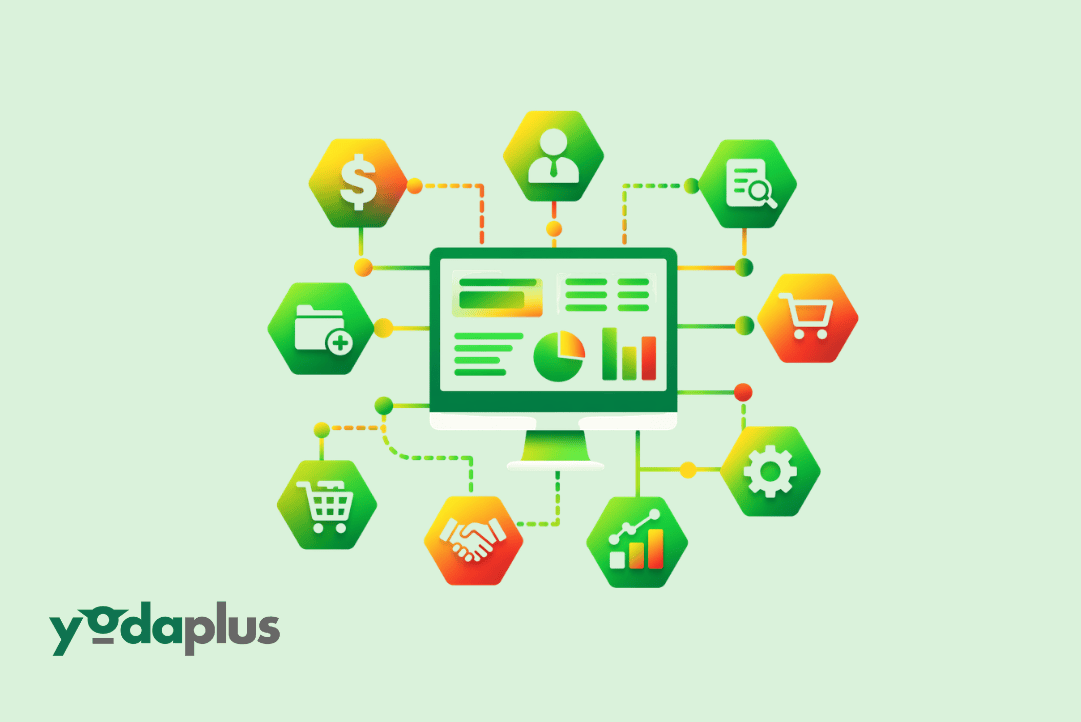
The ERP modules that benefit most from automation are finance, procurement, inventory and warehouse management, manufacturing, and sales forecasting. These areas involve high transaction volumes, repetitive tasks, and constant decision-making, making them ideal for automation. With the rise of Agentic AI, Artificial Intelligence, AI Agents, and LLMs, ERP systems are evolving beyond basic automation into intelligent systems that can analyze, decide, and act. Manufacturing automation plays a central role in this transformation, especially in environments where operational efficiency directly impacts profitability.
Finance and Accounting
Finance and accounting modules are among the earliest adopters of automation. These functions deal with structured data, recurring transactions, and strict compliance requirements. Automation helps streamline processes such as accounts payable, accounts receivable, reconciliations, and financial reporting. AI Agents can validate transactions, detect anomalies, and ensure compliance with financial policies. LLMs can generate summaries and reports, making financial data easier to interpret. Automation reduces manual errors and improves accuracy, which is critical in financial operations. While finance benefits from automation, it still requires human oversight for strategic decisions and regulatory compliance.
Procurement
Procurement is another module that benefits significantly from automation. Procurement automation simplifies vendor selection, purchase approvals, and order management. AI-driven systems can analyze supplier performance, pricing trends, and delivery timelines to make better decisions. In automation in retail environments, procurement efficiency directly impacts inventory availability and customer satisfaction. AI Agents enhance procurement workflows by evaluating risks and recommending optimal suppliers. LLMs can process supplier communications and extract relevant information from contracts and emails. This reduces manual effort and improves decision-making.
Inventory and Warehouse Management
Inventory and warehouse management modules benefit greatly from automation due to the need for real-time tracking and coordination. Retail supply chain automation software enables businesses to monitor stock levels, manage warehouse operations, and optimize replenishment. AI Agents analyze demand patterns and adjust inventory levels accordingly. This helps reduce stockouts and excess inventory. Intelligent retail automation improves visibility across the supply chain, ensuring that products are available when needed. LLMs add value by interpreting unstructured data such as shipment documents and logistics updates. Automation in this module improves efficiency and reduces operational costs.
Manufacturing
Manufacturing is one of the most automation-intensive ERP modules. Manufacturing automation enables businesses to streamline production planning, scheduling, and execution. Manufacturing process automation ensures that tasks such as material planning, quality checks, and production tracking are handled efficiently. AI Agents monitor production lines, detect issues, and suggest corrective actions in real time. This reduces downtime and improves productivity. In industries where precision and efficiency are critical, automation plays a key role in maintaining consistency. LLMs can assist by analyzing production reports and identifying trends. Manufacturing automation is especially important for scaling operations without increasing complexity.
Sales and Demand Forecasting
Sales and demand forecasting modules also benefit from automation, especially with the integration of Artificial Intelligence. AI-driven systems analyze historical data, market trends, and customer behavior to predict demand. This helps businesses plan inventory and production more effectively. In automation in retail, accurate demand forecasting is essential for maintaining the right stock levels. AI Agents continuously refine forecasts based on real-time data, improving accuracy over time. LLMs can generate insights and explain forecasting results, making it easier for teams to understand and act on predictions. Automation in this module supports better decision-making and reduces uncertainty.
Why Some Modules Benefit More Than Others
Not all ERP modules benefit equally from automation. Modules with high transaction volumes, repetitive tasks, and structured data are more suitable for automation. Finance, procurement, inventory, and manufacturing fall into this category. These processes require speed, accuracy, and consistency, which automation can deliver effectively. Modules that involve complex human judgment or strategic decision-making may not benefit as much from full automation. However, even in these areas, AI Agents can assist by providing insights and recommendations. The combination of Agentic AI and LLMs is expanding the scope of automation, allowing more complex workflows to be automated over time.
Conclusion
ERP automation is transforming how businesses operate by improving efficiency, accuracy, and scalability across key modules. Manufacturing automation stands out as one of the most impactful areas, along with finance, procurement, inventory, and sales forecasting. With the integration of Agentic AI, Artificial Intelligence, AI Agents, and LLMs, ERP systems are becoming more intelligent and capable of handling complex workflows. This is particularly valuable in automation in retail and supply chain environments where speed and precision are critical. Yodaplus Agentic AI for Supply Chain & Retail Operations helps organizations implement advanced automation across ERP modules, enabling smarter decisions and more efficient operations.
FAQs
Which ERP modules benefit the most from automation?
Finance, procurement, inventory, manufacturing, and sales forecasting benefit the most due to high transaction volumes and repetitive tasks.
Why is manufacturing automation important in ERP systems?
It improves production efficiency, reduces downtime, and ensures consistent quality.
How does AI improve ERP automation?
AI Agents analyze data, make decisions, and adapt workflows, while LLMs help process unstructured data and generate insights.
What is intelligent retail automation?
It uses AI to optimize retail operations such as inventory management, demand forecasting, and supply chain coordination.
Can all ERP modules be fully automated?
Not all modules can be fully automated, but most can benefit from partial automation supported by AI.