How Does Agentic AI Integrate With Existing Enterprise Software?
August 19, 2026 By Yodaplus
Most enterprises already have the software they need. The challenge is getting those systems to work together. Finance teams use ERP platforms, sales teams rely on CRM software, HR manages employee data in separate systems, and operations often depend on multiple business applications. While each platform performs its own function well, employees still spend a significant amount of time switching between systems, copying data, and coordinating workflows manually.
This is where Agentic AI creates value. Instead of replacing existing software, AI agents connect with enterprise applications, retrieve information, execute tasks, and coordinate workflows across multiple systems. By building on current technology investments, organisations can improve productivity without disrupting existing operations.
Why Enterprise Integration Matters
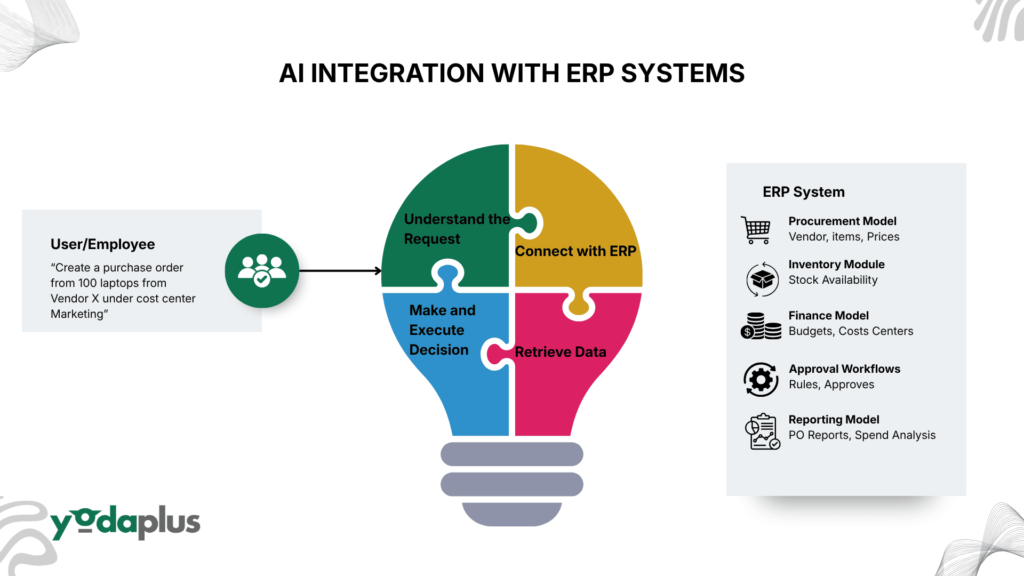
Most organisations operate dozens of business applications.
Common enterprise systems include:
- ERP platforms
- CRM software
- HR systems
- Procurement platforms
- Finance applications
- Customer support software
- Business intelligence tools
- Document management systems
These systems often operate independently, making it difficult to share information quickly.
Employees frequently:
- Search across multiple applications
- Re-enter the same data
- Transfer information manually
- Wait for approvals
- Switch between different dashboards
Enterprise integration allows AI agents to eliminate much of this manual work.
What Makes Agentic AI Different?
Traditional automation follows predefined rules.
For example, it might move data from one application to another whenever a specific event occurs.
Agentic AI goes much further.
AI agents can:
- Understand business requests
- Retrieve information from multiple systems
- Analyse context
- Make decisions within business policies
- Execute multi-step workflows
- Collaborate with other AI agents
- Escalate exceptions when necessary
Instead of automating individual tasks, Agentic AI automates complete business processes.
How AI Agents Connect With Enterprise Software
Modern enterprise AI integrates using secure technologies already supported by most business applications.
Common integration methods include:
- APIs
- Web services
- Enterprise middleware
- Cloud connectors
- Event-driven architecture
- Database integrations
Rather than replacing existing software, AI agents act as an intelligent layer that coordinates information across systems.
Integrating With ERP Systems
ERP systems contain critical operational data.
AI agents commonly interact with ERP platforms to:
- Retrieve financial information
- Process purchase requests
- Update inventory
- Monitor production
- Generate reports
- Validate transactions
Instead of employees searching through ERP screens, AI retrieves relevant information automatically.
Working With CRM Platforms
Sales and customer service teams depend heavily on CRM software.
AI agents help by:
- Retrieving customer history
- Summarising interactions
- Updating customer records
- Tracking sales opportunities
- Preparing meeting notes
- Recommending next actions
This reduces administrative work while improving customer engagement.
Supporting Finance Applications
Finance departments process large volumes of repetitive work.
Agentic AI integrates with accounting and financial systems to support:
- Invoice processing
- Accounts payable automation
- Expense approvals
- Financial reporting
- Budget monitoring
- Cash flow analysis
Finance teams spend less time collecting information and more time analysing business performance.
Improving Procurement Workflows
Procurement involves multiple systems and approvals.
AI agents can coordinate activities such as:
- Purchase requisitions
- Supplier onboarding
- Vendor management
- Three-way matching
- Invoice validation
- Payment approvals
Instead of manually tracking each stage, AI monitors the workflow and keeps it moving.
Connecting Document Management Systems
Many business decisions rely on documents rather than databases.
AI agents can access:
- Contracts
- Policies
- Financial reports
- PDFs
- Emails
- Operating procedures
- Supplier documents
Using document intelligence and natural language processing, AI extracts relevant information and combines it with structured enterprise data.
Enabling Cross-Department Collaboration
Many business processes involve several departments.
For example, onboarding a new supplier may require:
- Procurement approval
- Finance verification
- Legal review
- Compliance checks
- ERP updates
Rather than employees coordinating these activities manually, AI agents communicate across systems and departments to complete the workflow more efficiently.
The Role of Multi-Agent AI
Complex enterprise workflows often require more than one AI agent.
A multi-agent AI architecture assigns specialised responsibilities.
For example:
- A retrieval agent gathers enterprise data.
- A validation agent checks data quality.
- An analysis agent evaluates business information.
- A compliance agent verifies policies.
- An execution agent performs approved actions.
Each agent focuses on a specific task while collaborating with others to complete the workflow.
Security and Governance
Enterprise integration must always prioritise security.
AI agents should operate using:
- Role-based permissions
- Identity management
- Secure authentication
- Data encryption
- Audit trails
- Human approval workflows
Strong governance ensures AI accesses only the information required for its assigned responsibilities.
Benefits of Integrating Agentic AI
Integrating AI with enterprise software delivers benefits across the organisation.
These include:
- Reduced manual work
- Faster workflows
- Improved productivity
- Better data accuracy
- Real-time business insights
- Stronger collaboration
- Lower operational costs
- Improved customer experience
Businesses gain more value from their existing software investments without replacing core systems.
Common Integration Challenges
Although integration offers significant value, organisations often encounter challenges.
Common issues include:
- Legacy software
- Disconnected systems
- Poor data quality
- Inconsistent APIs
- Security requirements
- Complex workflows
- Change management
- Employee adoption
Planning integration carefully helps reduce these challenges.
Best Practices for Successful Integration
To maximise the value of AI workflow automation, organisations should:
- Start with high-impact workflows.
- Integrate AI with existing enterprise applications.
- Improve data quality before automation.
- Use secure APIs and authentication.
- Establish governance policies.
- Maintain human oversight for critical decisions.
- Monitor integrations continuously.
- Measure business outcomes regularly.
- Train employees alongside implementation.
- Expand integrations gradually.
These practices improve adoption while reducing operational risk.
The Future of Enterprise Integration
Enterprise software is becoming increasingly interconnected. Future autonomous AI agents will move seamlessly between ERP, CRM, finance, procurement, HR, and customer service platforms without requiring manual coordination. Instead of acting as separate applications, enterprise systems will become part of a unified, intelligent ecosystem where AI continuously retrieves information, executes workflows, and supports business decisions in real time.
Conclusion
Agentic AI does not replace enterprise software—it enhances it. By integrating with ERP systems, CRM platforms, financial applications, procurement tools, and document repositories, AI agents automate workflows, improve collaboration, and eliminate repetitive manual work. Organisations that successfully combine Agentic AI, enterprise AI, and AI workflow automation with their existing technology stack will be able to increase productivity while protecting previous technology investments.
Yodaplus Agentic AI Services help organisations modernise enterprise operations through Agentic AI, enterprise AI solutions, intelligent workflow automation, secure enterprise integrations, and multi-agent AI architectures. By connecting AI agents with existing business systems, Yodaplus enables enterprises to automate complex workflows, improve operational efficiency, and accelerate digital transformation.
FAQs
Agentic AI integrates through APIs, middleware, cloud connectors, databases, and other secure integration methods, allowing AI agents to communicate with ERP, CRM, finance, HR, and other enterprise applications.
Yes. Agentic AI is designed to enhance existing enterprise software by retrieving data, automating workflows, and coordinating tasks without replacing core business systems.
Key benefits include reduced manual work, faster workflows, improved data accuracy, better collaboration, real-time insights, lower operational costs, and enhanced productivity.
Yes, when implemented correctly. Secure integrations use role-based access controls, authentication, encryption, audit trails, and governance policies to protect sensitive business information.
Finance, procurement, sales, customer service, HR, supply chain, operations, and compliance teams benefit by automating repetitive tasks and improving cross-functional collaboration.