What Architecture Patterns Support Agentic AI at Scale?
August 19, 2026 By Yodaplus
Building a successful AI pilot is one challenge. Scaling it across an enterprise is another. Many organisations launch AI initiatives that perform well in isolated use cases but struggle when deployed across multiple departments, users, and business systems. The reason is often not the AI model itself, but the underlying architecture.
As businesses adopt Agentic AI for finance, procurement, customer service, supply chain, and enterprise operations, architecture becomes the foundation for scalability. A production-ready system must support multiple AI agents, integrate with existing enterprise software, maintain governance, and continue performing reliably as workloads grow.
Choosing the right architecture pattern allows organisations to move beyond individual AI assistants and build intelligent systems that automate complex business processes securely and efficiently.
Why Architecture Matters for Agentic AI
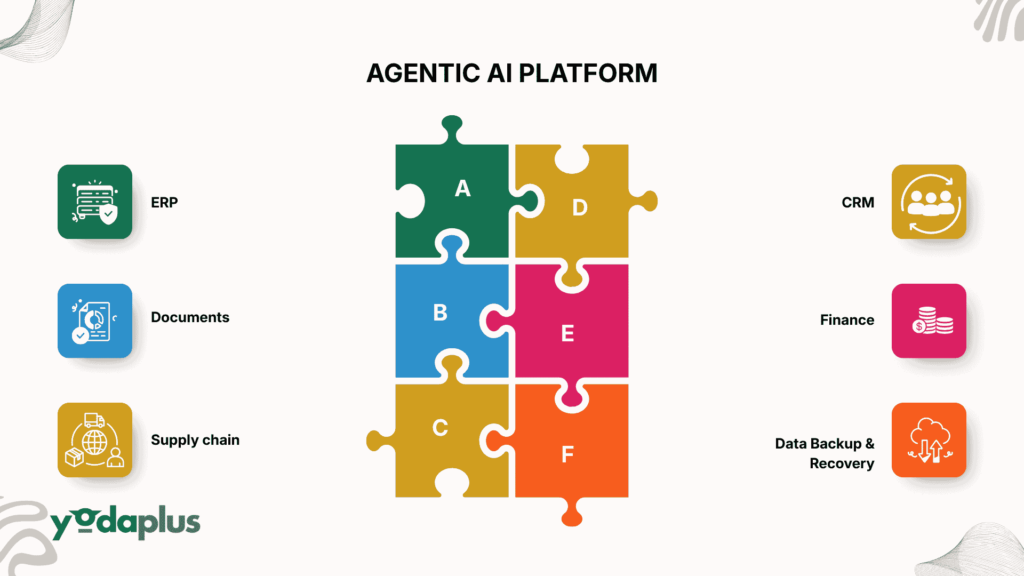
Unlike traditional AI applications that answer questions or generate content, Agentic AI interacts with enterprise systems, executes workflows, collaborates with other AI agents, and makes context-aware decisions.
As adoption grows, organisations need an architecture that can:
- Support multiple AI agents
- Connect with enterprise applications
- Process structured and unstructured data
- Scale across departments
- Maintain governance and security
- Handle increasing workloads
Without the right architecture, AI systems become difficult to maintain, integrate, and expand.
Pattern 1: Multi-Agent Architecture
One of the most common patterns for enterprise AI is the multi-agent AI architecture.
Instead of relying on a single AI system, specialised agents collaborate to complete complex workflows.
For example:
- A retrieval agent gathers enterprise data.
- An analysis agent evaluates information.
- A compliance agent validates policies.
- A reporting agent prepares business outputs.
- An execution agent performs approved actions.
This approach improves scalability because each agent focuses on a specific responsibility rather than handling every task.
Pattern 2: Orchestration-Based Architecture
Enterprise workflows rarely involve one task.
They often require multiple decisions, approvals, and system interactions.
An orchestration layer coordinates:
- Task sequencing
- AI agent collaboration
- Workflow execution
- Human approvals
- Exception handling
- Process monitoring
Rather than allowing AI agents to operate independently, orchestration ensures each activity happens in the correct order.
This is especially valuable for AI workflow automation.
Pattern 3: Event-Driven Architecture
Businesses generate thousands of events every day.
Examples include:
- New customer registrations
- Invoice submissions
- Purchase requests
- Inventory updates
- Payment confirmations
- Compliance alerts
An event-driven architecture allows AI agents to respond automatically whenever these events occur.
Instead of continuously checking systems for updates, AI reacts in real time, making workflows faster and more efficient.
Pattern 4: API-First Integration
Modern enterprises use dozens of software platforms.
Agentic AI should integrate with these systems through secure APIs.
Common integrations include:
- ERP systems
- CRM platforms
- HR software
- Finance applications
- Procurement platforms
- Document management systems
- Business intelligence tools
An API-first architecture makes integrations easier to maintain while allowing organisations to add new systems without redesigning the entire solution.
Pattern 5: Modular Architecture
Large AI applications become difficult to manage when everything is tightly connected.
A modular architecture separates responsibilities into independent components.
Examples include:
- Data services
- AI reasoning
- Workflow orchestration
- Security
- Monitoring
- Reporting
Each module can evolve independently without affecting the rest of the platform.
This improves flexibility and simplifies future upgrades.
Pattern 6: Human-in-the-Loop Architecture
Not every decision should be automated.
Production AI systems often include approval checkpoints for sensitive business activities.
Examples include:
- Large financial transactions
- Credit approvals
- Legal agreements
- Regulatory submissions
- Vendor selection
AI prepares recommendations while employees remain responsible for final decisions.
This architecture pattern balances automation with accountability.
Pattern 7: Governance-First Architecture
Scalable AI requires governance from the beginning.
Governance should include:
- Role-based access control
- Policy enforcement
- Audit trails
- Data security
- Monitoring
- Compliance management
Embedding governance into the architecture reduces operational and regulatory risks as AI adoption grows.
Pattern 8: Shared Enterprise Knowledge Layer
Many AI failures occur because different agents work with different information.
A shared enterprise knowledge layer provides consistent access to:
- Business policies
- Customer records
- Financial information
- Product data
- Supplier documents
- Contracts
- Operational procedures
Every AI agent retrieves information from the same trusted source, improving consistency across workflows.
Pattern 9: Cloud-Native Architecture
Most enterprise AI workloads continue to grow over time.
Cloud-native architecture supports:
- Automatic scaling
- High availability
- Distributed computing
- Disaster recovery
- Global deployments
- Continuous updates
This enables organisations to expand AI adoption without significant infrastructure changes.
Security Must Be Built Into Every Pattern
Regardless of the architecture pattern, security should never be treated as an afterthought.
Production AI systems should include:
- Identity management
- Authentication
- Encryption
- Secure APIs
- Access controls
- Continuous monitoring
- Threat detection
Security protects both enterprise systems and sensitive business information.
Choosing the Right Architecture
No single architecture pattern works for every organisation.
The right approach depends on:
- Business objectives
- Existing technology stack
- Workflow complexity
- Regulatory requirements
- Data availability
- Integration needs
- Expected scale
Many successful enterprises combine several architecture patterns rather than relying on just one.
Common Mistakes That Limit Scalability
Organisations often struggle to scale Agentic AI because they:
- Build isolated AI applications.
- Ignore enterprise integration.
- Delay governance planning.
- Automate high-risk processes too early.
- Underestimate data quality issues.
- Overlook monitoring requirements.
- Design tightly coupled systems.
Avoiding these mistakes makes future expansion much easier.
Best Practices for Building Scalable Agentic AI
To support long-term growth, organisations should:
- Design around business workflows rather than individual tasks.
- Adopt modular and API-first architectures.
- Use specialised AI agents for complex processes.
- Build governance into the platform from day one.
- Maintain human oversight for high-risk decisions.
- Create a shared enterprise knowledge layer.
- Monitor AI performance continuously.
- Improve enterprise data quality.
- Scale gradually across departments.
- Review architecture regularly as business needs evolve.
These practices help organisations build AI systems that remain reliable as adoption increases.
The Future of Agentic AI Architecture
Enterprise AI architectures are moving toward intelligent ecosystems where multiple AI agents work together across finance, procurement, customer service, supply chain, and operations. Future autonomous AI agents will share enterprise knowledge, coordinate workflows in real time, and interact seamlessly with existing business applications while operating within built-in governance and security frameworks.
Conclusion
Scaling Agentic AI requires more than powerful models. It requires architecture designed for collaboration, integration, governance, and continuous growth. By combining multi-agent AI, orchestration, modular design, API-first integration, and governance-first principles, organisations can build AI systems that automate complex enterprise workflows while remaining secure, reliable, and easy to expand.
Yodaplus Agentic AI Services help organisations build production-ready Agentic AI, enterprise AI, AI workflow automation, multi-agent AI architectures, and secure enterprise integrations. By combining intelligent AI agents with scalable engineering and governance-first design, Yodaplus enables enterprises to deploy AI confidently across finance, retail, supply chain, and enterprise operations.
FAQs
An architecture pattern is a structured design approach that defines how AI agents, enterprise systems, data sources, and workflows interact to build scalable and reliable AI solutions.
Multi-agent architecture allows specialised AI agents to handle different tasks, improving scalability, flexibility, accuracy, and collaboration across complex business workflows.
Orchestration coordinates AI agents, enterprise systems, approvals, and workflows to ensure tasks are completed in the correct sequence while handling exceptions and monitoring performance.
API-first architecture enables AI agents to integrate securely with ERP, CRM, HR, finance, procurement, and other enterprise applications without replacing existing systems.
Most enterprises combine multiple patterns, including multi-agent architecture, orchestration, API-first integration, modular design, governance-first controls, and cloud-native infrastructure to achieve secure and scalable AI deployments.