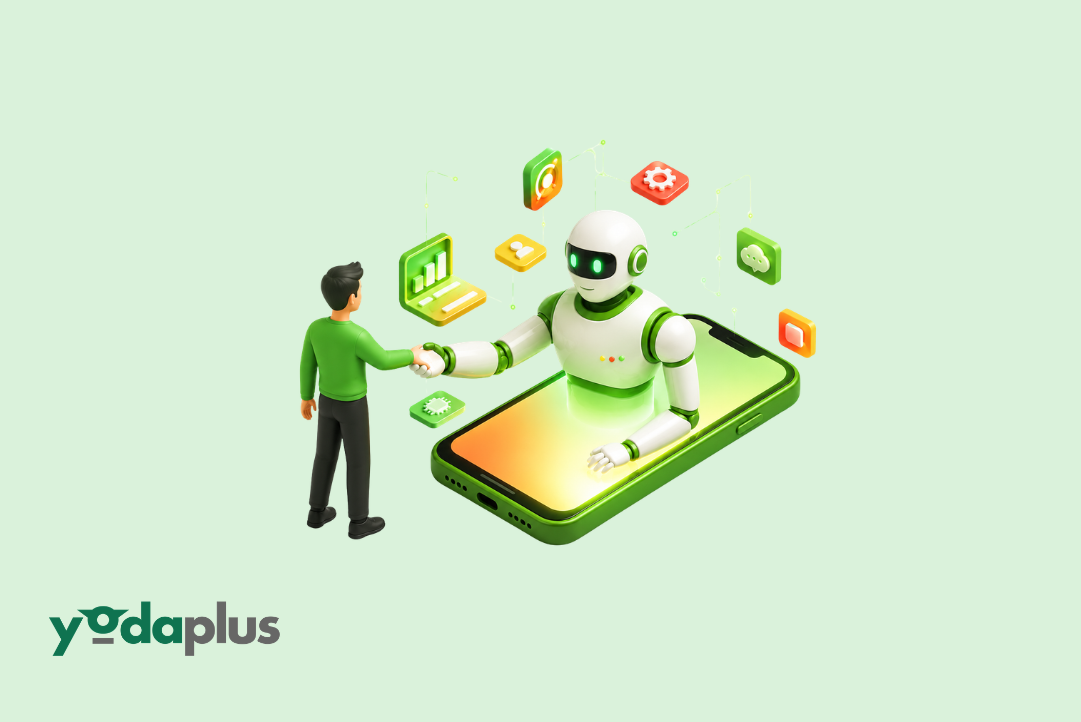
Do Agentic Systems Still Need Human Oversight?
July 8, 2026 By Yodaplus
Agentic AI can automate complex business workflows, make operational decisions, and coordinate multiple enterprise systems, but it still requires human oversight. While intelligent AI agents can independently achieve business objectives within predefined boundaries, people remain responsible for governance, strategic decision-making, regulatory compliance, and ethical accountability. The goal of Agentic AI is not to eliminate human involvement but to shift people away from repetitive operational work toward higher-value activities that require judgment and experience.
As enterprises adopt increasingly autonomous AI systems, governance has become just as important as automation. Organizations must ensure AI decisions remain transparent, auditable, secure, and aligned with business policies. Human oversight provides the control needed to build trust while allowing businesses to benefit from faster and more intelligent workflows.
According to Deloitte’s State of Generative AI in the Enterprise report, governance and risk management remain among the highest priorities for organizations deploying enterprise AI solutions. Businesses recognize that intelligent automation delivers the greatest value when combined with clear human accountability.
What Human Oversight Actually Means
Human oversight does not mean reviewing every action an AI system performs.
If employees needed to approve every recommendation or verify every automated decision, many of the efficiency gains of Agentic AI would disappear.
Instead, oversight means defining the boundaries within which AI can operate safely.
Organizations establish policies that determine:
- Which decisions AI can make independently.
- Which actions require managerial approval.
- What financial thresholds trigger additional review.
- Which activities require compliance validation.
- How AI decisions are monitored and audited.
Within these boundaries, Agentic AI can execute workflows efficiently while humans retain ultimate responsibility for business outcomes.
Why Complete Autonomy Is Rare in Enterprise Operations
Enterprise workflows often involve decisions with financial, legal, operational, or reputational consequences.
For example:
Approving a routine purchase order may be suitable for AI.
Approving a multi-million-dollar acquisition is not.
Scheduling customer support responses may be automated.
Responding to a major regulatory investigation requires experienced professionals.
Preparing financial reports can be automated.
Signing regulatory filings remains a human responsibility.
These examples illustrate why enterprises view Agentic AI as a decision-support and execution capability rather than a replacement for leadership.
The higher the business risk, the greater the need for human judgment.
Human Judgment Remains Essential
Agentic AI processes information quickly and consistently.
Humans contribute qualities that technology cannot fully replicate.
These include:
- Strategic thinking
- Ethical reasoning
- Business experience
- Relationship management
- Risk assessment
- Regulatory accountability
For example, an AI system may identify that reducing inventory improves short-term cash flow.
A supply chain executive may recognize that doing so increases the risk of product shortages during seasonal demand.
Both perspectives are valuable.
AI provides analytical support.
Humans make the final strategic decision when broader business considerations must be balanced.
Oversight Improves Trust
Successful enterprise AI adoption depends on trust.
Employees, customers, regulators, and business leaders must understand how important decisions are being made.
Organizations therefore implement governance practices such as:
- Approval thresholds
- Audit trails
- Decision logging
- Role-based permissions
- Continuous monitoring
- Performance reviews
These controls make AI decisions transparent while allowing organizations to investigate unexpected outcomes quickly.
Rather than slowing automation, governance enables businesses to deploy Agentic AI with greater confidence.
Human-in-the-Loop vs Human-on-the-Loop
Not every AI workflow requires the same level of supervision.
Many enterprises distinguish between two operating models.
Human-in-the-loop
Humans review and approve important decisions before the AI proceeds.
This model is common for:
- Large financial transactions
- Regulatory submissions
- Legal approvals
- High-value procurement
- Critical customer decisions
Human-on-the-loop
The AI completes routine tasks independently while humans monitor performance and intervene only when exceptions or unusual situations arise.
This approach is increasingly used for:
- Customer service
- Procurement
- Invoice processing
- Supply chain operations
- Internal workflow automation
Human-on-the-loop allows organizations to achieve greater efficiency while maintaining governance.
Real Enterprise Examples of Human Oversight
Human oversight looks different depending on the business process being automated. The objective is not to supervise every AI action but to ensure that decisions with significant financial, legal, or operational impact receive the appropriate level of review.
In finance, Agentic AI may reconcile accounts, validate transactions, identify anomalies, and prepare financial reports automatically. However, finance leaders remain responsible for approving regulatory submissions, reviewing material exceptions, and ensuring compliance with accounting standards.
In procurement, AI agents can evaluate supplier quotations, verify contract terms, generate purchase orders, and coordinate approval workflows. High-value contracts or purchases outside established policies are automatically escalated to procurement managers for review.
In customer service, Agentic AI can resolve routine requests, retrieve customer information, update CRM systems, and recommend solutions. Complaints involving legal issues, major service failures, or sensitive customer situations are transferred to human representatives.
Across industries, the pattern remains consistent. AI manages operational execution, while people oversee decisions that require accountability, experience, and strategic judgment.
Governance Makes Agentic AI Reliable
Effective Agentic AI depends on strong governance.
Without governance, even highly capable AI systems can produce inconsistent decisions, create compliance risks, or operate outside business objectives.
Organizations therefore establish governance frameworks that define:
- Decision authority
- Approval thresholds
- Data access permissions
- Audit requirements
- Performance monitoring
- Security controls
- Escalation procedures
These policies ensure AI agents operate within clearly defined business boundaries while remaining transparent and accountable.
Governance also makes it easier to explain how decisions were reached, which is increasingly important for regulators, auditors, customers, and internal stakeholders.
Oversight Evolves as AI Matures
Human oversight is not static.
As organizations gain confidence in Agentic AI, oversight models often evolve.
New AI deployments typically begin with greater human involvement.
Managers review recommendations.
Employees validate outputs.
Performance is monitored closely.
Once the AI consistently demonstrates accuracy and reliability, organizations gradually allow it to manage more routine decisions independently.
Human attention then shifts toward monitoring overall performance, refining business policies, and handling exceptional situations rather than reviewing every transaction.
This gradual transition enables businesses to expand automation responsibly while maintaining confidence in operational outcomes.
Best Practices for Human Oversight
Successful organizations treat governance as an integral part of AI implementation rather than an afterthought.
Some widely adopted best practices include:
- Define clear objectives before deploying Agentic AI.
- Establish decision thresholds for autonomous actions.
- Maintain complete audit trails for every AI decision.
- Monitor performance using measurable business KPIs.
- Regularly review AI recommendations for accuracy and consistency.
- Update governance policies as business requirements evolve.
- Train employees to work effectively alongside AI systems.
These practices help organizations balance operational efficiency with accountability and risk management.
The Future of Human and AI Collaboration
The future of enterprise AI is not fully autonomous organizations operating without people.
Instead, businesses are moving toward collaborative operating models where humans and AI contribute different strengths.
Agentic AI excels at processing information, coordinating workflows, identifying patterns, and executing repetitive operational activities at scale.
People provide strategic direction, ethical judgment, creativity, relationship management, and accountability.
Rather than replacing employees, Agentic AI enables them to spend less time on administrative work and more time on decisions that require expertise and critical thinking.
Organizations that combine intelligent automation with effective governance will be better positioned to improve productivity while maintaining trust across customers, employees, regulators, and business partners.
Conclusion
Agentic AI is transforming enterprise automation by enabling intelligent systems to make operational decisions, adapt to changing conditions, and coordinate complex workflows. However, human oversight remains essential because businesses still require accountability, governance, ethical judgment, and strategic decision-making. The most successful organizations do not choose between AI and people. Instead, they combine the speed and consistency of Agentic AI with the experience and judgment of human professionals.
As enterprise AI continues to mature, governance will become just as important as automation itself. Organizations that establish clear oversight models, transparent decision-making processes, and well-defined operating boundaries will be able to deploy Agentic AI with greater confidence while maximizing long-term business value.
Yodaplus Agentic AI Services help enterprises build intelligent AI systems with governance at their core. By combining Agentic AI, autonomous AI agents, enterprise workflow orchestration, role-based approvals, audit trails, and human-in-the-loop capabilities, Yodaplus enables organizations to automate complex business operations while maintaining transparency, compliance, and complete operational control.
FAQs
Yes. While Agentic AI can automate complex workflows and make operational decisions, human oversight remains necessary for governance, strategic decisions, regulatory compliance, and accountability.
Human-in-the-loop means AI recommendations or actions require human approval before execution, particularly for high-risk or high-value business decisions.
Human-on-the-loop allows Agentic AI to perform routine tasks independently while people monitor system performance and intervene only when necessary.
AI governance ensures intelligent systems operate within business policies, maintain compliance, protect sensitive data, and produce transparent, auditable decisions.
Yes, but only within predefined operational boundaries established by the organization. Strategic, legal, financial, and regulatory decisions typically remain under human responsibility.
Yodaplus Agentic AI Services combine intelligent automation with governance features such as approval workflows, audit trails, enterprise integration, role-based access, and human oversight to help organizations deploy AI responsibly and at scale.