What Can Agentic AI Do That Traditional Automation Cannot?
July 8, 2026 By Yodaplus
Agentic AI goes beyond traditional automation by understanding business objectives, making decisions, adapting to changing situations, coordinating multiple systems, and completing complex workflows with minimal human intervention. Traditional automation follows predefined rules and executes repetitive tasks exactly as programmed. Agentic AI, on the other hand, evaluates context, chooses appropriate actions, resolves exceptions, and continues working toward a business goal instead of stopping when unexpected situations arise.
Traditional automation has helped businesses improve efficiency for decades by eliminating repetitive manual work. It remains highly effective for structured processes with clearly defined rules. However, modern enterprises operate in dynamic environments where customer requests, supplier information, regulations, and market conditions change constantly. These situations require systems that can think through problems rather than simply execute instructions.
According to Gartner, by 2028, at least 15% of day-to-day business decisions are expected to be made autonomously through Agentic AI, compared to almost none in 2024. This reflects a significant shift from task automation to intelligent business execution.
Traditional Automation Works Within Fixed Rules
Traditional automation performs exactly what it has been instructed to do.
A workflow is created.
Business rules are defined.
Each step follows a predetermined sequence.
For example, an automated workflow may:
- Approve invoices below a fixed amount.
- Send purchase requests for manager approval.
- Generate scheduled reports.
- Update customer records after a form submission.
As long as every situation follows predefined rules, traditional automation performs efficiently and consistently.
However, when something unexpected happens, the workflow usually stops.
Missing information.
Unexpected document formats.
New supplier requirements.
Changing regulations.
These situations often require employees to intervene before automation can continue.
Agentic AI Focuses on Business Goals
One of the biggest differences is that Agentic AI works toward achieving a goal instead of simply executing instructions.
Rather than asking:
“What is the next step?”
It asks:
“What is the best way to achieve the desired outcome?”
For example, if the objective is to complete supplier onboarding, Agentic AI can collect supplier documents, validate tax information, compare compliance requirements, identify missing records, request additional information, coordinate approvals, and update enterprise systems without requiring someone to define every possible scenario in advance.
The objective remains constant even if the workflow changes.
This flexibility allows organizations to automate processes that were previously considered too complex for traditional automation.
Agentic AI Makes Operational Decisions
Traditional automation does not make decisions.
It executes predefined logic.
Agentic AI evaluates business context before deciding how to proceed.
For example, consider an invoice that contains inconsistent supplier information.
Traditional automation flags the issue and waits for manual review.
Agentic AI can:
- Compare historical supplier records.
- Search approved enterprise databases.
- Validate purchase order information.
- Identify the most likely correction.
- Recommend an action.
- Continue processing if confidence levels meet business policies.
Human review is requested only when necessary.
This reduces operational delays while improving efficiency.
Agentic AI Handles Exceptions Instead of Stopping
Exception handling is one of the biggest limitations of traditional automation.
Business operations rarely follow identical patterns every day.
Suppliers change information.
Customers submit incomplete documents.
Inventory availability changes unexpectedly.
Approval hierarchies evolve.
Traditional automation often stops whenever predefined rules no longer apply.
Agentic AI is designed to work through these situations.
Instead of immediately escalating every exception, intelligent AI agents analyze available information, evaluate possible solutions, retrieve additional data from connected systems, and determine whether the workflow can continue safely.
Only genuinely complex situations require human intervention.
This significantly reduces administrative work while improving business continuity.
Agentic AI Learns From Business Context
Traditional automation treats every transaction independently.
Agentic AI considers business context before acting.
For example, if a customer has repeatedly purchased from the same supplier, or a department regularly follows a particular procurement pattern, Agentic AI can use this historical information to support future decisions.
It recognizes relationships between data rather than processing every request in isolation.
This contextual understanding allows businesses to automate workflows that depend on changing operational conditions instead of fixed rules alone.
Multi-System Orchestration Is Where Agentic AI Creates the Biggest Impact
One of the most powerful capabilities of Agentic AI is its ability to coordinate work across multiple enterprise systems simultaneously.
Traditional automation usually operates within one workflow or application.
Agentic AI works across the entire business.
For example, a procurement request may require information from an ERP platform, supplier portal, inventory system, contract repository, finance application, and email platform.
Instead of employees switching between each system or creating multiple automations, intelligent AI agents orchestrate the entire workflow.
They retrieve information, validate records, make operational decisions, trigger downstream processes, and notify the right teams automatically.
This transforms disconnected business applications into one coordinated operational ecosystem.
Multi-System Orchestration Example
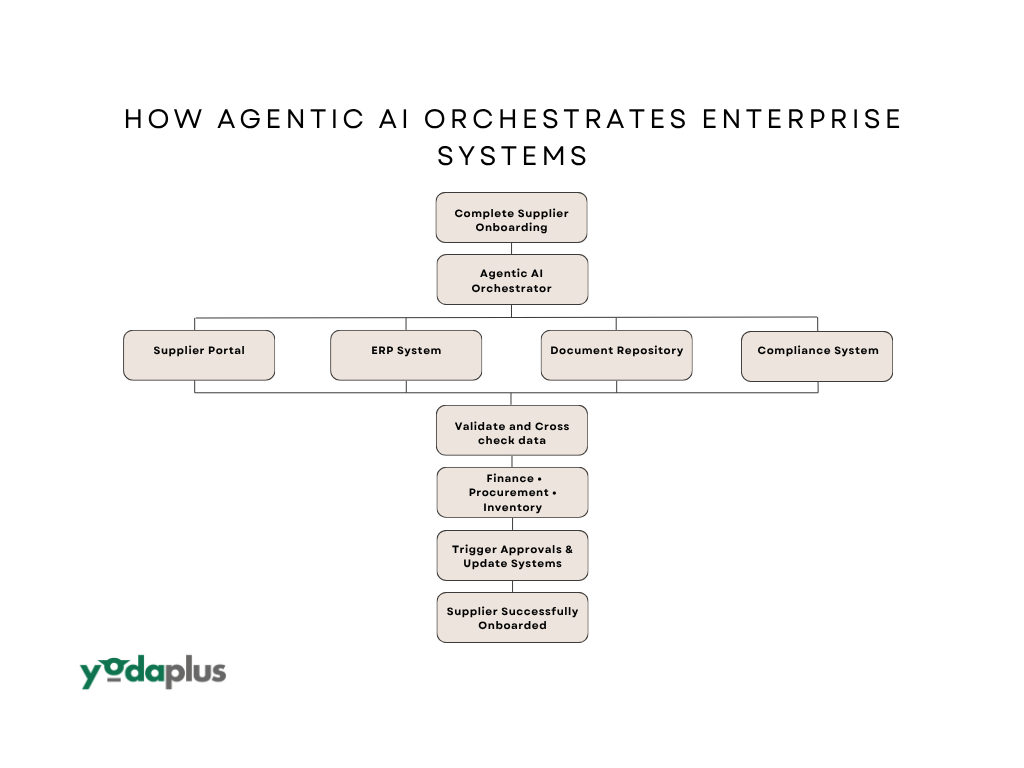
Instead of automating individual tasks, Agentic AI coordinates multiple enterprise systems to achieve a complete business outcome.
Agentic AI Continuously Adapts
Business environments rarely remain static.
Customers update requirements.
Suppliers modify product information.
Regulations change.
Market conditions evolve.
Traditional automation often requires workflows to be redesigned whenever these changes occur.
Agentic AI adapts without requiring every scenario to be programmed in advance.
If a supplier updates banking information during onboarding, the AI can validate the changes, notify finance, update connected systems, and continue the workflow without restarting the process.
This adaptability makes enterprise operations significantly more resilient.
Real Enterprise Examples
The advantages of Agentic AI become even clearer when looking at different business functions.
In finance, Agentic AI can reconcile transactions, identify discrepancies, retrieve supporting documents, prepare reports, and escalate only high-risk exceptions for review.
In procurement, it can compare supplier quotations, validate contracts, monitor inventory levels, recommend preferred vendors, generate purchase orders, and coordinate approvals across departments.
In customer service, AI agents can retrieve customer history, verify warranty details, update CRM systems, initiate refunds, schedule follow-ups, and communicate with customers without requiring agents to manually switch between multiple applications.
In equity research, Agentic AI can gather annual reports, earnings call transcripts, regulatory filings, news, and market data, synthesize insights, evaluate risks, and prepare structured research reports in a fraction of the time required through manual analysis.
Across each example, the difference is the same.
Traditional automation performs predefined tasks.
Agentic AI manages complete business outcomes.
Agentic AI Scales More Effectively
As organizations grow, business processes become more interconnected.
New applications are introduced.
Additional suppliers are onboarded.
Operations expand across regions.
Regulatory requirements become more complex.
Maintaining hundreds of independent automation workflows becomes increasingly difficult.
Agentic AI provides a more scalable approach because intelligent agents coordinate activities dynamically instead of relying on rigid workflow definitions.
Organizations can automate increasingly complex operations without redesigning every process whenever business requirements change.
This flexibility supports long-term digital transformation while reducing operational complexity.
The Future of Enterprise Automation
The future of automation is not about replacing every existing technology.
It is about combining automation with intelligence.
Rule-based automation will continue managing repetitive, predictable tasks.
RPA will continue interacting with legacy applications.
Agentic AI will become the orchestration layer that coordinates systems, makes operational decisions, adapts to changing business conditions, and drives complete workflows toward business objectives.
Instead of assigning dozens of individual tasks, organizations will increasingly assign outcomes.
Human employees will remain responsible for governance, strategy, and high-impact decisions, while AI manages execution across enterprise operations.
Conclusion
Traditional automation transformed business operations by eliminating repetitive manual work, but it remains limited by predefined rules and fixed workflows. Agentic AI extends automation by introducing reasoning, adaptability, and goal-oriented execution. It can make operational decisions, resolve exceptions, coordinate multiple enterprise systems, and continuously adapt as business conditions change. These capabilities allow organizations to automate workflows that were previously too dynamic and complex for conventional automation technologies.
As enterprises continue investing in intelligent operations, Agentic AI will play a central role in connecting people, data, and systems into unified business workflows. Businesses that adopt this approach will be better positioned to improve operational efficiency, strengthen decision-making, and respond more quickly to changing customer and market demands.
Yodaplus Agentic AI Services help enterprises build intelligent automation that goes beyond repetitive task execution. By combining Agentic AI, autonomous AI agents, enterprise workflow orchestration, intelligent document processing, and seamless integration with ERP, CRM, finance, supply chain, and other enterprise systems, Yodaplus enables organizations to automate complex business operations while maintaining governance, transparency, and measurable business outcomes.
FAQs
Agentic AI can understand business goals, make decisions, adapt to changing situations, coordinate multiple systems, and complete complex workflows with minimal human intervention.
Business processes often span ERP, CRM, finance, procurement, inventory, and document management systems. Agentic AI connects these systems into a single intelligent workflow, reducing manual coordination.
Yes. Unlike traditional automation, Agentic AI evaluates business context, retrieves additional information, and determines the best course of action instead of stopping whenever exceptions occur.
No. Traditional automation remains valuable for predictable, rule-based tasks. Agentic AI complements it by managing dynamic workflows that require reasoning and adaptability.
Financial services, retail, manufacturing, healthcare, logistics, maritime, procurement, customer service, and enterprise research all benefit from Agentic AI because they involve complex, cross-functional workflows.
It reduces manual intervention, automates end-to-end business processes, improves decision-making, accelerates workflow execution, and enables employees to focus on strategic work instead of repetitive operational tasks.