
How Finance Teams Measure P2P Automation Success
July 6, 2026 By Yodaplus
Procure-to-pay (P2P) automation is successful when it improves efficiency, reduces manual work, strengthens compliance, lowers processing costs, and provides greater visibility into financial operations. Finance teams measure this success using operational, financial, and compliance metrics rather than simply tracking how many processes have been automated. The goal is to determine whether automation delivers measurable business value across the entire procurement and accounts payable workflow.
Many organizations invest in procure to pay automation, expecting faster invoice approvals and lower administrative effort. While these benefits are important, finance leaders also want evidence that automation improves cash flow management, supplier relationships, financial accuracy, and decision-making.
According to Deloitte’s Global Procure-to-Pay Survey, organizations with mature P2P automation achieve significantly shorter invoice processing cycles and lower processing costs compared to businesses relying on manual workflows. Measuring these improvements allows finance teams to justify automation investments and identify further optimization opportunities.
Why Measuring P2P Automation Matters
Automation is not a one-time implementation.
Finance teams continuously evaluate whether automated workflows continue delivering operational improvements.
Without performance measurement, organizations cannot determine whether automation has:
- Reduced processing time
- Improved invoice accuracy
- Lowered operational costs
- Increased compliance
- Enhanced supplier experience
Measuring these outcomes helps finance leaders prioritize future automation initiatives while demonstrating business value to executive leadership.
Invoice Processing Time Is One of the First Metrics
One of the clearest indicators of successful invoice processing automation is how quickly invoices move through the approval process.
Finance teams monitor:
- Average invoice processing time
- Time to approval
- Payment cycle duration
- Exception handling time
Reducing invoice processing time allows organizations to capture early payment discounts, improve supplier relationships, and reduce late payment penalties.
Straight-Through Processing Rate
A mature accounts payable automation process should minimize manual intervention.
Straight-through processing (STP) measures the percentage of invoices processed without human involvement.
Higher STP rates indicate:
- Better invoice matching
- Cleaner supplier data
- Fewer processing errors
- More effective automation rules
Finance teams often track this metric monthly to monitor automation performance.
Invoice Exception Rate
Not every invoice follows the same approval path.
Some require manual review because of missing purchase orders, pricing discrepancies, duplicate invoices, or incomplete supplier information.
Finance teams monitor:
- Exception rate
- Exception resolution time
- Root causes
Lower exception rates generally indicate stronger intelligent document processing, better master data quality, and improved workflow design.
Cost Per Invoice
Automation should reduce processing costs.
Finance departments compare:
- Manual processing costs
- Automated processing costs
- Labor savings
- Technology costs
Industry studies from the Institute of Finance & Management (IOFM) have consistently shown that automated invoice processing can reduce the cost per invoice dramatically compared with manual processing.
This makes cost per invoice one of the most closely monitored P2P KPIs.
Invoice Accuracy
Automation should improve accuracy, not simply increase speed.
Finance teams monitor:
- OCR extraction accuracy
- Coding accuracy
- Matching accuracy
- Duplicate invoice detection
- Payment accuracy
Better OCR for invoices significantly reduces downstream corrections and reconciliation work.
Approval Bottlenecks
Automation creates visibility into approval workflows.
Finance managers identify:
- Slow approvers
- Department delays
- Approval workload
- Escalation frequency
Removing bottlenecks shortens procurement cycles while improving operational efficiency.
Supplier Performance
Successful P2P automation benefits suppliers as well.
Finance teams evaluate:
- Payment timeliness
- Supplier disputes
- Invoice rejection rate
- Vendor satisfaction
- Payment predictability
Better supplier relationships often translate into improved pricing and stronger collaboration.
Compliance Performance
Automation also strengthens governance.
Finance teams measure:
- Policy compliance
- Three-way matching success
- Audit readiness
- Approval compliance
- Fraud detection
Improved compliance reduces operational risk while simplifying audits.
AI Makes Performance Measurement Continuous
Traditional reporting often measures performance after transactions are completed.
Modern AI platforms monitor P2P workflows continuously.
Using finance automation, organizations can automatically track:
- Invoice volume
- Approval delays
- Exception trends
- Supplier behavior
- Processing costs
- Workflow efficiency
Instead of producing static reports, AI continuously identifies improvement opportunities.
This supports better operational decisions while strengthening financial process automation.
Measuring Success Beyond KPIs
Successful P2P automation is not only about faster invoice approvals.
Finance leaders also evaluate broader business outcomes such as:
- Improved cash flow visibility
- Better working capital management
- Reduced manual workload
- Stronger financial controls
- Better forecasting
- Higher employee productivity
When automation supports these strategic objectives, organizations realize greater long-term value from their investment.
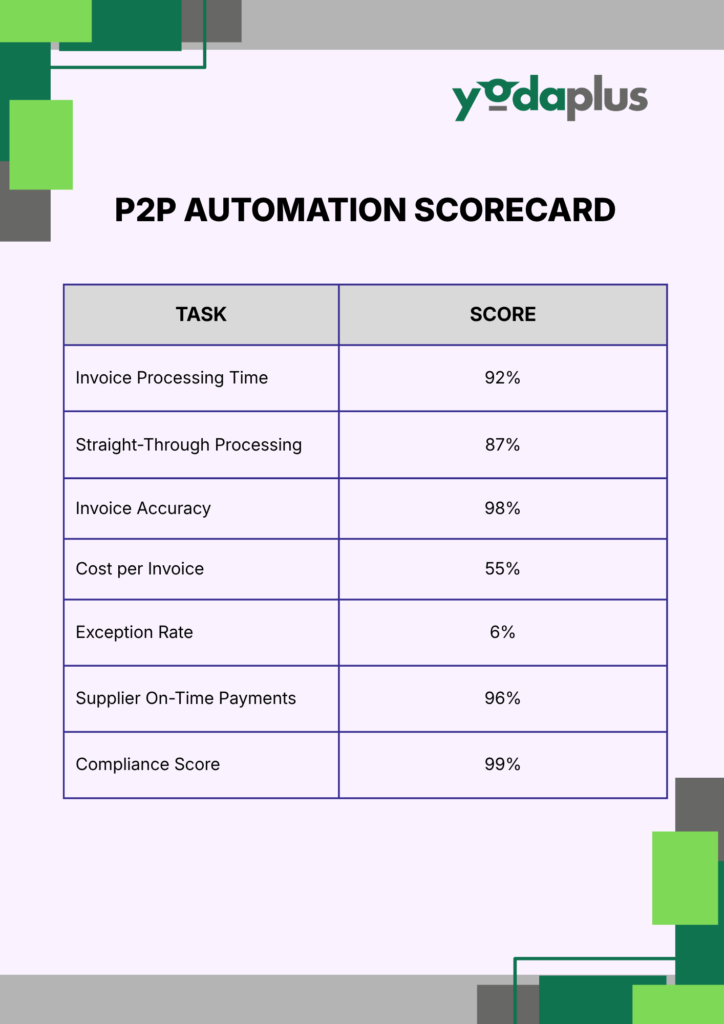
Conclusion
Measuring P2P automation success requires more than tracking the number of automated workflows. Finance teams evaluate processing speed, invoice accuracy, exception rates, compliance, supplier performance, operational costs, and overall business outcomes to determine whether automation is delivering measurable value. Continuous monitoring allows organizations to optimize workflows, improve financial controls, and maximize the return on their automation investment.
Yodaplus Agentic AI for Financial Operations helps organizations monitor every stage of the procure-to-pay process through intelligent document processing, workflow automation, AI-powered analytics, and real-time performance tracking. By combining automation with actionable insights, finance teams can continuously improve efficiency, reduce manual effort, and strengthen financial operations.