What Are the Core Stages of an Automated P2P Workflow?
July 6, 2026 By Yodaplus
An automated Procure-to-Pay (P2P) workflow connects every stage of purchasing, from identifying a business need to paying the supplier, through a single digital process. Instead of relying on emails, spreadsheets, and manual approvals, businesses automate requisitions, supplier selection, purchase orders, invoice processing, approvals, and payments. This reduces delays, improves compliance, and gives procurement and finance teams complete visibility into every transaction.
As organizations expand their supplier networks and procurement volumes, manual purchasing becomes increasingly difficult to manage. Delayed approvals, duplicate invoices, inconsistent supplier information, and disconnected systems slow operations and increase costs. According to APQC, top-performing procurement organizations process purchase orders at significantly lower costs than average organizations by standardizing and automating procurement workflows. This is why businesses across retail, manufacturing, and distribution are investing heavily in intelligent Procure-to-Pay automation.
Why Understanding the P2P Workflow Matters
Every purchase affects multiple business functions.
Procurement identifies suppliers.
Managers approve spending.
Finance validates invoices.
Warehouses receive goods.
Accounts payable processes payments.
When these activities operate independently, delays become unavoidable.
An automated P2P workflow connects every department into one coordinated process where information moves automatically between procurement, finance, suppliers, inventory, and ERP systems.
Instead of tracking purchases manually, businesses gain complete visibility from the initial request to the final payment.
Stage 1: Purchase Requisition
Every Procure-to-Pay workflow begins with a purchasing requirement.
An employee identifies the need for raw materials, office supplies, software, or inventory and submits a digital purchase requisition.
Instead of sending emails or completing paper forms, employees use procurement software where required information such as product details, quantity, budget codes, delivery location, and business justification is captured automatically.
Automation validates the request before it moves to the next stage, ensuring incomplete or duplicate requests are identified early.
This reduces unnecessary purchasing while improving procurement accuracy.
Stage 2: Automated Approval Workflow
Once a purchase request has been submitted, it enters the approval stage.
Traditional procurement often depends on managers approving requests through emails, resulting in delays whenever decision-makers are unavailable.
Automation replaces this with predefined approval rules.
Requests are automatically routed based on spending limits, departments, supplier categories, or business units.
Approvers receive notifications instantly, and escalation rules ensure requests continue moving if approvals are delayed.
This shortens procurement cycles while ensuring organizational purchasing policies remain consistent.
Stage 3: Vendor Selection and Vendor Onboarding
After approval, procurement teams identify the most suitable supplier.
Modern procurement systems maintain centralized supplier records, making vendor onboarding and vendor management much more efficient.
Instead of repeatedly collecting supplier documents, banking details, tax registrations, and compliance certificates, approved vendors maintain standardized digital profiles.
Automation verifies supplier information before purchase orders are created, reducing administrative work while improving supplier compliance.
Businesses also gain better visibility into supplier performance, pricing history, and delivery reliability.
Stage 4: Purchase Order Creation
Once a supplier has been selected, the system automatically generates a purchase order using approved procurement information.
This eliminates manual data entry while ensuring pricing, delivery schedules, supplier details, payment terms, and purchasing conditions remain consistent.
Purchase orders are delivered electronically to suppliers, allowing both parties to begin fulfillment immediately.
Because purchase orders originate from approved requisitions, procurement teams reduce purchasing errors while improving audit readiness.
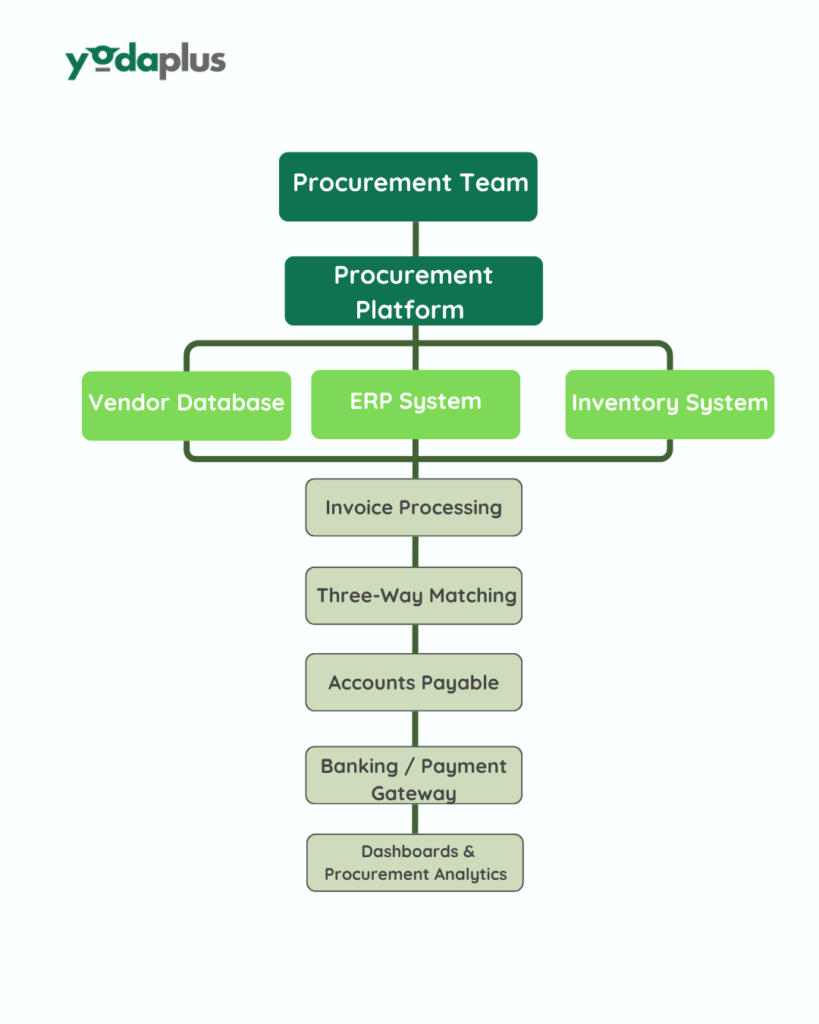
Automated Procure-to-Pay Lifecycle
Instead of viewing procurement as separate activities, modern businesses manage it as one connected workflow.
Automation Creates Better Procurement Visibility
One of the biggest advantages of an automated workflow is transparency.
Managers can track every purchase request, approval, supplier interaction, purchase order, invoice, and payment in real time.
Instead of requesting updates from different departments, procurement teams know exactly where every transaction is within the workflow.
This visibility supports better budgeting, improves supplier collaboration, and helps organizations identify bottlenecks before they affect business operations.
Stage 5: Goods Receipt and Verification
Once the supplier delivers the requested goods or services, the receiving team verifies that the order matches the purchase order.
Traditional procurement often records deliveries manually, making it difficult for procurement and finance teams to know whether products have actually been received.
Automated P2P systems solve this by updating inventory and procurement records immediately after goods are accepted.
Warehouse teams can scan barcodes or QR codes to confirm deliveries, while inventory systems automatically update stock availability.
This eliminates unnecessary communication between departments and gives procurement teams real-time visibility into incoming deliveries.
Stage 6: Invoice Processing Automation
Invoice processing has traditionally been one of the most time-consuming stages of procurement.
Suppliers send invoices in different formats, finance teams manually enter information into accounting software, and errors frequently occur during data entry.
Invoice processing automation removes these bottlenecks.
Invoices are captured digitally using OCR and intelligent document processing. The system extracts supplier names, invoice numbers, purchase order references, tax values, payment terms, and invoice amounts automatically.
Instead of manually reviewing every invoice, finance teams only need to investigate documents where exceptions are detected.
According to the Institute of Finance & Management (IOFM), organizations using automated invoice processing can reduce invoice processing costs by as much as 80% while significantly improving processing speed.
Stage 7: Three-Way Matching
One of the most important controls in an automated P2P workflow is three-way matching.
Before payment is released, the system compares three documents:
- Purchase Order
- Goods Receipt
- Supplier Invoice
If all three records match, the invoice moves directly to payment approval.
If pricing, quantities, or delivery information differ, the invoice is automatically flagged for review.
This automated validation improves financial accuracy while reducing duplicate payments, invoice fraud, and manual reconciliation work.
Instead of reviewing every transaction, finance professionals focus only on exceptions that require investigation.
Stage 8: Accounts Payable and Digital Payments
After successful validation, invoices move into accounts payable.
Automation schedules payments according to agreed supplier terms, helping businesses avoid both late payment penalties and unnecessary early payments.
Finance teams gain complete visibility into upcoming payment obligations while suppliers benefit from faster and more predictable payment cycles.
Digital payment integration also improves reconciliation because payment confirmations are automatically recorded within procurement and finance systems.
Analytics Drive Continuous Improvement
An automated P2P workflow does not end when payment is completed.
Every purchase generates valuable operational data.
Businesses can monitor procurement cycle times, supplier performance, approval delays, invoice processing speed, payment accuracy, purchasing trends, and procurement costs through real-time dashboards.
Instead of relying on monthly reports, procurement leaders identify bottlenecks as they occur and continuously optimize purchasing operations.
These insights also support better budgeting, supplier negotiations, compliance reporting, and long-term procurement planning.
The Future of Automated P2P Workflows
Procurement is evolving beyond workflow automation toward intelligent decision-making.
Future P2P platforms will use artificial intelligence to recommend suppliers, predict purchasing demand, identify contract risks, detect unusual spending behavior, and optimize procurement strategies automatically.
Instead of responding after procurement issues occur, businesses will increasingly use predictive insights to prevent delays, improve supplier performance, and optimize inventory planning before problems affect operations.
As procurement systems become more intelligent, automation will move from executing tasks to supporting strategic business decisions.
Conclusion
An automated Procure-to-Pay workflow transforms procurement from a collection of disconnected activities into one continuous business process. By automating purchase requisitions, approvals, vendor onboarding, purchase order creation, invoice processing, three-way matching, accounts payable, and reporting, organizations reduce manual work while improving visibility, compliance, and financial control.
The greatest value comes when every stage of the workflow is connected. Instead of moving information manually between procurement, warehouses, finance teams, and suppliers, businesses create an integrated ecosystem where data flows automatically, enabling faster purchasing decisions and stronger supplier relationships.
Yodaplus Agentic AI for Supply Chain & Retail Operations helps enterprises modernize procurement through intelligent workflow automation. By combining Agentic AI, intelligent document processing, supplier management, invoice automation, enterprise integration, and real-time procurement analytics, Yodaplus enables organizations to automate complex Procure-to-Pay workflows, improve operational visibility, strengthen compliance, and build more agile supply chain and retail operations.
FAQs
The core stages include purchase requisition, approval, vendor selection, purchase order creation, goods receipt, invoice processing, three-way matching, accounts payable, and reporting.
It reduces manual data entry, improves accuracy, accelerates approvals, and lowers invoice processing costs while allowing finance teams to focus on exceptions.
Three-way matching compares the purchase order, goods receipt, and supplier invoice before payment is approved, helping prevent payment errors and fraud.
Automation speeds up approvals, reduces payment delays, improves communication, and provides suppliers with greater transparency throughout the procurement process
Businesses can track procurement cycle times, supplier performance, approval bottlenecks, invoice processing efficiency, spending patterns, and payment accuracy to continuously improve procurement operations.
AI helps predict purchasing needs, recommend suppliers, detect procurement risks, automate invoice validation, and optimize procurement decisions using real-time business data.