What Problem Does the FDE Model Solve in Software Delivery?
October 29, 2026 By Yodaplus
The Forward Deployed Engineer (FDE) model addresses one of the biggest challenges in enterprise technology: the gap between software that works technically and software that solves real business problems.
Traditional software delivery is effective at building standardised products, developing features, and releasing applications to customers. However, businesses often operate within complex environments involving legacy systems, disconnected databases, specialised workflows, and industry-specific requirements.
A software product may perform perfectly during a demonstration but struggle when introduced into an organisation’s actual operations.
The FDE model helps solve this problem by placing engineers directly alongside customers. These engineers understand business requirements, identify technical constraints, and adapt solutions to work within existing enterprise environments.
This approach is becoming particularly important for artificial intelligence, enterprise automation, and Agentic AI applications, where successful implementation depends on much more than software functionality.
Why Traditional Software Delivery Sometimes Falls Short
Traditional software development typically follows a structured process involving product managers, developers, testing teams, and implementation specialists.
Customers communicate requirements, engineering teams develop features, and software is delivered according to an established roadmap.
This approach works effectively when customer requirements are predictable and the software can serve multiple organisations with limited customisation.
However, enterprise technology implementation is rarely straightforward.
A financial institution may need an AI reporting platform to connect with internal databases, retrieve financial documents, and follow specific approval procedures.
The software may support all the required capabilities, but implementing them within the institution’s existing environment can be difficult.
Data may be stored in incompatible formats. Internal systems may have restricted access. Operational workflows may involve exceptions that were never considered during product development.
Traditional delivery processes can address these challenges, but doing so may require several rounds of communication between customers, implementation teams, and developers.
The FDE model creates a more direct route to resolving these problems.
The Gap Between Product Capabilities and Business Requirements
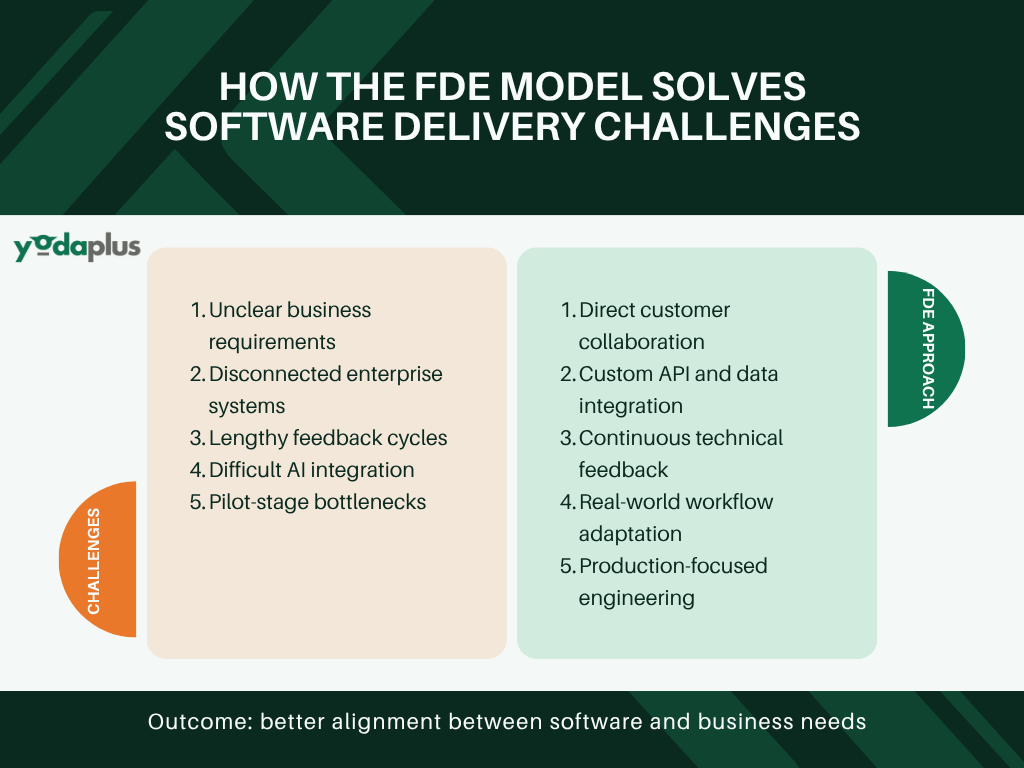
One of the main problems the FDE model addresses is the difference between what software is designed to do and what a business actually needs.
Enterprise software products are generally developed around common customer requirements.
However, organisations rarely operate in exactly the same way.
For example, two investment firms may use similar financial reporting platforms but follow different processes for data validation, compliance review, and report approval.
A standardised application may not accommodate every requirement without additional configuration or development.
Forward-deployed engineers investigate these differences before determining how the technology should be implemented.
They work with business teams to understand existing processes, identify operational challenges, and determine which technical changes are necessary.
This helps ensure that implementation decisions are based on actual business conditions rather than assumptions made during product development.
Why Direct Engineering Collaboration Matters
Enterprise technology projects often involve communication between several departments.
Business users explain their requirements to project managers, who communicate them to implementation teams. Technical issues may then be escalated to software developers.
Although this structure supports coordination, important details can be lost during communication.
Forward-deployed engineers reduce this distance by participating directly in customer discussions and technical development.
For example, a treasury team may explain that an automated reporting system must account for specific approval requirements before financial information is finalised.
An FDE can translate this operational requirement into application logic, workflow permissions, and validation procedures.
This direct involvement helps engineers understand why particular features are necessary.
It also allows technical problems to be investigated with the employees who experience them.
As a result, businesses can spend less time clarifying requirements and more time addressing implementation challenges.
Solving Complex Enterprise Integration Problems
Integration is one of the most important areas where the FDE model can create value.
Large organisations frequently use multiple software platforms developed at different times.
A financial institution may rely on separate systems for transaction processing, risk management, compliance, and financial reporting.
Introducing a new AI application requires these systems to exchange information reliably.
For example, an AI-powered equity research platform may need access to company filings, financial databases, internal spreadsheets, and research repositories.
Simply deploying the application does not guarantee that these connections will function correctly.
Forward-deployed engineers can help develop APIs, configure data pipelines, address compatibility issues, and establish secure connections.
They also work with customers to understand data access restrictions and existing infrastructure limitations.
This makes enterprise software implementation more practical, particularly when organisations cannot easily replace their existing technology.
Why the FDE Model Is Valuable for AI Deployment
Artificial intelligence introduces additional challenges because AI applications depend heavily on data quality, workflow design, and system integration.
An AI model may produce impressive results during testing but encounter difficulties when processing inconsistent enterprise data.
For example, an organisation may develop an AI agent that automatically prepares financial reports.
During a pilot, the agent may successfully retrieve information from a limited dataset and generate accurate summaries.
However, production deployment may require connections to several databases, support for different document formats, and compliance with internal approval procedures.
The Forward Deployed Engineer model helps address these practical requirements.
FDEs can work with employees to identify data limitations, configure integrations, establish validation procedures, and test the application under realistic operating conditions.
They can also help determine when AI-generated outputs require human review.
This is especially important for Agentic AI systems that interact with enterprise applications and execute multiple workflow activities.
How Forward Deployed Engineers Help Reduce Implementation Delays
Enterprise technology projects frequently experience delays when unexpected technical requirements emerge during implementation.
A system may require additional integrations, changes to existing workflows, or modifications to data processing procedures.
In traditional delivery models, these issues may need to be added to development backlogs or escalated through multiple teams.
Forward-deployed engineers can investigate problems directly and develop suitable solutions within their responsibilities.
For example, if an AI reporting application cannot retrieve information from an internal database, an FDE can work with the customer’s IT team to identify the cause.
The problem may involve authentication settings, data structures, or API limitations.
Direct collaboration can shorten the time required to diagnose and address such issues.
However, the FDE model does not automatically guarantee faster deployment. Results depend on technical complexity, available resources, and the organisation’s readiness.
Turning Customer Feedback Into Product Improvements
Another important benefit of the FDE model is the connection it creates between real customer experiences and product development.
Forward Deployed Engineers observe how software performs within operational environments.
They may identify recurring integration problems, missing capabilities, or workflows that require additional support.
These findings can help product teams improve the core application.
For example, if several financial institutions require similar integrations with reporting systems, the engineering team may develop a reusable connector.
This reduces the need to build the same integration separately for every customer.
The FDE model therefore supports customer-specific implementation while also creating opportunities for broader product improvements.
For this approach to remain sustainable, organisations must distinguish between reusable capabilities and highly specialised customisations.
When Does the FDE Model Make the Most Sense?
The Forward Deployed Engineer model is particularly valuable when software implementation involves complex systems, specialised requirements, or significant operational dependencies.
Financial services, healthcare, manufacturing, and logistics are examples of industries where enterprise technology must often integrate with established processes.
The model is also useful when organisations introduce Agentic AI applications that need access to multiple systems and require careful workflow orchestration.
However, not every business needs a forward-deployed engineer.
Standardised software with straightforward implementation requirements may be effectively delivered through conventional development and support models.
The FDE approach becomes more valuable when direct engineering involvement can meaningfully improve implementation quality, reliability, or business outcomes.
Conclusion
The Forward Deployed Engineer model solves a problem that traditional software delivery can struggle to address efficiently: making complex technology work within the realities of individual business environments.
Its value lies in connecting software engineering with operational understanding.
By working directly with customers, FDEs can identify implementation challenges, improve enterprise integrations, reduce communication gaps, and adapt solutions to specific requirements.
For businesses adopting AI and enterprise automation, this approach can help bridge the gap between successful demonstrations and reliable production systems.
Yodaplus supports organizations through enterprise AI development, workflow automation, and systems integration. Combining these capabilities with a forward deployed engineering approach can help businesses implement AI solutions that address real operational challenges and deliver measurable value.
FAQs
The FDE model addresses the gap between standardized software capabilities and the specific technical and operational requirements of enterprise customers.
Enterprise software often requires complex integrations, specialized workflows, and customization. Forward Deployed Engineers help businesses address these requirements through direct technical collaboration.
Forward Deployed Engineers help organizations connect AI applications with enterprise systems, manage data requirements, establish workflow controls, and test solutions in realistic environments.
Yes. Traditional software delivery can address complex implementation challenges, particularly with experienced integration and consulting teams. The FDE model provides a more direct approach by involving engineers closely in customer environments.
Businesses with complex technology environments, specialized operational requirements, legacy systems, and significant AI integration needs are particularly likely to benefit from the FDE model.