Where Agentic AI Already Works in Capital Markets
October 28, 2026 By Yodaplus
Agentic AI is already finding practical applications in capital markets, particularly in investment research, financial reporting, compliance monitoring, trade operations, and risk management. While fully autonomous financial decision-making remains limited, AI agents are helping financial institutions automate repetitive activities, process complex information, and coordinate workflows across enterprise systems.
Investment banks, asset managers, brokerage firms, and other capital markets participants manage enormous volumes of financial data every day. Analysts review company filings, operations teams reconcile transactions, and compliance professionals monitor activities against regulatory requirements.
Many of these processes involve multiple steps and depend on information stored across different applications.
Agentic AI can help by retrieving relevant data, analysing information, using connected tools, and completing authorised activities within a defined workflow.
The most practical applications today are generally those where AI agents support employees rather than independently make high-risk financial decisions.
Why Is Agentic AI Gaining Traction in Capital Markets?
Capital markets firms are under pressure to improve operational efficiency while managing growing data volumes and regulatory requirements.
Traditional automation has already helped organisations process transactions and manage repetitive tasks. However, many financial workflows still require employees to interpret documents, investigate exceptions, and coordinate activities across multiple systems.
Agentic AI creates opportunities to automate parts of these processes.
An AI agent can retrieve information, identify missing details, initiate permitted actions, and prepare results for human review.
For example, an investment research team may use an AI agent to collect financial statements, organise company disclosures, and prepare an initial research summary.
This allows analysts to spend more time evaluating investment opportunities rather than manually gathering information.
Agentic AI in Equity Research and Investment Analysis
Equity research is one of the clearest areas where Agentic AI can support capital markets professionals.
Investment analysts regularly review annual reports, quarterly results, earnings transcripts, industry developments, and financial performance indicators.
Collecting and organising this information can take considerable time.
AI agents can support the research process by retrieving relevant documents, extracting financial information, identifying important disclosures, and preparing structured research materials.
For example, an AI research workflow may collect a company’s latest financial statements, organise revenue and profitability information, identify changes in business performance, and prepare an initial summary.
The analyst can then review the findings, verify sources, and develop an investment opinion.
These applications are particularly useful for information-intensive activities where the final interpretation remains with investment professionals.
Automating Financial Reporting Workflows
Financial reporting involves collecting information from different sources, validating records, preparing calculations, and organising results into standardised formats.
Agentic AI can support these activities by coordinating tasks across connected financial systems.
For example, an AI agent may retrieve financial information from approved databases, identify missing records, and prepare a preliminary management report.
If the workflow encounters incomplete information, the agent can flag the issue and request additional review.
This reduces the time employees spend collecting information and coordinating reporting activities.
However, financial reports still require appropriate validation, particularly when they contain information used for regulatory submissions, investment decisions, or financial disclosures.
Supporting Trade Reconciliation and Exception Management
Trade reconciliation is another area where AI agents can provide operational support.
Capital markets firms process large numbers of transactions involving trading platforms, custodians, clearing systems, and internal accounting applications.
Differences between records can create exceptions that require investigation.
Agentic AI can assist operations teams by retrieving transaction details, comparing available records, identifying discrepancies, and preparing supporting information for review.
For example, when a trade record does not match settlement information, an AI agent may collect related transaction data and identify possible reasons for the mismatch.
Employees can then investigate the exception using the information provided.
This can reduce manual investigation time and improve operational visibility.
Transaction corrections and settlement-related actions should remain subject to the firm’s established permissions and approval procedures.
Agentic AI in Compliance Monitoring
Capital markets firms must monitor activities for potential regulatory and policy violations.
Compliance teams review transactions, communications, disclosures, and internal records to identify unusual behaviour or incomplete documentation.
AI agents can help organise this information and support investigation workflows.
For example, an agent may retrieve records associated with a flagged transaction, identify relevant policies, and prepare a summary for a compliance professional.
The system can also help track missing documentation and route cases to the appropriate team.
These applications support faster information retrieval and more consistent case preparation.
However, compliance decisions require reliable evidence, traceable outputs, and appropriate human oversight.
AI-generated findings should support professional judgement rather than replace established compliance responsibilities.
Improving Risk Monitoring and Portfolio Oversight
Risk management teams continuously evaluate market exposure, portfolio performance, counterparty relationships, and changing financial conditions.
This requires information from multiple internal and external sources.
Agentic AI can support risk monitoring by retrieving updated information, organising relevant indicators, and preparing alerts or summaries for risk professionals.
For example, an AI agent may identify a significant change in a company’s financial disclosures and notify the relevant portfolio or risk team.
It may also collect supporting information to help employees understand the potential implications.
These capabilities can improve the speed at which organisations identify developments requiring attention.
However, risk assessments must remain grounded in verified data, established models, and appropriate review procedures.
Streamlining Treasury and Liquidity Operations
Treasury teams manage cash positions, funding requirements, liquidity information, and financial obligations.
These activities often require employees to collect information from banking systems, accounting platforms, and internal financial applications.
Agentic AI can assist by retrieving relevant records, organising cash position information, and preparing operational summaries.
For example, an AI agent may gather information about upcoming payments, outstanding receivables, and available balances to support liquidity planning.
It can also identify missing information or unusual changes that require investigation.
These applications can reduce manual coordination and improve access to operational information.
However, funding decisions and payment authorisation should remain governed by established financial controls.
How Agentic AI Helps Across Connected Financial Systems
Many capital markets workflows involve several applications that do not operate as a single system.
An investment research process may require information from financial databases, document repositories, market data platforms, and internal reporting tools.
Agentic AI can coordinate authorised activities across these environments through APIs and enterprise integrations.
This allows organisations to automate processes that previously required employees to move information manually between applications.
For example, an AI agent may retrieve a financial document, extract relevant information, update an approved internal workflow, and notify the responsible employee.
The effectiveness of this approach depends on reliable integrations, data quality, access permissions, and workflow design.
Without these foundations, AI agents may struggle to complete tasks consistently.
Why Human Oversight Remains Essential
Although Agentic AI can complete increasingly complex tasks, capital markets firms must carefully manage the level of autonomy given to AI systems.
Financial operations involve sensitive information, regulatory obligations, and decisions with significant consequences.
An AI agent may be permitted to retrieve company filings and prepare a research summary.
However, publishing investment recommendations, modifying sensitive financial records, or initiating transactions may require human authorisation.
Organisations should establish clear rules defining what agents can do independently.
These controls should include access permissions, activity logs, approval checkpoints, and procedures for handling errors.
Human oversight helps financial institutions benefit from automation while maintaining accountability.
What Is Preventing Wider Agentic AI Adoption?
Despite growing interest, several challenges continue to limit broader Agentic AI deployment in capital markets.
Legacy technology remains a significant obstacle. Many financial institutions rely on complex systems that require additional integration work before supporting AI agents.
Fragmented financial data can also affect application reliability.
Organizations must ensure that AI agents retrieve accurate information and operate within established security policies.
Governance presents another challenge, particularly when agents are authorized to interact with financial systems or perform operational actions.
Firms also need technical expertise to develop, test, monitor, and maintain these applications.
As organizations address these requirements, more Agentic AI use cases may become suitable for production deployment.
What Comes Next for Agentic AI in Capital Markets?
The next stage of Agentic AI adoption is likely to focus on connecting individual applications into more coordinated enterprise workflows.
Instead of using separate AI tools for document analysis, reporting, and exception management, financial institutions may develop systems that coordinate these activities.
For example, an investment research workflow could involve specialized agents responsible for retrieving company information, analyzing financial statements, preparing peer comparisons, and organizing research outputs.
A coordinating system could track progress and manage dependencies between these activities.
However, broader automation will require stronger governance, reliable infrastructure, and clear business ownership.
The objective should be to improve operational efficiency without compromising accuracy or control.
Conclusion
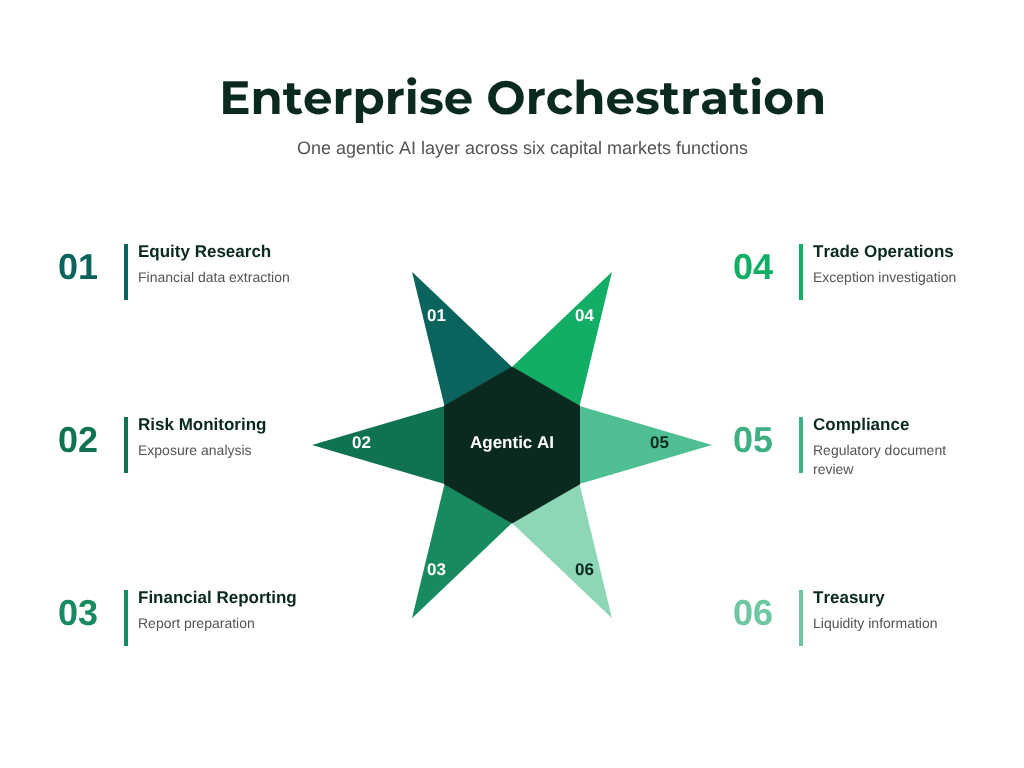
Agentic AI is already supporting practical activities across capital markets, particularly in equity research, financial reporting, reconciliation, compliance monitoring, risk analysis, and treasury operations.
Its immediate value lies in reducing manual effort, improving access to information, and coordinating complex workflows.
While autonomous financial decision-making requires additional safeguards, supervised AI agents can help institutions improve everyday operations.
Yodaplus Agentic AI for Financial Operations helps financial institutions implement intelligent workflow automation, financial document processing, enterprise integrations, and human-in-the-loop controls. By connecting AI agents with existing financial systems, organizations can develop practical solutions that support more efficient and reliable operations.
FAQs
Agentic AI is being applied to investment research, financial document processing, reporting, reconciliation support, compliance investigation, and risk monitoring. The maturity of these applications varies across institutions.
Agentic AI helps research teams retrieve company filings, extract financial information, organize disclosures, and prepare preliminary research materials for analyst review.
Agentic AI can support trade reconciliation, exception investigation, information retrieval, and workflow coordination. Actions involving financial transactions require appropriate authorization and controls.
Agentic AI can be deployed within regulated environments when organizations establish reliable data access, security controls, model validation, monitoring, and human oversight.
Future applications may involve more coordinated multi-agent workflows across research, risk, compliance, and financial operations. Wider adoption will depend on reliable integrations, governance, and demonstrated business value.