What Makes a Process a Poor Fit for Agentic AI?
July 20, 2026 By Yodaplus
Agentic AI is powerful, but it is not the right solution for every business process. While it excels at handling complex workflows, coordinating multiple systems, and adapting to changing conditions, some processes are better served by traditional automation or standard software. Choosing Agentic AI for the wrong use case can increase implementation costs, add unnecessary complexity, and deliver little additional business value. One of the biggest mistakes organizations make is assuming every repetitive task should be automated with intelligent agents. In reality, the best automation strategy matches the technology to the complexity of the process. Simple, predictable workflows often perform better with rule-based automation, while dynamic, decision-heavy processes benefit from Agentic AI. Understanding what makes a process a poor fit for Agentic AI helps businesses invest in the right technology while maximizing return on investment.
What Makes Agentic AI Valuable?
Before identifying where Agentic AI should not be used, it helps to understand where it performs best.
Agentic AI is designed for workflows that involve:
- Multiple business systems
- Frequent decision-making
- Changing business conditions
- Unstructured information
- Human collaboration
- Complex approvals
- Dynamic planning
If a process lacks these characteristics, Agentic AI may provide little additional value.
Sign 1: The Process Is Entirely Rule-Based
Some business processes follow the same steps every time.
For example:
- Sending invoice confirmation emails
- Generating monthly reports
- Copying data between systems
- Scheduled database backups
- Daily file transfers
These activities rarely require reasoning or adaptation.
Traditional automation, robotic process automation (RPA), or workflow software can complete them efficiently without the additional intelligence of Agentic AI.
Sign 2: There Are Very Few Decisions to Make
Agentic AI adds value by evaluating options and selecting the most appropriate action.
If every step is predetermined, there is little need for autonomous decision-making.
Examples include:
- Employee attendance synchronization
- Fixed approval chains
- Automatic invoice numbering
- Scheduled payment reminders
- Routine notifications
These processes are predictable and rarely change, making them better suited for conventional automation.
Sign 3: The Workflow Never Changes
Some operational workflows remain stable for years.
If the sequence of activities is fixed and exceptions are extremely rare, businesses gain little from an adaptive AI system.
Examples include:
- Daily data exports
- Batch file processing
- Standard payroll calculations
- Routine compliance reporting
Agentic AI is most valuable when workflows need to adjust dynamically based on changing information.
Sign 4: Data Is Already Structured and Clean
Many AI systems spend significant effort interpreting unstructured information such as emails, contracts, images, and reports.
If all required data already exists in structured databases with consistent formats, sophisticated reasoning may not be necessary.
Examples include:
- Barcode scanning
- Product master synchronization
- Inventory count updates
- Financial ledger postings
Traditional integrations and workflow automation often complete these tasks more efficiently.
Sign 5: The Cost Outweighs the Benefit
Implementing Agentic AI requires planning, integration, governance, and ongoing monitoring.
For low-value or infrequently performed tasks, the investment may not be justified.
Organizations should evaluate:
- Time saved
- Process frequency
- Operational complexity
- Business impact
- Maintenance effort
- Expected return on investment
If automation delivers only minor efficiency gains, simpler technologies may provide better value.
Sign 6: Strict Regulatory Rules Leave No Room for Interpretation
Some industries require processes to follow exact regulatory procedures with no flexibility.
Examples include:
- Fixed tax calculations
- Mandatory statutory filings
- Standard payroll deductions
- Regulatory reporting formats
While Agentic AI can support these processes by gathering information or validating data, the execution itself is often better handled by deterministic software that guarantees consistent outcomes.
Sign 7: Human Judgment Is the Primary Requirement
Certain business decisions depend on negotiation, ethics, legal interpretation, or strategic thinking.
Examples include:
- Executive hiring decisions
- Merger and acquisition negotiations
- Legal dispute resolution
- Board-level strategy discussions
- Crisis management
Agentic AI can assist by collecting information, preparing summaries, and identifying risks, but the final decisions should remain with experienced professionals.
Choosing the Right Automation Approach
Instead of asking whether a process can be automated, organizations should ask which technology is best suited to automate it.
A practical approach is:
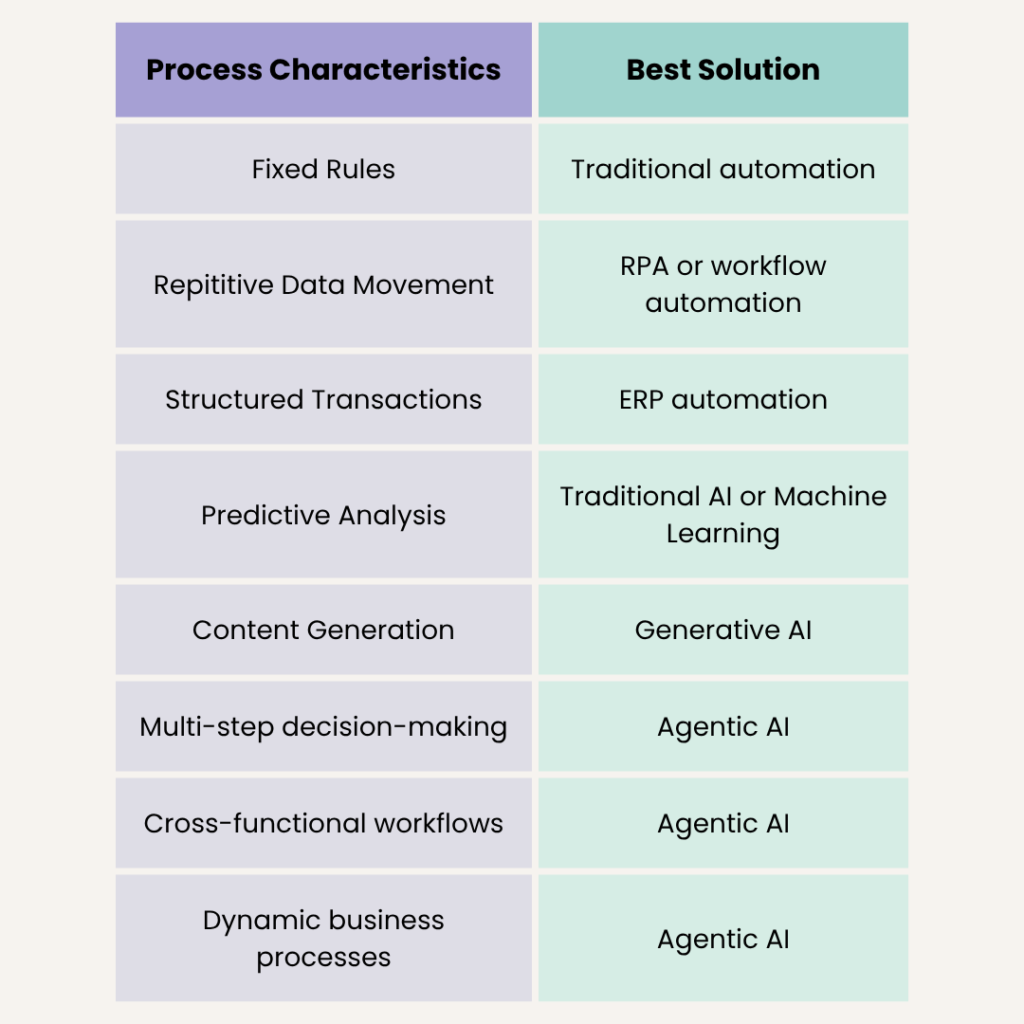
Selecting the right technology improves efficiency while avoiding unnecessary implementation complexity.
Agentic AI Works Best Alongside Other Technologies
The most successful organizations do not replace every automation tool with Agentic AI.
Instead, they combine multiple technologies.
For example:
- Traditional automation executes repetitive workflows.
- Machine learning predicts demand.
- Generative AI creates reports.
- Agentic AI coordinates procurement, finance, customer service, and supply chain operations.
This layered approach allows each technology to focus on the tasks it performs best.
Conclusion
Agentic AI is a powerful technology, but it is not intended to replace every form of business automation. Processes that are highly repetitive, rule-based, structured, or governed by fixed regulations often achieve better results with traditional automation or standard enterprise software. The greatest value comes from applying Agentic AI where workflows involve multiple systems, changing information, complex decisions, and collaboration across departments.
Successful automation strategies focus on selecting the right technology for each business process rather than applying the same solution everywhere. By combining traditional automation, artificial intelligence, generative AI, and Agentic AI, organizations can build efficient, scalable, and intelligent operations that deliver measurable business value.
Yodaplus Agentic AI Services helps organizations evaluate business processes, identify the right automation approach, and implement artificial intelligence, Agentic AI, generative AI, AI workflow automation, enterprise AI, and multi-agent AI solutions. By matching the right technology to the right workflow, Yodaplus enables businesses to automate efficiently while maximizing return on investment.
FAQs
No. Agentic AI is best suited for complex, dynamic workflows. Simple, rule-based processes are often better handled by traditional automation.
Processes with fixed rules, structured data, minimal decision-making, stable workflows, or strict regulatory requirements generally do not benefit significantly from Agentic AI.
Traditional automation is ideal for repetitive tasks such as data transfers, scheduled reports, payroll calculations, invoice notifications, and other predictable workflows.
Yes. Many organizations combine traditional automation, machine learning, generative AI, and Agentic AI to automate different parts of their operations based on the complexity of each process.
Yodaplus Agentic AI Services assesses business workflows, identifies automation opportunities, integrates enterprise systems, and implements AI solutions that align with operational goals, helping organizations improve efficiency without adding unnecessary complexity.