How Do You Identify Agentic AI Use Cases in Your Organization?
July 20, 2026 By Yodaplus
The best Agentic AI use cases are usually found in business processes that involve multiple systems, frequent decisions, changing information, and significant manual coordination. Rather than trying to automate every task, organizations should focus on workflows where intelligent agents can reduce delays, improve accuracy, and help employees spend more time on higher-value work.
Many businesses already use AI for forecasting, reporting, or customer support. However, Agentic AI goes a step further by planning tasks, coordinating actions across enterprise applications, and adapting to changing business conditions. The challenge is knowing where these capabilities will have the greatest impact.
A structured evaluation helps organizations identify the right opportunities while avoiding costly automation projects that deliver limited value.
What Makes a Good Agentic AI Use Case?
Not every process needs autonomous AI.
The strongest candidates typically share several characteristics:
- Multiple steps
- Cross-functional collaboration
- Frequent decision-making
- Manual handoffs
- Changing business conditions
- Data from multiple systems
- High process volume
- Repetitive coordination work
When these factors come together, Agentic AI can automate not just individual tasks but the entire workflow.
Start by Mapping Your Business Processes
The first step is understanding how work flows across your organization.
Document processes such as:
- Procurement
- Accounts payable
- Customer onboarding
- Employee onboarding
- Inventory management
- Claims processing
- Compliance reviews
- Financial reporting
- Vendor management
For each process, identify:
- Who performs each step
- Which systems are involved
- Where approvals happen
- Where delays occur
- Where employees spend the most time
This creates a clear picture of where automation can deliver the greatest value.
Look for Repetitive Coordination
One of the biggest indicators for Agentic AI is repetitive coordination rather than repetitive work.
Ask questions like:
- Do employees spend time following up with other teams?
- Are people manually moving information between systems?
- Are approvals delayed because someone forgets to act?
- Does work frequently stop while waiting for information?
These coordination activities often consume more time than the actual business task.
Agentic AI can monitor workflow progress, gather missing information, notify stakeholders, and keep processes moving without constant human intervention.
Identify Processes That Require Multiple Systems
Many enterprise workflows involve several applications.
For example, a procurement process may use:
- ERP software
- Supplier portals
- Inventory systems
- Approval software
- Finance applications
Employees often switch between these systems throughout the day.
Agentic AI can connect these systems, reducing manual effort and improving workflow efficiency.
Find Decision-Heavy Workflows
Agentic AI performs best when processes require frequent operational decisions.
Examples include:
- Selecting suppliers
- Prioritizing customer requests
- Identifying compliance risks
- Routing support tickets
- Evaluating inventory shortages
- Escalating exceptions
If employees regularly evaluate options before deciding what to do next, the workflow may be a strong candidate for Agentic AI.
Measure the Cost of Manual Work
Not every complex process needs automation.
Focus on workflows where manual effort creates measurable business impact.
Useful metrics include:
- Time spent per task
- Process completion time
- Error rates
- Rework frequency
- Customer waiting time
- Operational costs
- Number of approvals
- Employee workload
Processes with high costs and frequent delays often provide the greatest return on investment.
Prioritize High-Impact Opportunities
Once potential use cases have been identified, rank them based on business value.
A simple prioritization framework includes:
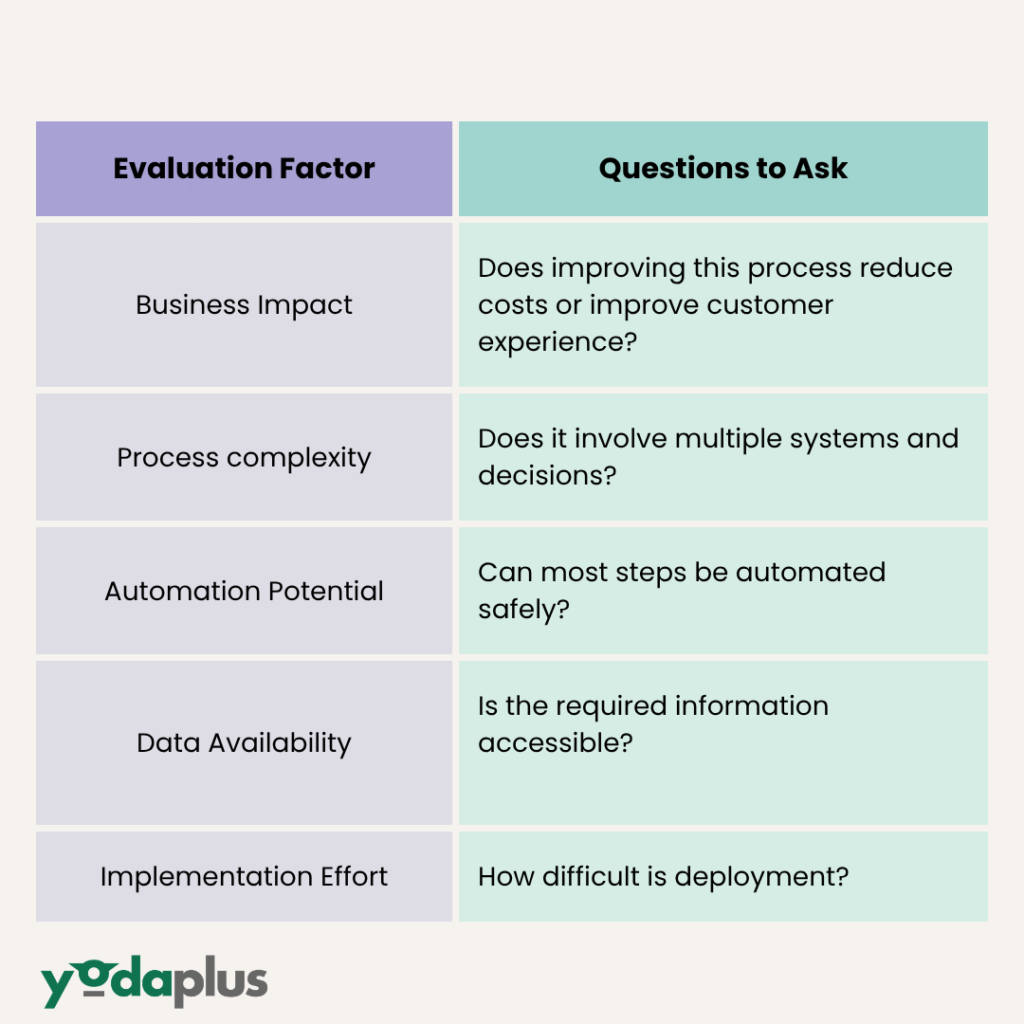
Starting with high-impact, medium-complexity workflows often delivers faster and more measurable results.
Common Agentic AI Use Cases Across Industries
Although every organization is different, several business functions consistently benefit from Agentic AI.
Examples include:
- Procurement and sourcing
- Accounts payable automation
- Supply chain planning
- Customer onboarding
- Regulatory compliance
- Financial reporting
- IT service management
- Healthcare administration
- Insurance claims processing
- Enterprise research
These workflows typically involve multiple stakeholders, changing information, and ongoing coordination.
Build a Pilot Before Scaling
Organizations do not need to automate every workflow immediately.
Instead, begin with a pilot project.
Choose a process that:
- Has measurable business value
- Involves multiple systems
- Has clear success metrics
- Can be monitored easily
- Has support from business stakeholders
Once the pilot demonstrates measurable improvements, organizations can expand Agentic AI to additional business functions.
Conclusion
Identifying the right Agentic AI use cases begins with understanding how work moves through your organization. The strongest opportunities are usually found in workflows that span multiple systems, involve frequent decisions, require coordination between teams, and create delays through manual effort. Rather than automating isolated tasks, businesses should focus on processes where autonomous agents can orchestrate complete workflows and deliver measurable operational improvements.
A thoughtful evaluation process helps organizations prioritize projects with the highest business value while avoiding unnecessary complexity. Starting with targeted pilot projects allows businesses to build confidence, demonstrate results, and develop a roadmap for broader AI adoption.
Yodaplus Agentic AI Services helps organizations identify, design, and implement high-impact Agentic AI, AI workflow automation, enterprise AI, artificial intelligence, multi-agent AI, and enterprise AI solutions. From process assessment to deployment and integration, Yodaplus enables businesses to automate complex workflows and accelerate digital transformation with confidence.
FAQs
Look for workflows that involve multiple systems, frequent decisions, manual coordination, changing business conditions, and significant operational effort.
Procurement, finance, supply chain, customer service, compliance, HR, IT operations, and enterprise research commonly benefit from Agentic AI.
No. Simple, rule-based processes are often better suited to traditional automation, while Agentic AI delivers the most value in complex and dynamic workflows.
Evaluate processes based on business impact, automation potential, implementation effort, process complexity, and the availability of reliable data.
Yodaplus works with organizations to assess business processes, identify high-value automation opportunities, integrate enterprise systems, and deploy Agentic AI solutions that improve efficiency, reduce manual work, and support long-term business growth.