
The Ultimate Guide to Artificial Intelligence Solutions: From Traditional AI to Agentic AI
March 24, 2025 By Yodaplus
Artificial intelligence has evolved from a technology that automates individual tasks into one that can support complex business processes, improve decision-making, and coordinate work across multiple systems. Organizations across industries are adopting AI to improve productivity, reduce operational costs, enhance customer experiences, and gain deeper business insights. As AI continues to advance, businesses are moving beyond traditional automation toward intelligent systems that can plan, reason, and adapt to changing business conditions.
Today’s artificial intelligence solutions extend far beyond chatbots and predictive analytics. They include machine learning, computer vision, natural language processing, generative AI, workflow automation, and the latest evolution, Agentic AI. Each type of AI addresses different business challenges, making it important for organizations to understand how these technologies work together and where they deliver the greatest value.
Whether an organization is improving customer service, automating financial operations, optimizing supply chains, or modernizing enterprise workflows, selecting the right AI solution is becoming a strategic business decision.
What Are Artificial Intelligence Solutions?
Artificial intelligence solutions are software systems that use AI technologies to perform tasks that normally require human intelligence.
Depending on the business objective, AI solutions can:
- Analyze large volumes of data
- Recognize patterns
- Generate content
- Understand language
- Automate workflows
- Support business decisions
- Predict future outcomes
- Coordinate business processes
Rather than replacing employees, AI helps organizations improve speed, accuracy, and operational efficiency while allowing people to focus on higher-value work.
Why Businesses Are Investing in AI
Organizations are facing increasing operational complexity.
Business data continues to grow.
Customer expectations continue to rise.
Markets change more rapidly than ever before.
Artificial intelligence helps businesses respond by improving decision-making and reducing manual effort.
Common business objectives include:
- Improving operational efficiency
- Reducing repetitive work
- Supporting faster decisions
- Enhancing customer experiences
- Strengthening risk management
- Increasing productivity
- Improving business visibility
These benefits explain why AI has become a core part of enterprise digital transformation strategies.
Traditional Artificial Intelligence
Traditional AI focuses on solving specific business problems using predefined algorithms, machine learning models, or statistical analysis.
Examples include:
- Fraud detection
- Recommendation engines
- Credit scoring
- Demand forecasting
- Predictive maintenance
- Image recognition
These systems perform well when solving clearly defined problems using historical data.
However, they typically operate within a limited scope and are not designed to manage complete business workflows.
Generative AI
Generative AI represents the next stage of AI adoption.
Instead of simply analyzing data, it creates new content.
Generative AI can produce:
- Reports
- Emails
- Images
- Software code
- Presentations
- Product descriptions
- Business documents
Organizations increasingly use generative AI to improve productivity by reducing the time required to create business content.
Although powerful, generative AI generally responds to prompts rather than independently completing business objectives.
Agentic AI
Agentic AI represents the latest evolution of enterprise artificial intelligence.
Instead of waiting for instructions at every step, Agentic AI receives a business objective and determines how to achieve it.
It can:
- Plan tasks
- Gather information
- Coordinate multiple systems
- Make decisions within defined boundaries
- Adapt to changing conditions
- Execute complete workflows
Rather than automating isolated activities, Agentic AI automates business outcomes.
For example, instead of simply generating a report, an AI agent can collect data from multiple enterprise systems, analyze findings, identify risks, prepare recommendations, generate the report, and distribute it to relevant stakeholders.
Comparing Different AI Solutions
Each type of artificial intelligence serves a different purpose.
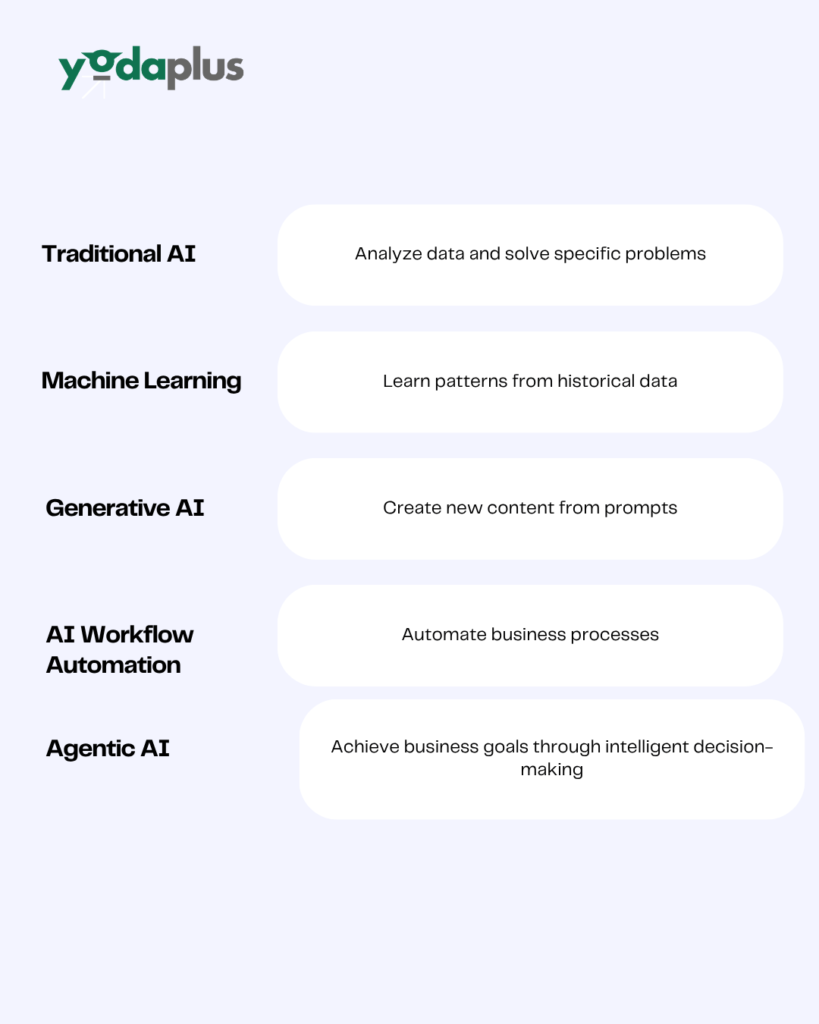
Organizations often combine several AI technologies rather than relying on a single solution.
For example, a business may use machine learning for forecasting, generative AI for report creation, and Agentic AI to coordinate the entire workflow.
Enterprise Applications of Artificial Intelligence
Artificial intelligence is transforming business operations across every industry.
Organizations are using different AI solutions depending on the complexity of their business processes and operational goals.
Some common enterprise applications include:
- Customer service automation
- Financial forecasting
- Fraud detection
- Supply chain optimization
- Inventory planning
- Document processing
- Risk management
- Sales forecasting
- Regulatory compliance
- Business intelligence
Rather than replacing existing systems, AI enhances enterprise software by improving decision-making and reducing manual work.
Choosing the Right AI Solution
Not every business challenge requires the same type of artificial intelligence.
Selecting the right solution depends on the complexity of the process, the available data, and the desired business outcome.
Traditional AI is well suited for organizations that need predictive analytics, fraud detection, forecasting, or pattern recognition.
Generative AI is valuable when businesses need to create reports, emails, presentations, product descriptions, or other forms of business content.
Workflow automation is most effective for repetitive, rule-based processes that follow clearly defined business rules.
Agentic AI becomes the preferred solution when business processes involve multiple systems, changing information, frequent exceptions, and complex decision-making.
Understanding these differences helps organizations invest in AI technologies that deliver measurable business value.
Why Businesses Are Moving Toward Agentic AI
Many enterprise workflows extend beyond a single task.
A procurement request may involve ERP systems, supplier portals, inventory platforms, finance applications, approvals, and compliance checks.
Similarly, preparing an investment research report may require collecting financial statements, analyzing earnings calls, reviewing market news, building valuation models, and generating recommendations.
Traditional AI and workflow automation can support individual activities.
Agentic AI coordinates the entire process.
Instead of asking employees to manage every step manually, intelligent AI agents plan the workflow, retrieve information from multiple systems, evaluate available options, and complete the objective while escalating only the situations that require human judgment.
This shift from task automation to outcome-driven automation is changing how enterprises approach digital transformation.
Human Expertise Remains Essential
Artificial intelligence is designed to support people, not replace them.
Business leaders continue to define objectives, approve strategic decisions, manage customer relationships, and provide oversight for critical operations.
AI contributes by:
- Processing information faster
- Identifying patterns
- Automating repetitive work
- Generating recommendations
- Coordinating routine workflows
The combination of human expertise and intelligent automation enables organizations to improve productivity while maintaining governance, accountability, and business control.
The Future of Artificial Intelligence Solutions
Artificial intelligence continues to evolve rapidly.
Future enterprise platforms will increasingly combine:
- Traditional AI
- Machine learning
- Generative AI
- Agentic AI
- Intelligent workflow automation
- Predictive analytics
- Multi-agent AI systems
- Real-time business intelligence
Rather than operating as independent technologies, these capabilities will work together to support complete business processes across finance, retail, supply chain, healthcare, manufacturing, customer service, and enterprise operations.
Organizations that adopt the right combination of AI technologies will be better positioned to improve efficiency, strengthen decision-making, and respond quickly to changing business conditions.
Conclusion
Artificial intelligence solutions have evolved from specialized analytical tools into intelligent enterprise platforms that support decision-making, automate workflows, and improve business performance. Traditional AI, machine learning, generative AI, workflow automation, and Agentic AI each address different business challenges, making it important for organizations to understand where each technology delivers the greatest value. Rather than choosing one approach over another, successful enterprises combine multiple AI capabilities to build scalable and efficient digital operations.
As business processes become more connected and data-driven, Agentic AI represents the next stage of enterprise automation by coordinating complete workflows instead of isolated tasks. Organizations that invest in intelligent AI solutions today will be better equipped to improve productivity, enhance customer experiences, strengthen operational resilience, and accelerate digital transformation.
Yodaplus Agentic AI Services helps organizations design, develop, and deploy enterprise AI solutions using artificial intelligence, Agentic AI, generative AI, AI agents, AI workflow automation, enterprise AI, enterprise AI solutions, autonomous AI agents, and multi-agent AI. By combining intelligent automation with deep enterprise integration, Yodaplus enables businesses to modernize operations, automate complex workflows, and build future-ready AI-powered enterprises.
FAQs
Artificial intelligence solutions are software systems that use AI technologies such as machine learning, generative AI, and Agentic AI to analyze data, automate tasks, support decision-making, and improve business operations.
Traditional AI focuses on solving specific problems such as prediction or classification, while Agentic AI can plan, reason, coordinate multiple systems, and complete entire business workflows to achieve defined goals.
Generative AI is ideal for creating reports, emails, presentations, software code, product descriptions, and other business content that would otherwise require manual effort.
Yes. Many organizations combine traditional AI, machine learning, generative AI, workflow automation, and Agentic AI to improve different stages of their business processes.
Yodaplus Agentic AI Services provides enterprise AI consulting, custom AI solutions, AI workflow automation, Agentic AI implementation, system integration, and intelligent business process automation to help organizations accelerate digital transformation and improve operational efficiency.