Agentic AI vs Traditional Automation: What Actually Changes?
July 3, 2026 By Yodaplus
Automation has helped businesses improve efficiency for decades, but it has largely been limited to following predefined rules. Agentic AI changes this model by enabling systems to understand business objectives, make decisions, adapt to changing situations, and coordinate work across multiple applications. The difference is not simply that one technology is newer than the other. The difference lies in how work gets completed. Traditional AI automation executes instructions, while Agentic AI determines the best way to achieve an outcome.
This shift is becoming increasingly important as enterprises manage growing volumes of data, complex workflows, and rapidly changing business conditions. According to Gartner, by 2028, at least 15% of day-to-day work decisions will be made autonomously through Agentic AI, compared with almost none in 2024. Businesses are moving beyond task automation toward intelligent execution that supports complete operational processes.
Why Traditional Automation Has Been So Successful
Traditional automation transformed business operations by removing repetitive manual work. Rule-based workflows helped organizations process invoices, approve purchase requests, generate reports, move files between applications, and update databases automatically.
The biggest strength of traditional automation is consistency.
If a workflow always follows the same sequence, automation performs it quickly and accurately. It never forgets a step, becomes distracted, or deviates from predefined business rules.
This made automation an essential technology for finance, manufacturing, customer service, healthcare, logistics, and many other industries.
However, business operations have changed.
Modern enterprises rarely operate through predictable workflows alone. Employees work across ERP platforms, CRM systems, cloud applications, communication tools, document repositories, and external data sources. They constantly make decisions based on changing information rather than fixed rules.
This is where traditional automation begins to struggle.
Where Traditional Automation Reaches Its Limits
Rule-based automation depends entirely on predefined instructions.
If every possible scenario has been programmed into the workflow, automation performs well.
But business operations rarely remain predictable.
A supplier changes delivery schedules.
A customer submits incomplete documentation.
A regulation changes unexpectedly.
Market conditions shift overnight.
Traditional automation cannot determine what to do unless someone updates the workflow manually.
This means employees often spend more time handling exceptions than processing routine work.
As organizations become larger and more connected, exception handling becomes one of the biggest operational bottlenecks.
What Actually Changes With Agentic AI?
The biggest change is that businesses stop automating tasks and begin automating objectives.
Instead of telling software exactly how to complete every step, organizations define the desired business outcome.
The AI determines how to achieve it.
It gathers information from multiple systems.
Evaluates available options.
Chooses appropriate actions.
Adapts when new information appears.
Requests human approval when necessary.
Then continues working until the objective has been achieved.
This represents a fundamental shift in how enterprise software operates.
Rather than executing workflows, intelligent AI agents actively manage them.
Rules Become Reasoning
Traditional automation asks:
“What instruction should I execute next?”
Agentic AI asks:
“What is the best action to achieve the objective?”
This difference affects every stage of enterprise operations.
Instead of stopping whenever information is missing, Agentic AI searches approved enterprise systems for additional data.
Instead of waiting for employees to determine the next step, it evaluates business context before deciding how to proceed.
Instead of treating every transaction identically, it adjusts its actions according to changing business conditions while remaining within predefined governance policies.
Reasoning allows automation to become significantly more flexible without sacrificing control.
Enterprise Systems Become Connected
One of the biggest operational changes is how enterprise software interacts.
Traditional automation often connects two applications through predefined integrations.
Agentic AI coordinates work across many enterprise systems simultaneously.
A finance workflow, for example, may retrieve ERP data, verify invoices stored in document repositories, check payment records, analyze banking information, validate compliance requirements, prepare reports, and notify stakeholders without requiring employees to move between applications.
Instead of multiple disconnected workflows, organizations create intelligent AI-powered workflows capable of coordinating complete business operations.
Decision-Making Becomes Distributed
Another major difference is that decision-making is no longer concentrated entirely with employees.
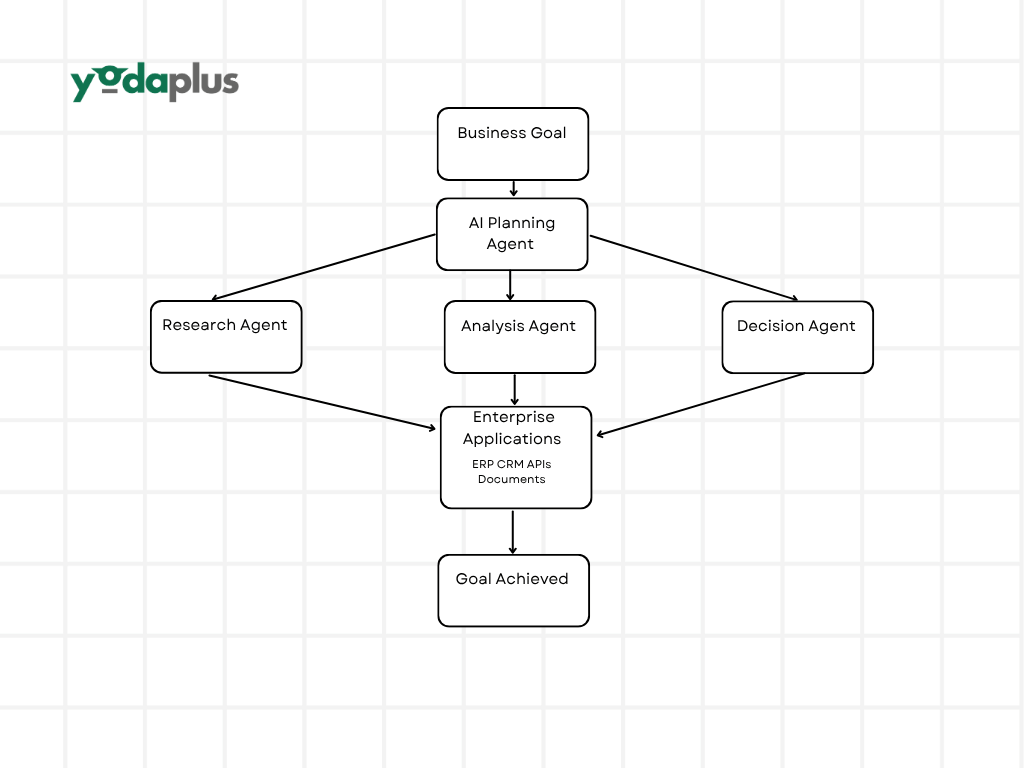
Agentic AI distributes operational decisions across specialized AI agents.
Instead of one system attempting to perform every activity, different agents handle research, analysis, compliance, reporting, planning, and execution.
Each agent contributes expertise while collaborating toward the same business objective.
This modular approach allows organizations to improve scalability, governance, and maintainability while supporting increasingly complex enterprise workflows.
Real Business Processes Show the Difference
The differences between traditional automation and Agentic AI become much clearer when viewed in the context of everyday enterprise operations.
Consider invoice processing.
With traditional automation, invoices move through a predefined approval workflow. If the invoice matches the purchase order and all required information is available, the process continues automatically. If data is missing, the workflow stops and waits for someone to resolve the issue.
Agentic AI approaches the same situation differently.
An intelligent agent can search enterprise systems for missing information, verify supplier records, compare historical transactions, identify potential discrepancies, recommend corrective actions, and determine whether the issue requires human approval. Rather than stopping at the first exception, the AI works toward resolving the problem while following business policies.
The same applies across customer service, procurement, regulatory compliance, IT operations, and supply chain management. Instead of automating individual activities, Agentic AI coordinates complete business processes.
Multi-Agent AI Changes How Work Is Executed
One of the biggest developments in enterprise agentic AI is the use of multi-agent AI systems.
Traditional automation generally relies on one workflow engine executing predefined rules.
Agentic AI distributes responsibilities across multiple intelligent agents.
For example, in a financial reporting process:
- A Data Agent collects information from ERP systems.
- An Analysis Agent validates financial data.
- A Compliance Agent checks regulatory requirements.
- A Reporting Agent prepares dashboards.
- A Review Agent identifies unusual transactions before submitting reports for approval.
Each agent specializes in one responsibility while sharing information with the others.
This collaborative approach improves flexibility because organizations can modify individual agents without redesigning the complete workflow. It also makes enterprise AI systems easier to scale as business requirements evolve.
Human Oversight Still Matters
A common misconception is that Agentic AI removes humans from business operations.
In reality, successful enterprise implementations keep people involved where their expertise creates the greatest value.
Routine operational decisions can be handled by AI, but strategic decisions, regulatory approvals, customer negotiations, ethical considerations, and high-risk financial transactions continue to require human judgment.
This combination creates a balanced operating model.
AI manages repetitive execution.
Employees provide governance, oversight, and strategic direction.
Instead of replacing professionals, Agentic AI enables them to spend more time solving business problems and less time coordinating administrative work.
Measuring Business Impact
Organizations invest in enterprise AI solutions because they expect measurable improvements rather than simply adopting new technology.
Businesses implementing Agentic AI often report improvements in several operational areas.
Workflows complete more quickly because AI coordinates activities across multiple systems without waiting for manual handoffs.
Operational costs decrease as repetitive work is automated.
Employees spend more time on analysis and decision-making instead of data collection.
Compliance improves through consistent execution and better audit trails.
Business leaders also gain faster access to insights because intelligent systems continuously monitor operations rather than generating reports only at predefined intervals.
According to McKinsey, generative AI and intelligent automation could contribute trillions of dollars in annual productivity gains across industries, with many of the largest opportunities coming from knowledge-intensive enterprise workflows. Agentic AI builds on this foundation by extending automation beyond content generation into end-to-end business execution.
Governance Becomes More Important, Not Less
As AI becomes capable of making operational decisions, governance becomes even more important.
Organizations must define approval thresholds, access permissions, audit requirements, security controls, and escalation policies before deploying Agentic AI across enterprise workflows.
Responsible AI implementation requires continuous monitoring to ensure decisions remain transparent, explainable, and aligned with business objectives and regulatory requirements.
Successful enterprises view governance as an essential component of intelligent automation rather than an obstacle to innovation.
The Future of Enterprise Automation
Enterprise automation is entering a new phase.
Instead of building hundreds of isolated workflows, organizations are creating intelligent operating environments where multiple AI agents collaborate across finance, procurement, customer service, HR, software development, manufacturing, and supply chain operations.
Future agentic AI platforms will increasingly coordinate work across entire organizations rather than individual departments.
Employees will assign objectives such as preparing financial reports, resolving customer issues, onboarding suppliers, or managing compliance activities. Intelligent agents will determine how to complete those objectives while keeping humans informed whenever approvals or strategic decisions are required.
The result will be organizations that operate with greater speed, adaptability, and resilience without sacrificing governance or human oversight.
Conclusion
The difference between traditional automation and Agentic AI is not simply a technological upgrade. It represents a fundamental shift in how enterprise work is performed. Traditional automation excels at executing predefined rules, while Agentic AI understands objectives, reasons through changing situations, coordinates multiple AI agents, and adapts workflows as business conditions evolve. Instead of automating isolated tasks, enterprises can automate complete business processes that span multiple systems, departments, and decisions.
As enterprise AI adoption accelerates, organizations will increasingly combine rule-based automation with intelligent, goal-driven systems capable of managing complex operational workflows. Businesses that embrace this evolution will be better equipped to improve efficiency, strengthen decision-making, and respond more effectively to changing market demands.
Yodaplus Agentic AI Services help enterprises move beyond conventional automation by building intelligent, scalable, and secure AI solutions tailored to real business challenges. From finance and retail to supply chain, maritime, and enterprise operations, Yodaplus combines Agentic AI, autonomous AI agents, workflow orchestration, intelligent document processing, and enterprise system integration to automate complex workflows while maintaining governance, transparency, and measurable business outcomes.
FAQs
Traditional automation follows predefined rules, while Agentic AI works toward business goals by making decisions, adapting to new information, and coordinating multiple tasks independently.
No. Traditional automation remains the best choice for predictable, rule-based processes. Agentic AI complements it by handling dynamic workflows that require reasoning and adaptability.
AI agents are specialized software components that perform specific responsibilities such as research, planning, compliance, analysis, reporting, or execution while collaborating with other agents.
Multi-agent AI improves scalability, flexibility, and operational efficiency by allowing multiple specialized agents to work together across complex enterprise workflows.
Agentic AI can make routine operational decisions within predefined policies, but high-risk approvals, strategic decisions, and governance remain under human oversight.
Financial services, retail, manufacturing, healthcare, logistics, supply chain, insurance, maritime, and technology companies are among the industries benefiting most from Agentic AI.