What Makes an AI System Agentic Rather Than Just Automated?
July 3, 2026 By Yodaplus
Businesses have been automating repetitive tasks for decades, but not every automated system is agentic. An AI system becomes agentic AI when it can understand a goal, make decisions, adapt to changing situations, and coordinate multiple actions without requiring human instructions at every step. Traditional AI automation follows predefined rules, while an agentic system uses reasoning, planning, memory, and intelligent AI agents to determine the best way to complete a task.
This distinction is becoming increasingly important as organizations invest in enterprise AI. Instead of simply digitizing manual work, businesses now want AI systems that can solve problems, collaborate across software applications, and manage complete workflows. According to Gartner, by 2028, at least 15% of day-to-day work decisions will be made autonomously through Agentic AI, compared to virtually none in 2024. This shift reflects how enterprises are moving beyond automation toward intelligent execution.
Automation and Agentic AI Are Not the Same
Automation has always been designed around predefined rules.
For example, if an invoice exceeds a certain amount, the system automatically sends it to a manager for approval. If inventory falls below a predefined threshold, the software generates a purchase order. Every action follows a fixed workflow created in advance.
Agentic AI operates differently.
Instead of asking artificial intelligence to execute one rule after another, businesses provide an objective. The AI then decides how to achieve that objective by gathering information, selecting the right tools, interacting with business applications, evaluating outcomes, and adapting if circumstances change.
The objective remains the same, but the path to achieving it can change dynamically.
What Makes an AI System Truly Agentic?
Several characteristics distinguish agentic AI from traditional automation.
The first is goal-oriented execution. Rather than completing a single task, an agentic system focuses on achieving a business outcome.
The second is reasoning. Before taking action, the system evaluates available information, determines the most appropriate sequence of activities, and decides which tools or data sources should be used.
The third characteristic is adaptability. If new information becomes available or a workflow changes unexpectedly, the AI adjusts its approach instead of waiting for manual intervention.
Finally, agentic systems maintain context throughout an entire workflow. They remember previous actions, understand dependencies between tasks, and continue working until the objective has been completed.
These capabilities allow organizations to automate business processes that would be difficult to manage using traditional workflow automation alone.
Traditional Automation vs Agentic AI
The easiest way to understand the difference is by comparing how each system approaches the same business process.
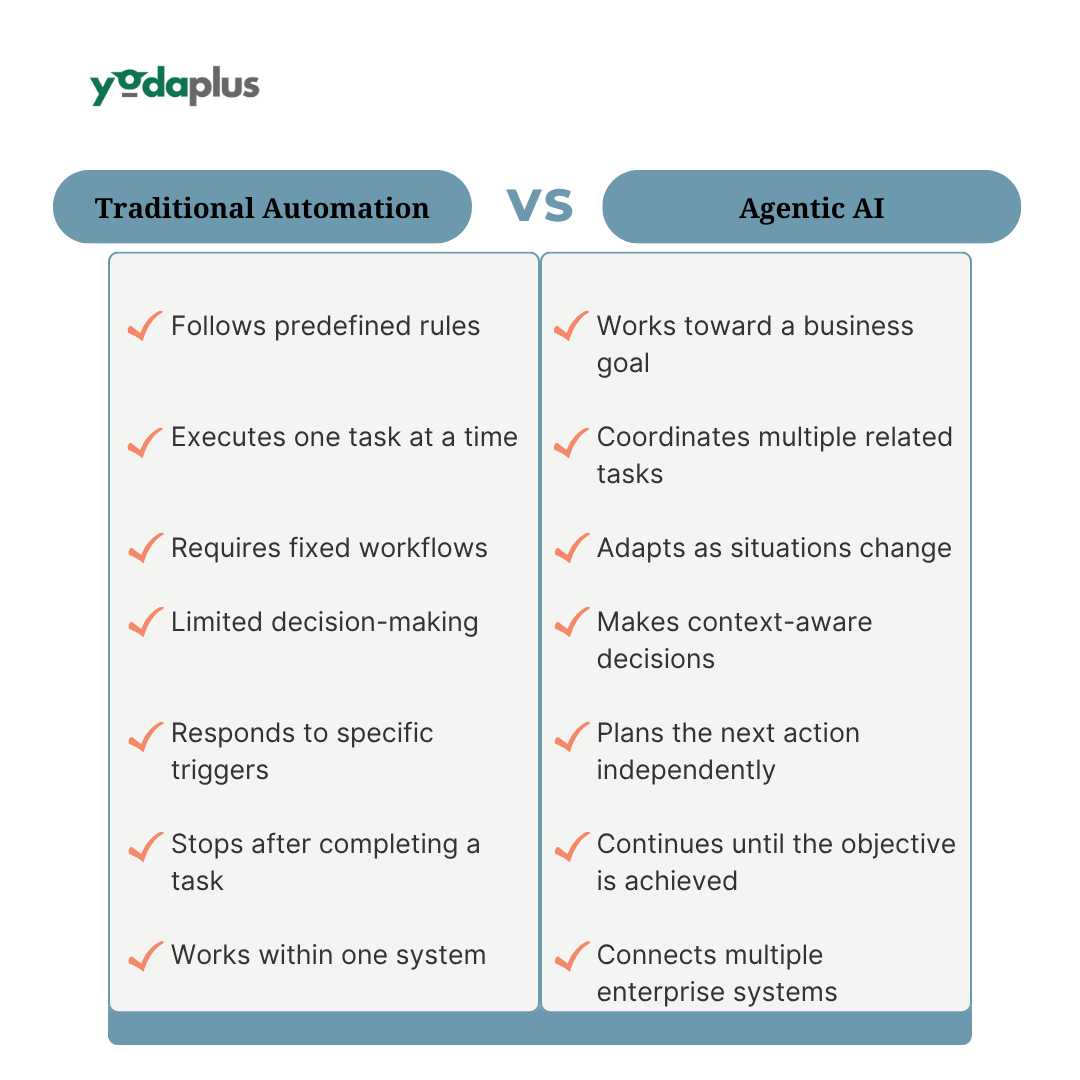
Rather than replacing automation, Agentic AI builds on it by introducing intelligence, reasoning, and adaptability into business workflows.
AI Agents Are the Building Blocks
Another defining characteristic of enterprise agentic AI is the use of specialized AI agents.
Instead of relying on one AI model to perform every activity, organizations build multiple intelligent agents, each responsible for a different business function.
For example, one agent may collect business data, another analyzes financial information, another validates compliance requirements, while another prepares reports or updates enterprise applications.
These agents collaborate throughout the workflow, sharing information and coordinating actions until the business objective has been achieved.
This approach makes systems more scalable while allowing organizations to automate increasingly complex business operations.
Agentic AI Works Across Entire Business Workflows
Traditional automation usually operates inside one application or one department.
Agentic AI works across multiple systems.
An agentic AI platform can retrieve information from ERP systems, CRM platforms, cloud applications, document repositories, APIs, databases, and collaboration tools before making decisions or executing tasks.
Instead of automating isolated activities, businesses create AI-powered workflows that connect procurement, finance, customer service, operations, compliance, and reporting into one intelligent process.
This is why enterprises increasingly view Agentic AI as a business capability rather than another software feature.
How Enterprises Are Using Agentic AI
The difference between automation and Agentic AI becomes much clearer when looking at real business operations.
Consider a finance team preparing monthly reports.
A traditional automation platform can collect data from predefined sources, populate a report template, and email it to stakeholders. If one of the data sources changes or information is missing, the workflow stops until someone manually resolves the issue.
An agentic system behaves differently.
It identifies missing information, searches approved enterprise systems for alternative data, validates the results, adjusts the workflow if necessary, and continues preparing the report. If a decision requires human approval, it escalates only that specific task before resuming the remaining work automatically.
The same principle applies across customer service, procurement, supply chains, compliance, and software development. Instead of completing isolated tasks, AI agents work toward achieving a business objective.
Why Multi-Agent AI Is Becoming the Enterprise Standard
As enterprise workflows become more complex, organizations are moving away from relying on a single AI model.
Instead, they are adopting multi-agent AI, where multiple specialized agents collaborate to complete different parts of a workflow.
For example, a procurement workflow may involve:
- A Research Agent that identifies approved suppliers.
- A Procurement Agent that creates purchase orders.
- A Compliance Agent that validates purchasing policies.
- A Finance Agent that verifies invoices.
- A Reporting Agent that prepares procurement dashboards.
Each agent performs one responsibility exceptionally well while sharing information with the others.
This modular approach makes enterprise AI systems easier to scale, maintain, and improve over time. Instead of redesigning an entire workflow, organizations can simply upgrade or replace one specialized agent.
Why Businesses Are Investing in Agentic AI
Organizations are adopting enterprise AI solutions because traditional automation can no longer keep pace with increasingly dynamic business environments.
Supply chain disruptions, changing regulations, evolving customer expectations, and growing volumes of enterprise data require systems that can reason and adapt rather than simply execute predefined instructions.
According to Deloitte’s State of Generative AI in the Enterprise report, organizations are increasingly prioritizing AI initiatives that deliver measurable operational improvements rather than isolated productivity gains. This shift is driving investment in AI workflow automation that connects multiple business functions instead of automating individual tasks.
Some of the biggest business benefits include:
- Faster decision-making
- Reduced manual work
- Greater operational efficiency
- Improved compliance
- Better use of enterprise data
- Higher employee productivity
- More scalable business operations
Rather than replacing employees, Agentic AI enables teams to focus on strategic work while intelligent systems manage repetitive operational processes.
Where Traditional Automation Still Makes Sense
Despite the rapid growth of Agentic AI, traditional automation continues to play an important role.
Processes that are repetitive, predictable, and based on fixed business rules often do not require intelligent reasoning.
Examples include:
- Sending scheduled reports
- Creating recurring invoices
- Updating routine database records
- Processing standard payroll calculations
- Generating backup files
These workflows remain well suited for conventional AI process automation because every step is clearly defined.
Agentic AI becomes valuable when workflows involve changing information, multiple systems, business decisions, or unexpected situations that require flexibility.
For many organizations, the future will involve combining traditional automation with intelligent AI agents rather than replacing one technology with the other.
The Future of Enterprise Agentic AI
Enterprise AI is moving toward systems that operate more like digital teams than software applications.
Future agentic AI platforms will coordinate multiple AI agents capable of planning projects, collaborating across departments, retrieving information from enterprise applications, monitoring business performance, and continuously optimizing workflows.
Instead of assigning dozens of individual tasks, organizations will increasingly assign business objectives.
Human employees will remain responsible for governance, approvals, strategy, and customer relationships, while intelligent agents manage routine execution across enterprise systems.
This evolution represents a major shift in how businesses think about automation, changing AI from a task-based assistant into an intelligent operational capability.
Conclusion
What makes an AI system agentic is not simply its ability to generate content or automate repetitive work. It is the ability to understand goals, reason through problems, adapt to changing situations, coordinate multiple actions, and continue working until a business objective has been achieved. Unlike traditional automation, which follows fixed rules, Agentic AI combines planning, intelligence, and execution to automate complex business operations across multiple enterprise systems.
As organizations continue investing in enterprise AI, AI-powered workflows, and multi-agent AI, intelligent agents will become an essential part of modern business operations. Companies that successfully combine traditional automation with Agentic AI will be better positioned to improve efficiency, strengthen decision-making, and respond more quickly to changing business needs.
Yodaplus Agentic AI Services help enterprises build intelligent AI systems that go beyond conventional automation. By combining autonomous AI agents, enterprise workflow orchestration, intelligent document processing, and deep integration with existing business applications, Yodaplus enables organizations to automate complex operations across finance, retail, supply chain, maritime, and other enterprise functions. The result is scalable, secure, and outcome-driven AI that delivers measurable business value.
FAQs
An AI system is considered agentic when it can understand goals, plan actions, make decisions, adapt to changing conditions, and complete multi-step tasks with minimal human intervention.
Traditional automation follows predefined rules and workflows, while Agentic AI reasons through problems, adapts to new information, and works toward achieving a business objective.
AI agents are intelligent software components designed to perform specific tasks independently, such as research, financial analysis, compliance monitoring, or reporting.
Multi-agent AI allows specialized AI agents to collaborate on complex workflows, improving scalability, flexibility, and operational efficiency.
No. Traditional automation remains effective for predictable, rule-based tasks, while Agentic AI is better suited for dynamic workflows that require reasoning and decision-making.
Financial services, retail, manufacturing, healthcare, logistics, supply chain, maritime, and customer service are among the industries benefiting most from Agentic AI.