
How Does P2P Automation Differ From Traditional Procurement Software?
July 2, 2026 By Yodaplus
Traditional procurement software helps businesses manage purchasing activities, but P2P automation goes much further by connecting procurement, finance, suppliers, approvals, invoice processing, and payments into one intelligent workflow. While procurement software primarily focuses on creating purchase requests and managing suppliers, P2P automation automates the entire purchasing lifecycle, reducing manual work, improving financial accuracy, and providing complete visibility into organizational spending.
Many businesses already have procurement software in place, yet procurement teams still spend hours following up on approvals, manually processing invoices, reconciling purchase orders, and coordinating with finance departments. Modern procure-to-pay automation addresses these challenges by automating repetitive tasks while ensuring every purchase follows company policies and financial controls.
According to Deloitte’s Global Chief Procurement Officer Survey, digital procurement continues to be one of the highest investment priorities for procurement leaders as organizations focus on improving efficiency, reducing operational costs, and building more resilient supply chains.
What Is Traditional Procurement Software?
Traditional procurement software was designed to digitize purchasing activities that were previously managed through spreadsheets, emails, and paper documents.
These systems typically help organizations:
- Create purchase requisitions
- Generate purchase orders
- Maintain supplier records
- Track procurement requests
- Monitor procurement spending
While these capabilities improve procurement visibility, many business activities still depend on manual intervention.
For example, invoices may still require manual data entry, approvals often rely on email communication, finance teams manually reconcile invoices, and supplier payments remain disconnected from procurement workflows.
As organizations grow, these manual activities become increasingly difficult to manage.
Why Traditional Procurement Software Has Limitations
Procurement software improves purchasing administration, but it usually manages procurement as an isolated business function.
Once a purchase order has been created, procurement teams often rely on finance departments to continue the remaining process manually.
Invoices must be reviewed.
Purchase orders need to be matched against supplier invoices.
Goods receipts require verification.
Payment approvals involve multiple stakeholders.
Finance teams frequently switch between ERP systems, accounting software, banking platforms, and spreadsheets to complete the procurement cycle.
These disconnected workflows create delays, increase administrative costs, and make it difficult to maintain complete visibility across procurement and finance.
How P2P Automation Changes the Process
Unlike traditional procurement software, P2P automation manages the entire purchasing lifecycle rather than individual procurement activities.
Instead of automating only purchase requests and purchase orders, P2P automation connects procurement, supplier management, finance, invoice processing, approvals, and payments into one continuous workflow.
Once a purchase request is submitted, approval workflows are triggered automatically.
Approved requests generate purchase orders without manual intervention.
Invoices are captured digitally using invoice processing automation.
The system performs three-way matching by comparing purchase orders, supplier invoices, and goods receipts.
If everything matches, invoices move directly to payment approval.
If discrepancies exist, exceptions are automatically routed to the appropriate employee for review.
Rather than moving documents between departments manually, the workflow progresses automatically until payment is completed.
Traditional Procurement Software vs P2P Automation
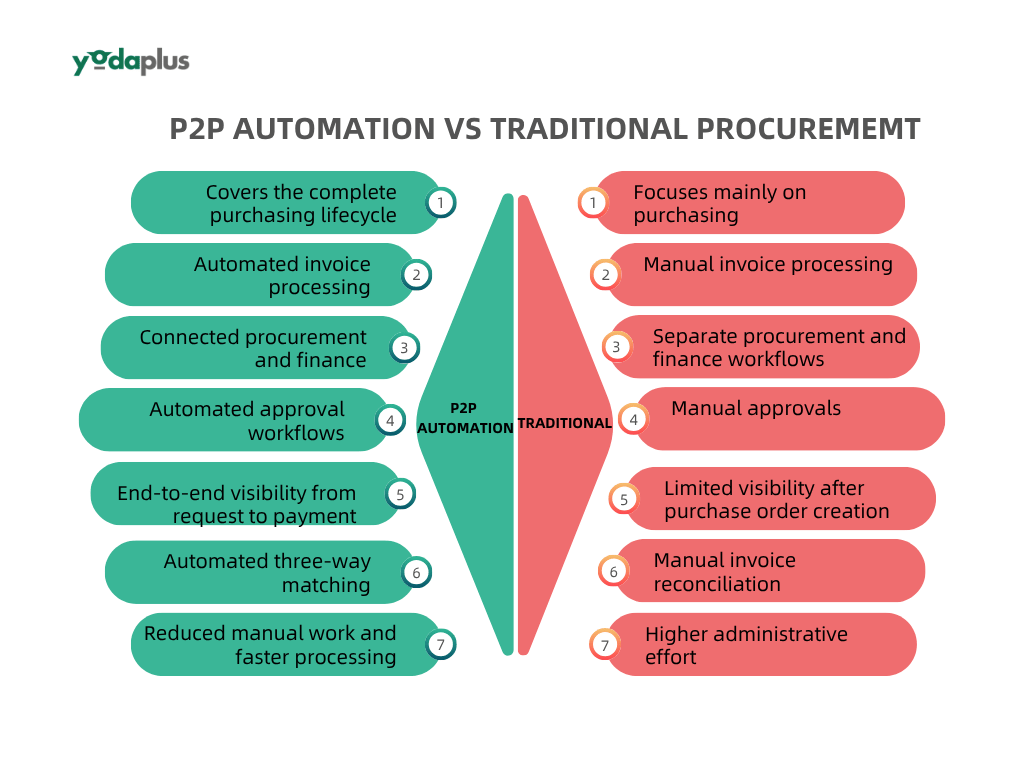
Procurement Becomes a Connected Business Process
One of the biggest differences between traditional procurement software and procure-to-pay automation is how information moves across the organization.
Traditional systems often require procurement teams, finance departments, suppliers, and managers to work independently.
P2P automation removes these handoffs by connecting everyone through one integrated workflow.
Supplier information is maintained centrally through vendor management.
New suppliers complete digital vendor onboarding.
Purchase orders are generated automatically through purchase order automation.
Invoices move through invoice automation and accounts payable automation without requiring repeated manual intervention.
Instead of multiple disconnected activities, procurement becomes one coordinated business process.
How AI Makes P2P Automation Smarter
Modern P2P automation goes beyond digitizing procurement by introducing artificial intelligence into everyday purchasing decisions. While traditional procurement software follows predefined workflows, AI helps organizations analyze information, identify exceptions, and automate decision-making.
For example, instead of manually entering invoice details into an accounting system, AI extracts supplier information, invoice numbers, payment terms, tax details, and purchase amounts automatically. The system then validates the invoice against purchase orders and goods receipts before routing it for approval.
AI can also detect duplicate invoices, identify unusual purchasing patterns, recommend preferred suppliers, and flag transactions that may require additional review. This reduces manual effort while improving procurement accuracy and financial control.
According to the Institute of Finance & Management (IOFM), organizations that automate invoice processing can reduce invoice processing costs by as much as 80% while significantly shortening invoice approval times.
Better Visibility Across Procurement and Finance
One of the biggest challenges with traditional procurement software is limited visibility once a purchase order has been created. Procurement teams often lose visibility after sending the purchase order, while finance teams work separately to process invoices and supplier payments.
P2P automation connects both departments through a shared workflow.
Every purchase request, approval, purchase order, supplier invoice, payment, and audit record is stored within one system. Managers can monitor procurement activities in real time, identify approval bottlenecks, track outstanding invoices, and analyze spending patterns across departments.
This level of visibility supports better budgeting, supplier negotiations, and financial planning while reducing the need for manual reporting.
Faster Supplier Collaboration
Supplier relationships also improve with automated Procure-to-Pay processes.
Traditional procurement often relies on email exchanges, manual document submissions, and repeated follow-ups for supplier onboarding, purchase order confirmations, and payment updates.
Modern P2P platforms simplify these interactions through digital vendor onboarding, centralized vendor management, automated purchase order notifications, and real-time payment tracking.
Suppliers receive faster responses, fewer payment delays, and better communication throughout the procurement cycle, helping businesses build stronger long-term supplier partnerships.
Why Businesses Are Replacing Traditional Procurement Software
Organizations are not replacing traditional procurement software because it no longer works. They are upgrading because business operations have become more complex.
Growing supplier networks, global sourcing, stricter compliance requirements, increasing invoice volumes, and rising customer expectations require procurement systems that do much more than manage purchase orders.
P2P automation addresses these challenges by integrating procurement, finance, and supplier management into a single connected workflow.
According to APQC, top-performing procurement organizations process purchase orders significantly faster and at a lower cost than average organizations because they standardize and automate procurement workflows rather than relying on manual processes.
For businesses looking to improve operational efficiency, automation is becoming a strategic investment rather than simply a technology upgrade.
The Future of Procure-to-Pay Automation
Procurement software is evolving from transaction management to intelligent decision support.
Future P2P platforms will combine artificial intelligence, predictive analytics, intelligent document processing, and Agentic AI to automate increasingly complex procurement activities.
Instead of simply routing approvals, procurement systems will recommend suppliers, predict inventory shortages, evaluate supplier risk, identify cost-saving opportunities, and automatically coordinate purchasing decisions across multiple business functions.
Procurement professionals will spend less time processing paperwork and more time focusing on supplier relationships, strategic sourcing, contract negotiations, and long-term business planning.
As procurement continues to become more data-driven, organizations that adopt intelligent automation will be better positioned to improve efficiency, reduce procurement costs, and build more resilient supply chains.
Conclusion
While traditional procurement software helps organizations manage purchasing activities, it often leaves procurement, finance, and supplier management operating in separate workflows. P2P automation brings these functions together into one connected process that automates approvals, purchase orders, invoice processing, three-way matching, payments, and reporting. The result is faster procurement cycles, better financial visibility, improved compliance, and stronger supplier relationships.
As businesses continue investing in digital transformation, intelligent procurement will become the standard rather than the exception. By combining automation, artificial intelligence, and integrated business workflows, organizations can reduce manual effort while making procurement faster, smarter, and more strategic.
Yodaplus Agentic AI for Supply Chain & Retail Operations helps enterprises modernize procurement through intelligent workflow automation. By combining Agentic AI, intelligent document processing, vendor management, procurement automation, invoice processing, and enterprise system integration, Yodaplus enables businesses to automate end-to-end Procure-to-Pay workflows, improve operational visibility, strengthen compliance, and build more efficient supply chain and retail operations.
FAQs
Traditional procurement software focuses mainly on purchasing activities, while P2P automation manages the entire procurement lifecycle from purchase requests to supplier payments.
Not necessarily. Many organizations extend or integrate their existing procurement software with P2P automation capabilities instead of replacing it completely.
AI automates invoice processing, identifies duplicate invoices, validates procurement data, recommends suppliers, detects anomalies, and supports faster procurement decisions.
Three-way matching compares the purchase order, supplier invoice, and goods receipt before payment is approved, helping prevent payment errors and fraud.