
Why Businesses Need Forward Deployed Engineers (And Why the Model Is More Fruitful)
October 29, 2026 By Yodaplus
Businesses are investing heavily in artificial intelligence, automation, and digital transformation. Yet implementing new technology successfully remains a challenge. Organisations may have access to advanced AI models, sophisticated software platforms, and experienced development teams, but turning these capabilities into measurable business outcomes requires more than technical expertise. This is where Forward Deployed Engineers (FDEs) are becoming increasingly valuable.
Forward Deployed Engineers work directly with customers to understand business challenges, integrate technology into existing systems, and develop solutions that function within real operational environments. Unlike traditional software development approaches that primarily focus on building standardised products, the forward deployed engineering model brings technical problem-solving closer to the people and processes using the technology.
For businesses adopting Agentic AI, enterprise automation, and complex software platforms, this approach can make implementation more practical and effective.
The growing interest in Forward Deployed Engineers reflects a broader shift in enterprise technology. Organisations increasingly want solutions that address specific operational problems, integrate with existing infrastructure, and deliver measurable value.
Understanding why businesses need Forward Deployed Engineers requires examining the challenges of enterprise technology implementation and how the FDE model addresses them.
What Is a Forward Deployed Engineer?
A forward-deployed engineer is a technical professional who works closely with customers to design, develop, integrate, and deploy software solutions within their business environments.
The role combines software engineering, systems integration, technical consulting, and business problem-solving.
An FDE must understand both the technology being implemented and the operational challenges it is expected to address.
For example, a financial institution may want to introduce an AI-powered reporting system that collects information from internal databases, analyses financial documents, and generates standardised reports.
The technical solution may appear straightforward during initial development. However, implementing it within the organisation could involve connecting legacy databases, managing data permissions, supporting existing reporting formats, and addressing compliance requirements.
A forward-deployed engineer works with the institution to understand these requirements and adapt the solution accordingly.
The objective is not simply to deliver software. It is to make the software useful within the customer’s actual operating environment.
Why Are Businesses Increasingly Looking for Forward Deployed Engineers?
Enterprise technology has become more powerful, but business environments have also become more complex.
Organisations often operate multiple applications, databases, cloud platforms, and legacy systems. These technologies may have been introduced at different times and developed by different vendors.
As a result, implementing a new enterprise solution frequently requires extensive integration and customisation.
A business may purchase an AI platform with advanced analytical capabilities but discover that its existing systems cannot easily provide the information the platform needs.
Employees may also follow operational procedures that differ from the assumptions built into the software.
These challenges can delay implementation and reduce the value of technology investments.
Forward-deployed engineers help address this problem by working directly with business teams and technical stakeholders.
They investigate the operating environment, identify integration requirements, and develop practical solutions around existing constraints.
This close collaboration helps organisations move beyond software demonstrations and focus on actual implementation.
The Problem With Traditional Enterprise Software Implementation
Traditional enterprise software development often begins with a product roadmap.
Engineering teams build features intended to serve a broad customer base. Product managers collect requirements, prioritise development activities, and coordinate releases.
This approach works well for standardised software products used by many organisations.
However, enterprise customers frequently have requirements that cannot be addressed through standard configurations alone.
A banking institution may need a reporting application to connect with proprietary financial systems. A manufacturing company may require automation software to interact with equipment management platforms. A logistics organisation may need AI applications to process information from several disconnected systems.
These requirements create additional implementation challenges.
Customers may need to communicate their problems through account managers, support teams, implementation consultants, and product specialists before reaching the engineers responsible for technical changes.
Each additional communication step can introduce delays or misunderstandings.
The forward deployed engineering model reduces some of this distance by allowing engineers to work directly with customers and understand the operational context.
This does not eliminate the need for product management or traditional engineering teams. Instead, it creates a more direct connection between enterprise requirements and technical execution.
How the Forward Deployed Engineering Model Works
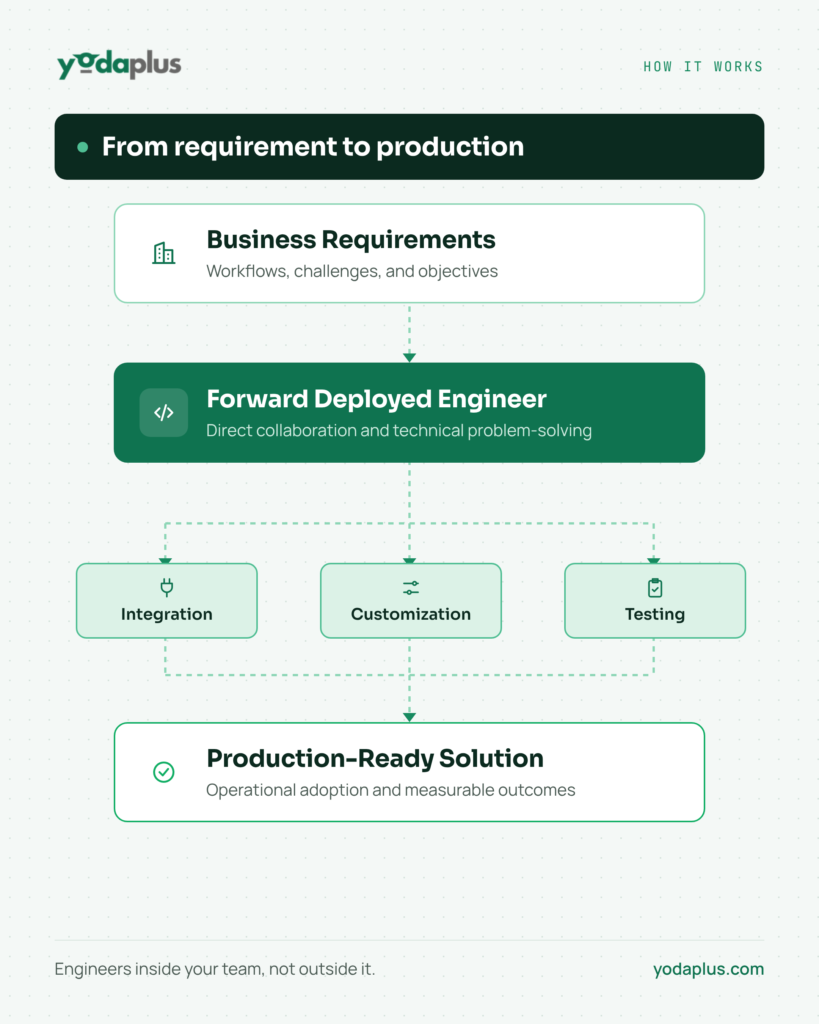
The FDE model typically begins with understanding the customer’s business problem.
Before developing a solution, Forward Deployed Engineers examine the existing workflow, available data, technical infrastructure, and expected outcomes.
For example, an organisation may want to automate the preparation of financial research reports.
The initial requirement may be described as generating reports faster.
However, further investigation could reveal that the primary challenge involves collecting information from disconnected databases, validating financial figures, and organising research outputs.
An FDE works with stakeholders to identify these underlying problems.
Once the requirements are understood, the engineer evaluates the available technology and determines how it can be integrated into the business environment.
This may involve building APIs, configuring data pipelines, developing application components, or connecting AI agents with enterprise tools.
The solution is then tested using realistic workflows.
Employees provide feedback, technical issues are addressed, and the implementation is refined.
The FDE may also help establish monitoring, documentation, and procedures for ongoing maintenance.
This iterative process allows businesses to evaluate whether the technology is solving the intended problem before expanding deployment.
Why the FDE Model Can Deliver Better Business Outcomes
The forward-deployed engineering model can be particularly effective when organisations face complex implementation requirements.
Its value comes from bringing technical expertise closer to business operations.
Rather than relying entirely on predefined product capabilities, engineers can identify the changes required to make a solution function in a particular environment.
This creates several opportunities for improved implementation outcomes.
Faster Identification of Business Problems
Technology projects sometimes begin with assumptions about what customers need.
A business may request an AI chatbot when its underlying problem is inefficient document retrieval. Another organisation may ask for an analytics dashboard when the primary issue is inconsistent data across departments.
Forward-deployed engineers investigate these requirements directly.
By working with employees and understanding operational processes, they can identify problems that may not be obvious during initial discussions.
This helps organisations focus development efforts on capabilities that address actual business needs.
It can also reduce time spent building features that have limited practical value.
Better Integration With Existing Enterprise Systems
One of the biggest challenges in enterprise technology deployment is integration.
Businesses rarely operate within a single software environment.
Financial institutions may use separate applications for treasury management, credit risk, transaction processing, reporting, and compliance.
Introducing AI into these environments requires reliable access to information and clearly defined permissions.
Forward-deployed engineers can develop integrations that connect new applications with existing infrastructure.
They may also address data formatting issues, authentication requirements, and system compatibility problems.
For example, an AI-powered financial reporting solution may need to retrieve information from SQL databases, internal APIs, spreadsheets, and document repositories.
An FDE can help establish the technical connections required to support this workflow.
The result is a solution designed around the organisation’s existing technology environment rather than an isolated application.
Reduced Communication Gaps Between Teams
Enterprise technology projects often involve business leaders, operations teams, IT departments, software vendors, and external consultants.
Each group may understand the project differently.
Business teams focus on operational outcomes, while engineering teams concentrate on technical requirements.
Forward-deployed engineers help connect these perspectives.
Because they participate in customer discussions and technical implementation, they can translate business requirements into engineering decisions.
For example, a compliance team may explain that every automated decision must have a traceable record.
An FDE can translate this requirement into technical capabilities involving activity logs, data references, and approval workflows.
This direct communication helps reduce misunderstandings and supports more effective collaboration.
More Practical AI Implementation
AI applications often perform well in controlled demonstrations but encounter difficulties in enterprise environments.
An AI model may generate accurate responses using sample documents but struggle when processing inconsistent data, outdated records, or complex operational instructions.
Forward Deployed Engineers help identify these challenges during implementation.
They can evaluate the quality of available data, develop validation procedures, and configure AI applications around realistic workflows.
For example, an AI agent designed to support transaction reconciliation may need access to multiple financial systems.
The agent must retrieve records, compare information, identify discrepancies, and provide supporting evidence.
An FDE can help integrate these activities while establishing appropriate error handling and human approval requirements.
This makes the technology more suitable for everyday business use.
Continuous Improvement Based on Real Usage
Enterprise requirements often change after a solution is introduced.
Employees may identify new operational scenarios, additional data requirements, or workflow limitations.
The forward deployed engineering model supports ongoing improvement through direct customer feedback.
Engineers can observe how the application performs, investigate recurring problems, and recommend technical changes.
For example, an AI reporting system may initially support a limited number of financial document formats.
As employees begin using it, additional document structures may need to be supported.
An FDE can help evaluate these requirements and determine how the application should be adapted.
This ongoing collaboration helps businesses refine their technology investments based on practical experience.
Why Forward Deployed Engineers Are Important for Agentic AI
Agentic AI introduces new opportunities for enterprise automation.
Unlike AI applications designed primarily to generate responses, Agentic AI systems can plan activities, interact with tools, and execute authorized steps within business workflows.
However, these capabilities also introduce implementation challenges.
An AI agent must understand its assigned objective, access the appropriate information, interact with enterprise applications, and operate within established permissions.
For example, a financial institution may want an AI agent to investigate reporting discrepancies.
The agent could retrieve records from connected systems, identify inconsistent information, and prepare a summary for review.
Implementing this workflow requires more than selecting an AI model.
The organization must establish secure integrations, workflow rules, validation procedures, and monitoring mechanisms.
Forward Deployed Engineers can help develop these components and test how the agent behaves under realistic conditions.
They can also work with business teams to determine which activities should remain subject to human approval.
This makes the FDE model particularly relevant to organizations implementing Agentic AI in regulated or operationally complex environments.
The Role of Forward Deployed Engineers in Financial Services
Financial services organizations manage large volumes of sensitive information across complex technology environments.
Banks, asset managers, investment firms, and other financial institutions frequently rely on systems that have evolved over many years.
Introducing new technology can require extensive coordination between business operations, technology teams, and compliance functions.
Forward Deployed Engineers can support financial institutions by developing integrations and adapting enterprise software to existing workflows.
In equity research, they may help connect AI-powered analysis tools with financial databases and document repositories.
In treasury operations, they may support integrations between reporting applications and internal financial systems.
In compliance workflows, they may help implement document retrieval, case management, and activity tracking capabilities.
Their contribution is particularly valuable when the organization requires a solution that combines multiple systems and business processes.
However, financial institutions must still maintain appropriate security, governance, and regulatory controls throughout implementation.
How the FDE Model Supports Faster Production Deployment
Many enterprise technology projects begin with proof-of-concept demonstrations.
These projects establish whether a technology can perform a particular task under limited conditions.
Moving into production requires additional work.
Applications must integrate with operational systems, handle realistic data volumes, support user permissions, and remain reliable during unexpected events.
Forward Deployed Engineers help address these implementation requirements.
Because they work directly with customer environments, they can identify deployment challenges early and coordinate technical improvements.
For example, an AI application may successfully generate reports during a pilot but experience difficulties when connected to multiple production databases.
An FDE can investigate integration performance, identify data inconsistencies, and help establish more reliable processing workflows.
This can reduce delays between initial experimentation and operational deployment.
However, successful production implementation also depends on infrastructure readiness, testing, security reviews, and long-term operational support.
When Is the Forward Deployed Engineering Model Most Useful?
The FDE model is particularly useful when enterprise technology must be adapted to complex business requirements.
Organizations introducing AI into existing workflows may benefit from direct engineering involvement.
The model is also relevant when implementation requires multiple integrations, specialized data processing, or significant coordination between technical and operational teams.
For example, a company adopting an AI-powered reporting platform may need to connect several internal databases, establish document processing procedures, and configure reporting outputs.
A Forward Deployed Engineer can help manage these requirements.
However, not every software implementation requires an FDE.
Organizations adopting standardized applications with straightforward configuration requirements may be adequately supported by conventional implementation teams.
The FDE model creates the greatest value when close engineering collaboration materially improves the likelihood of successful deployment.
What Makes the Forward Deployed Engineering Model More Fruitful?
The effectiveness of the FDE model comes from its focus on practical implementation.
Businesses increasingly evaluate technology investments based on measurable outcomes rather than the number of features available.
A technically sophisticated application provides limited value if employees cannot integrate it into everyday operations.
Forward Deployed Engineers help address this gap by connecting technical capabilities with business requirements.
Their involvement can improve problem identification, accelerate integration work, and support ongoing application refinement.
The model can also provide valuable feedback to product engineering teams.
When FDEs encounter recurring customer requirements, they can identify opportunities to improve the core product.
For example, if multiple customers require similar financial data integrations, the product team may develop reusable connectors.
This allows insights from individual deployments to contribute to broader product improvements.
However, organizations must avoid excessive customization that creates maintenance challenges.
A successful FDE model balances customer-specific requirements with reusable engineering practices and long-term product sustainability.
Challenges Businesses Should Consider Before Adopting the FDE Model
Although Forward Deployed Engineers can improve implementation outcomes, the model introduces its own challenges.
Hiring engineers with strong technical skills and business understanding can be difficult.
FDEs must communicate effectively with customers while maintaining the ability to develop reliable software.
The model may also require significant engineering involvement for individual customers.
If every deployment involves extensive custom development, implementation costs can increase.
Organizations must therefore establish clear responsibilities between Forward Deployed Engineers, product teams, and customer support functions.
Documentation and knowledge transfer are equally important.
A solution should not become dependent on a single engineer who understands its implementation.
Businesses should also ensure that customer-specific development follows established security, testing, and maintenance standards.
These practices help preserve the benefits of the FDE model while supporting long-term scalability.
How Businesses Can Measure the Success of Forward Deployed Engineering
Organizations should evaluate the FDE model using outcomes that reflect implementation effectiveness.
Time required to move a solution into production is one useful indicator.
Businesses can also examine integration reliability, employee adoption, workflow completion rates, and reductions in manual effort.
For AI implementations, additional measures may include output accuracy, exception rates, system availability, and the proportion of tasks requiring human intervention.
For example, a financial institution implementing AI-powered document processing could evaluate how quickly documents are processed and how often employees need to correct extracted information.
These measurements help determine whether the implementation is delivering meaningful operational improvements.
Customer satisfaction and ongoing maintenance requirements should also be considered.
The objective is to establish whether direct engineering involvement creates sustainable business value.
The Future of Forward Deployed Engineering
As organizations adopt more sophisticated AI applications, the demand for professionals who understand both software engineering and business operations may continue to grow.
Agentic AI, enterprise automation, and complex data integrations create implementation requirements that cannot always be addressed through standardized software configurations.
Forward Deployed Engineers are positioned to support these requirements because they combine technical development with practical customer collaboration.
The role may also evolve as AI-assisted development tools become more capable.
Engineers may spend less time writing routine code and more time designing workflows, evaluating system behavior, establishing integrations, and solving operational problems.
However, the long-term success of the model will depend on its ability to produce reusable solutions rather than relying entirely on customer-specific development.
Organizations that combine direct engineering collaboration with strong product architecture will be better positioned to scale enterprise AI implementations.
Conclusion
Businesses need Forward Deployed Engineers because implementing enterprise technology requires more than developing software.
Organizations must connect new applications with existing systems, understand operational requirements, address technical constraints, and ensure that solutions deliver measurable value.
The forward deployed engineering model helps bring technical expertise closer to these challenges.
By working directly with customers, FDEs can improve implementation efficiency, support enterprise integrations, and help organizations move AI applications into production.
This approach is particularly relevant for Agentic AI, where successful deployment depends on reliable data access, workflow orchestration, system integration, and human oversight.
Yodaplus supports enterprise technology transformation through AI development, intelligent automation, and integration capabilities. For organizations implementing Agentic AI in financial operations, combining these capabilities with a forward deployed engineering approach can help bridge the gap between technical potential and practical business outcomes.
FAQs
Businesses need Forward Deployed Engineers to help integrate complex software into existing systems, address customer-specific technical requirements, and ensure that technology solutions work effectively within real business environments.
The FDE model involves engineers working directly with customers to understand business problems, develop integrations, configure software, test workflows, and support deployment within the customer’s operating environment.
The FDE model helps organizations address practical AI implementation challenges involving data quality, enterprise integrations, workflow design, security requirements, and operational reliability.
A Forward Deployed Engineer typically needs software development, API integration, database management, systems architecture, problem-solving, and communication skills. Understanding the customer’s industry and business processes is also important.
Yes. Forward Deployed Engineers can help organizations address integration challenges, test applications in realistic environments, implement operational controls, and resolve technical issues that may delay production deployment.