
Why Is the Forward Deployed Engineer Role Popular at AI Companies?
October 15, 2026 By Yodaplus
The Forward Deployed Engineer (FDE) title has become popular at AI companies because enterprise AI products require more than software development. They need engineers who can work directly with customers, integrate AI into existing systems, customise workflows, and ensure the technology delivers measurable business value.
Traditional software engineers primarily focus on building products. Forward-deployed engineers work closely with customers to make those products useful within their business environments.
Companies such as Palantir Technologies helped establish the forward-deployed engineering model, while AI companies such as OpenAI have adopted customer-facing engineering roles to support enterprise AI implementations.
The growing complexity of AI applications, demand for custom integrations, and need for technical expertise during deployment have made the FDE role increasingly relevant.
Where Did the Forward Deployed Engineer Title Come From?
The term ‘forward deployed’ originated in the military, where it describes personnel positioned close to active operations rather than at headquarters.
Technology companies adopted the term to describe engineers who work closely with customers and solve problems where software is actually being used.
Palantir became particularly associated with the Forward Deployed Engineer title. Its engineers worked directly with customers to implement software, connect data systems, and develop solutions for complex operational requirements.
The model proved useful for enterprise software because customers often needed extensive technical support beyond the initial product installation.
As AI companies began selling sophisticated enterprise applications, the same approach became increasingly valuable.
Why Are AI Companies Hiring Forward Deployed Engineers?
AI products often require significant customisation before they can operate effectively within an organisation.
For example, a financial institution implementing an AI research assistant may need to connect the application with internal financial databases, research repositories, market data platforms, and compliance systems.
A standard software installation cannot address every requirement.
Forward-deployed engineers help companies solve these challenges by:
- Understanding customer requirements
- Designing AI implementation strategies
- Integrating enterprise applications
- Developing custom workflows
- Configuring AI models and agents
- Troubleshooting technical issues
- Testing AI performance
- Supporting production deployments
Their involvement helps AI companies turn general-purpose technology into practical enterprise solutions.
Enterprise AI Requires More Than an AI Model
A large language model can generate text, summarise documents, and answer questions. However, these capabilities alone do not make it suitable for enterprise operations.
Organisations need AI applications that can securely access business information, follow internal processes, and interact with existing software.
Consider a bank deploying an AI system for credit analysis.
The application may need access to customer financial records, lending policies, transaction histories, and risk assessment models.
It must also follow approval procedures and maintain audit records.
Forward Deployed Engineers connect these components and ensure the AI application operates within the bank’s technical and regulatory requirements.
This explains why enterprise AI companies increasingly value engineers who understand both software development and business implementation.
Why Traditional Software Engineering Is Not Always Enough
Traditional software engineering and forward deployed engineering share many technical skills, but their responsibilities differ.
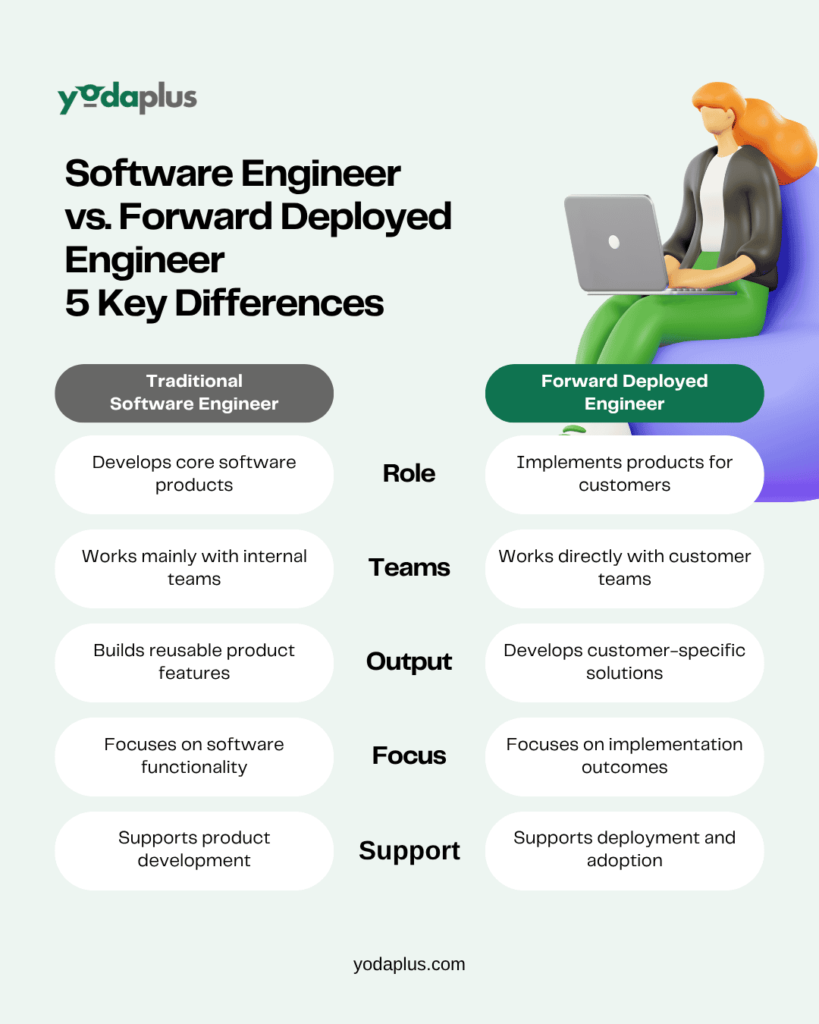
Traditional engineers remain essential for developing reliable AI products.
However, Forward Deployed Engineers address challenges that arise when those products interact with real business systems.
The two roles complement each other rather than compete.
Why Customer Proximity Matters in AI Development
One reason AI companies prefer the forward-deployed model is that customer requirements are difficult to understand through documentation alone.
Customers may describe a problem differently from how it appears within their actual workflows.
For example, a company may request an AI solution to automate financial reporting. During implementation, the FDE may discover that the real challenge involves inconsistent data formats, disconnected applications, and manual approval procedures.
By working closely with employees, Forward Deployed Engineers can identify these problems and design suitable solutions.
They also communicate implementation feedback to internal product teams, helping AI companies improve their products based on real customer needs.
The Growing Importance of Humans in the Loop
Enterprise AI applications often require human oversight, particularly when decisions involve financial, legal, or regulatory consequences.
A human-in-the-loop approach allows AI to handle routine activities while employees review important outputs.
Common examples include:
- Loan approvals
- Insurance claims
- Contract reviews
- Compliance verification
- Financial reporting
- Investment recommendations
Forward-deployed engineers help design these approval workflows.
They establish when AI can complete a task automatically, when human review is required, and how decisions should be recorded.
This becomes especially important as companies introduce Agentic AI systems capable of executing multiple actions with limited human intervention.
Data Fabric and Enterprise Integration
Another reason forward-deployed engineers are becoming important is the complexity of enterprise data.
Most organisations store information across ERP systems, CRM platforms, cloud applications, databases, and document repositories.
AI applications need reliable access to this information to generate useful results.
A data fabric architecture helps organisations discover, connect, and govern data across different environments.
Forward-deployed engineers may use data fabric principles, APIs, and integration frameworks to connect enterprise AI applications with these systems.
They also configure permissions and security controls so AI agents can access only the information required for their tasks.
What Skills Do AI Companies Expect From FDEs?
Forward-deployed engineers need a combination of technical and customer-facing capabilities.
Important technical skills include:
- Python and software development
- API integration
- Cloud computing
- Database management
- AI and machine learning
- Large language models
- System architecture
- Agentic AI frameworks
- Troubleshooting and testing
They also need business analysis, communication, stakeholder management, project management, and problem-solving skills.
An FDE must be comfortable discussing technical architecture with developers and explaining implementation decisions to business leaders.
How Forward Deployed Engineers Help AI Companies Grow
The FDE model also offers commercial advantages.
Enterprise customers are more likely to continue using AI products when implementation is successful and the technology solves meaningful business problems.
Forward-deployed engineers support this process by reducing deployment challenges, improving product adoption, and identifying additional opportunities for automation.
They can also help product teams identify common customer requirements that should become standard features.
This allows AI companies to improve their platforms while supporting customers with complex implementation needs.
However, the model must be managed carefully. Excessive customer-specific development can increase costs and make software harder to maintain.
The Future of Forward Deployed Engineering in AI
As enterprise AI applications become more capable, forward-deployed engineers are likely to work on increasingly complex implementations.
Emerging responsibilities include:
- Multi-agent AI orchestration
- Autonomous business workflows
- AI governance
- Enterprise knowledge assistants
- AI security and monitoring
- Intelligent process automation
- Large-scale enterprise integration
The role may also become more specialised, with engineers focusing on industries such as financial services, healthcare, manufacturing, and logistics.
The underlying responsibility will remain the same: ensuring AI technology works reliably within the customer’s business environment.
Conclusion
The Forward Deployed Engineer title has become popular at AI companies because enterprise AI requires close collaboration between engineering teams and customers. Building an AI product is only one part of the process. Integrating it with existing systems, configuring workflows, maintaining security, and supporting adoption are equally important.
Forward Deployed Engineers combine software engineering, enterprise integration, and business understanding to help organisations implement AI successfully.
Yodaplus Agentic AI Services helps enterprises adopt intelligent automation through secure application integrations, human-in-the-loop workflows, data fabric architectures, and enterprise AI implementation. Forward deployed engineering principles help connect these technical capabilities with practical business requirements.
FAQs
The title is becoming popular because AI companies need engineers who can work directly with customers to implement, customize, and integrate complex enterprise AI solutions.
Palantir is widely associated with popularizing the Forward Deployed Engineer role through its customer-focused software implementation model.
AI companies need FDEs to connect AI applications with enterprise systems, customize workflows, resolve technical challenges, and support successful deployment.
No. An AI engineer typically focuses on developing AI systems and applications, while a Forward Deployed Engineer focuses on implementing and adapting technology within customer environments. Some roles combine both responsibilities.
Yes. Forward Deployed Engineers generally need strong software development skills, including programming, APIs, databases, cloud technologies, and system integration.
Forward Deployed Engineers help implement Agentic AI by integrating AI agents with enterprise applications, designing automated workflows, configuring permissions, and establishing human approval controls.