
How Large Is the Gap Between AI Ambition and Deployment?
October 15, 2026 By Yodaplus
The gap between AI ambition and production deployment remains significant in 2026. Many enterprises have invested in artificial intelligence, launched pilot projects, and identified opportunities for automation. However, far fewer have successfully integrated AI into their core business operations at scale.
The challenge is not simply developing an AI model. It is making that model reliable, secure, cost-effective, and useful within existing enterprise systems.
A company might demonstrate an AI assistant that analyses financial documents in seconds. Yet deploying the same assistant across multiple departments requires data integration, access controls, governance, testing, monitoring, and employee adoption.
This difference between a successful demonstration and a dependable production system is one of the biggest challenges in enterprise AI adoption.
What Is the AI Ambition and Deployment Gap?
The AI ambition and deployment gap refers to the difference between what organisations plan to achieve with artificial intelligence and what they successfully implement in production environments.
AI ambition typically includes goals such as improving productivity, reducing operating costs, automating decisions, accelerating research, and delivering better customer experiences.
Production deployment means that an AI application is actively used in business operations, supported by reliable infrastructure, monitored for performance, and governed by appropriate security controls.
For example, developing an AI chatbot for internal testing represents experimentation. Integrating that chatbot with enterprise knowledge systems, employee permissions, and customer support workflows represents production deployment.
The distinction matters because successful pilots do not automatically translate into measurable business outcomes.
How Large Is the AI Deployment Gap in 2026?
Recent research shows that AI adoption is growing faster than enterprise-wide deployment.
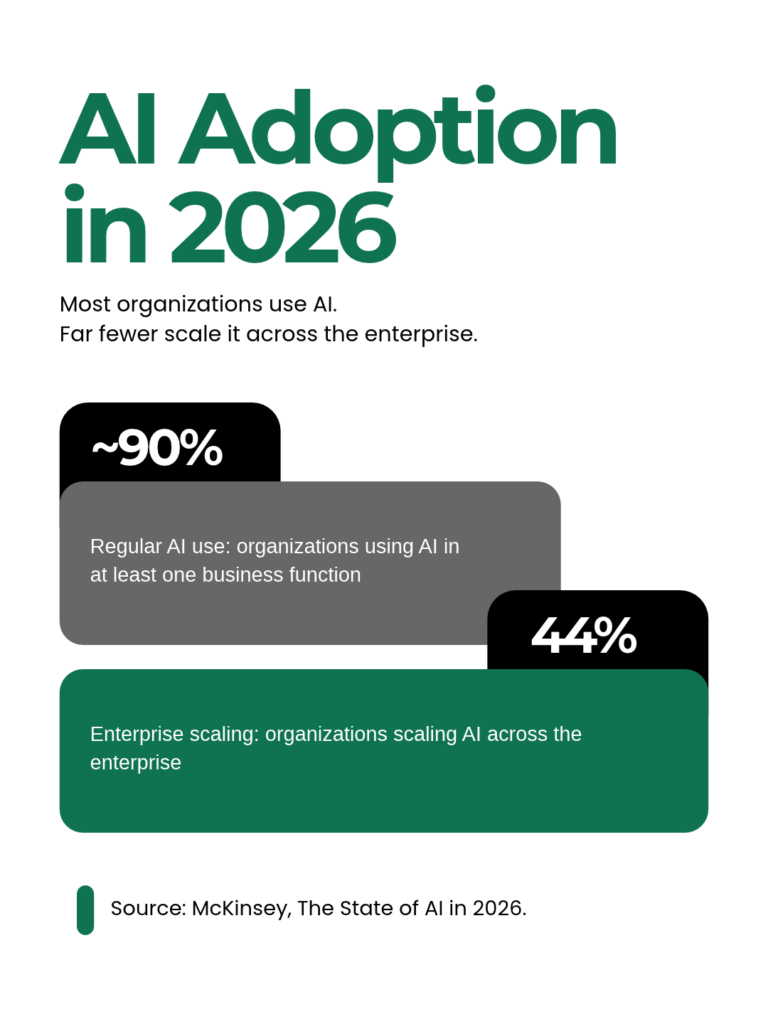
The difference is substantial. Although nearly nine in ten organisations report regular AI use, fewer than half report scaling it across the enterprise.
Deloitte’s 2026 research reveals another challenge: only 25% of surveyed organisations had moved at least 40% of their AI pilots into production.
These figures measure different stages of adoption, so they should not be interpreted as a single failure rate. However, they demonstrate that widespread experimentation does not necessarily lead to successful deployment.
Why Do AI Projects Struggle to Reach Production?
Several technical and organisational challenges prevent AI projects from progressing beyond the pilot stage.
1. Poor Data Readiness
AI applications depend on accurate, accessible, and well-structured information.
Many enterprises maintain data across disconnected databases, legacy applications, and departmental systems.
Without reliable data integration, AI models may produce incomplete or inconsistent outputs.
2. Legacy System Integration
Enterprise software was not always designed to support AI agents or real-time automation.
Connecting AI applications with ERP systems, financial platforms, and internal databases often requires custom APIs, middleware, and infrastructure changes.
3. Security and Governance
Organisations must control how AI applications access sensitive information and make decisions.
Production systems require authentication, access permissions, audit trails, privacy safeguards, and monitoring.
4. Lack of Technical Expertise
Developing an AI prototype requires different capabilities than maintaining a production application.
Enterprises need professionals experienced in software engineering, AI infrastructure, integration, security, and operational monitoring.
5. Unclear Business Value
Some organisations begin AI projects without defining measurable outcomes.
A successful demonstration may generate interest, but businesses still need evidence that the application reduces costs, improves productivity, or supports revenue growth.
Why Is Moving From AI Pilot to Production So Difficult?
A pilot typically operates in a controlled environment with limited users, selected datasets, and clearly defined tasks.
Production environments are considerably more complex.
An enterprise AI application must handle unexpected inputs, changing business requirements, system failures, and different user permissions.
For example, an AI-powered financial reporting tool may perform well when analysing a small collection of standardised documents.
However, deploying it across an investment firm may require the system to process different reporting formats, retrieve updated market information, support multiple departments, and maintain consistent accuracy.
The organisation must also establish procedures for reviewing outputs and correcting errors.
These requirements increase the time, cost, and technical complexity of deployment.
How Does AI Readiness Affect Production Deployment?
AI readiness determines how prepared an organisation is to implement artificial intelligence across its business operations.
It involves more than purchasing AI tools or hiring data scientists.
Organisations must evaluate several areas:
- Data readiness: Availability, quality, governance, and accessibility of enterprise data.
- Infrastructure readiness: Cloud environments, computing resources, APIs, and integration capabilities.
- Operational readiness: Clearly defined workflows, ownership, and implementation procedures.
- Governance readiness: Security policies, compliance requirements, and human oversight.
- Workforce readiness: Employee skills, training, and willingness to adopt AI.
- Business readiness: Defined objectives, budgets, and performance measurements.
Deloitte’s 2026 research found that 42% of surveyed companies considered their AI strategy highly prepared, while preparedness in areas such as infrastructure, data, risk, and talent lagged behind.
This suggests that strategic ambition alone is insufficient for enterprise AI implementation.
What Role Does Agentic AI Play in Closing the Gap?
Agentic AI introduces systems that can plan tasks, use tools, interact with enterprise applications, and execute workflows with varying levels of autonomy.
Unlike basic AI assistants that primarily generate responses, AI agents can support multi-step business processes.
For example, an AI agent supporting financial operations could retrieve transaction records, compare information against internal policies, identify exceptions, and prepare a report for human review.
However, Agentic AI also introduces additional deployment challenges.
Organisations must define which actions agents can perform independently, establish approval limits, monitor their behaviour, and manage access to enterprise systems.
Deloitte reported that nearly three-quarters of surveyed companies planned to deploy Agentic AI within two years, while only 21% reported mature agent governance.
This makes governance an essential part of moving Agentic AI applications into production.
How Can Enterprises Close the AI Deployment Gap?
Organisations can improve AI deployment success by following a structured implementation approach.
How Should Businesses Measure AI Production Success?
Production deployment should be evaluated through business outcomes, not merely the number of AI applications launched.
Important metrics include:
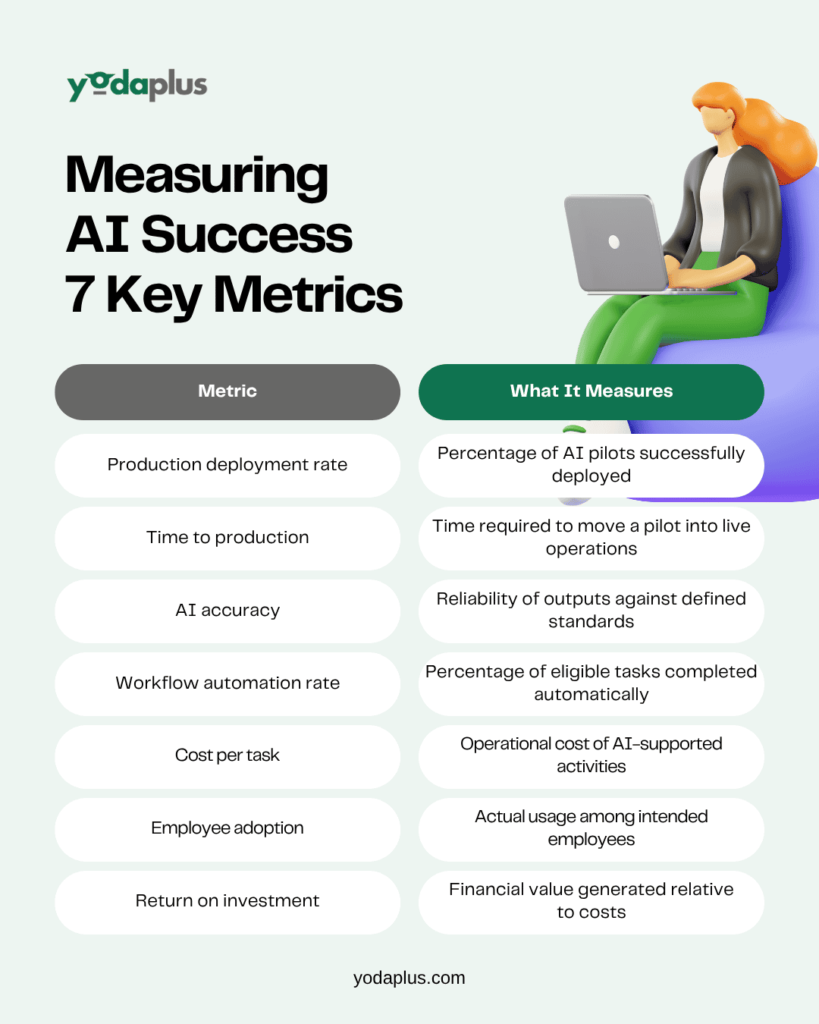
These measurements help organisations distinguish between AI experimentation and sustainable operational value.
Conclusion
The gap between AI ambition and production deployment remains considerable in 2026. Although AI adoption is widespread, many organisations still struggle to integrate AI into core operations and scale successful pilots.
Closing this gap requires more than advanced AI models. Enterprises need reliable data, connected applications, strong governance, technical expertise, and measurable business objectives.
Yodaplus Agentic AI Services helps enterprises address these implementation challenges through intelligent workflow automation, enterprise system integration, AI-powered financial analysis, and human oversight. By connecting AI capabilities with existing financial processes, organisations can build practical applications that support long-term operational efficiency.
FAQs
It is the difference between an organisation’s AI implementation goals and the AI applications successfully deployed in everyday business operations.
According to McKinsey’s 2026 survey, 44% of responding organisations report scaling AI across their enterprises.
Common reasons include poor data quality, integration challenges, security concerns, insufficient technical expertise, unclear business objectives, and limited governance.
Businesses can improve deployment by assessing AI readiness, selecting measurable use cases, establishing governance, integrating enterprise systems, and monitoring production performance.
An AI pilot tests a solution in a limited environment. Production AI operates within live business systems, supports real users, and requires ongoing security, reliability, monitoring, and maintenance.