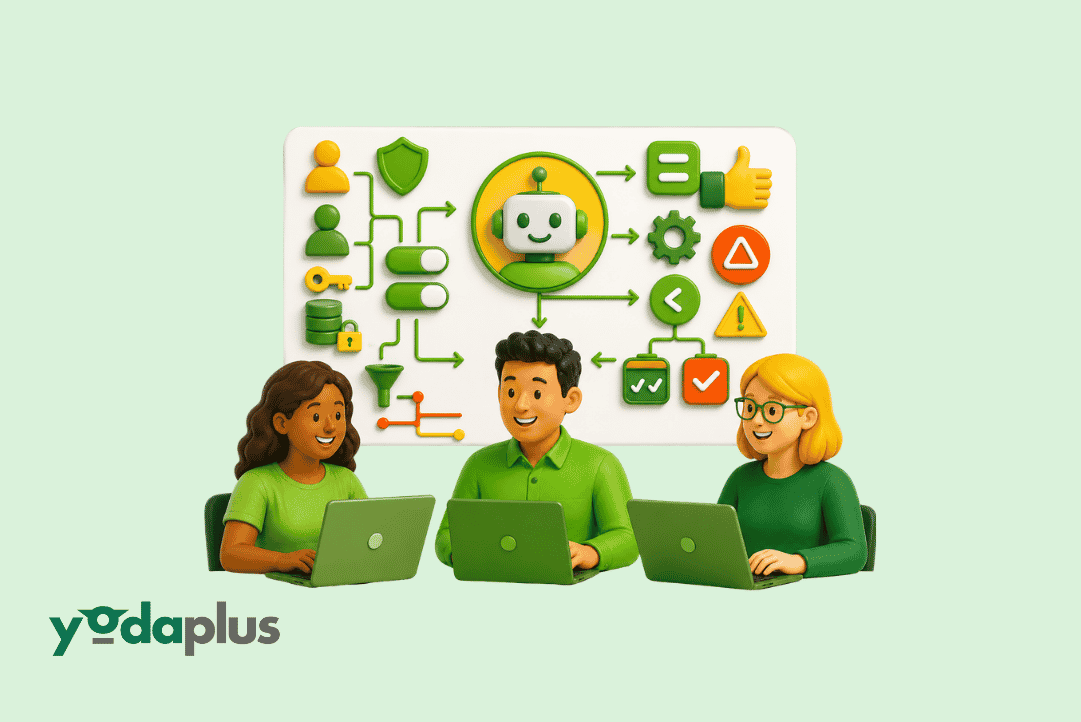
What Guardrails Prevent Agentic AI From Acting Outside Its Scope?
August 18, 2026 By Yodaplus
Giving AI agents more autonomy doesn’t mean giving them unlimited freedom. As businesses adopt Agentic AI to automate finance, procurement, customer service, and enterprise operations, one question becomes increasingly important: How do you ensure AI only performs the tasks it’s authorised to do? The answer lies in AI guardrails. These controls define what an AI agent can access, which decisions it can make, and when it must involve a human. Without them, even a well-designed AI system can create security, compliance, or operational risks.
The most successful enterprise AI deployments don’t rely on trust alone. They combine intelligent AI agents with governance, permissions, monitoring, and human oversight to ensure automation remains safe, transparent, and aligned with business objectives.
What Are AI Guardrails?
AI guardrails are the policies, rules, and technical controls that define how AI agents operate within an organisation.
They determine:
- What information an AI agent can access
- Which systems it can interact with
- What actions it is authorised to perform
- When approvals are required
- How its activities are monitored
- How decisions are recorded
Think of guardrails as the boundaries that allow AI to operate independently without exceeding its responsibilities.
Why Agentic AI Needs Guardrails
Traditional automation follows predefined instructions.
Agentic AI is different because it can analyse information, make decisions, collaborate with other AI agents, and execute workflows.
For example, an AI agent may:
- Route invoices for approval
- Generate financial reports
- Review procurement requests
- Respond to customer queries
- Schedule supplier payments
- Monitor operational performance
The more responsibility an AI agent has, the more important it becomes to define what it should and should not do.
Guardrails ensure autonomy does not become uncontrolled automation.
Define Clear Decision Boundaries
One of the most effective guardrails is deciding which tasks AI can perform independently.
Most organisations divide decisions into three categories.
Fully autonomous decisions
Suitable for repetitive, low-risk activities such as:
- Document classification
- Report generation
- Data validation
- Workflow routing
Human-assisted decisions
AI provides recommendations while people make the final decision.
Examples include:
- Budget approvals
- Procurement reviews
- Credit assessments
- Customer escalations
Human-controlled decisions
Critical business activities should always require human approval.
These include:
- Large financial transactions
- Legal agreements
- Strategic investments
- Regulatory submissions
Clearly defining these boundaries helps organisations automate confidently without increasing unnecessary risk.
Use Role-Based Access Controls
Not every AI agent should have access to every business system.
Role-based permissions ensure AI only accesses the information needed for its assigned task.
For example:
- A finance AI agent may access ERP and accounting systems but not HR records.
- A customer service AI agent can retrieve order history but not confidential financial information.
- A procurement AI agent can review supplier data but cannot approve high-value purchases independently.
Applying the principle of least privilege reduces both security risks and accidental misuse.
Build Policy-Driven Workflows
AI agents should follow the same business policies as employees.
These policies may include:
- Spending limits
- Procurement approval thresholds
- Customer privacy requirements
- Financial controls
- Compliance rules
- Internal governance policies
Instead of making unrestricted decisions, AI evaluates each action against predefined business rules before proceeding.
This makes AI workflow automation more reliable and consistent.
Keep Humans in the Loop
Human oversight remains one of the strongest safeguards in enterprise AI.
Even when AI handles routine work, people should remain responsible for high-impact decisions.
Human reviewers should be able to:
- Approve or reject AI recommendations
- Override incorrect actions
- Investigate unusual activity
- Review exceptions
- Update business rules
The objective is not to slow automation but to ensure accountability where it matters most.
Validate Inputs and Outputs
AI is only as reliable as the information it receives.
Before processing requests, AI should verify:
- Data completeness
- Required fields
- Duplicate records
- Business rule compliance
- Financial thresholds
- Customer information
Similarly, outputs should also be validated before execution.
If something falls outside expected parameters, the workflow should pause and request human review.
Secure Enterprise Integrations
AI agents often interact with multiple enterprise applications.
These may include:
- ERP systems
- CRM platforms
- Procurement software
- Banking applications
- Document management systems
- Business intelligence platforms
Every integration should include:
- Secure authentication
- Data encryption
- API security
- Access logging
- Identity verification
Strong integrations prevent AI from accessing information beyond its intended scope.
Monitor AI Continuously
Deploying AI is not the end of governance.
Businesses should continuously monitor:
- AI activity
- Workflow completion
- Decision accuracy
- Security events
- Policy violations
- Exception rates
- System performance
Continuous monitoring helps identify issues early before they affect business operations.
Maintain Complete Audit Trails
Every action performed by an AI agent should be recorded.
An audit trail should capture:
- Which AI agent performed the task
- When the action occurred
- Information used
- Business rules applied
- Human approvals
- Final outcomes
Audit trails improve transparency while supporting compliance, internal reviews, and operational accountability.
Govern Multi-Agent AI Systems
Many organisations are adopting multi-agent AI, where specialised AI agents collaborate to complete complex workflows.
For example:
- A retrieval agent collects enterprise information.
- An analysis agent evaluates the data.
- A compliance agent verifies business rules.
- An approval agent requests human review.
- An execution agent completes authorised actions.
Rather than giving one AI agent complete control, responsibilities are distributed across specialised agents with clearly defined permissions.
This significantly reduces operational risk.
Prevent AI From Drifting Over Time
Business processes change.
Policies evolve.
Regulations are updated.
Without regular reviews, AI agents may continue following outdated instructions.
Organisations should periodically review:
- Prompt instructions
- Business policies
- Approval rules
- Compliance requirements
- AI performance
- Workflow logic
Keeping AI aligned with current business requirements is an essential part of governance.
Common Mistakes Businesses Make
Many organisations weaken AI governance without realising it.
Common mistakes include:
- Giving AI excessive system permissions
- Automating high-risk processes too early
- Ignoring data quality
- Skipping audit logging
- Failing to monitor AI behaviour
- Delaying governance planning
- Not training employees
Addressing these issues early creates a much stronger foundation for enterprise AI adoption.
Best Practices for Building Effective Guardrails
To keep Agentic AI secure and reliable, organisations should:
- Define clear decision boundaries.
- Limit system access using role-based permissions.
- Build policy-driven workflows.
- Maintain human oversight for critical decisions.
- Validate inputs and outputs continuously.
- Secure every enterprise integration.
- Monitor AI performance regularly.
- Maintain detailed audit trails.
- Review governance policies frequently.
- Expand AI autonomy gradually as confidence grows.
These practices allow organisations to increase automation without compromising security or trust.
Conclusion
Agentic AI delivers the greatest value when it operates within clearly defined boundaries. Guardrails ensure AI agents can automate workflows, support employees, and improve business efficiency without exceeding their authority or creating unnecessary risk. By combining enterprise AI, AI workflow automation, human oversight, governance policies, and continuous monitoring, organisations can deploy AI systems that are both powerful and trustworthy.
Yodaplus Agentic AI Services help organisations build production-ready enterprise AI, multi-agent AI, intelligent workflow automation, governance-first AI architectures, and secure enterprise integrations. By combining autonomous AI agents with robust guardrails and industry-specific expertise, Yodaplus enables businesses to scale AI confidently while maintaining security, compliance, and operational control.
FAQs
AI guardrails are policies, permissions, governance controls, and security mechanisms that define how AI agents can access data, make decisions, and perform actions within an organisation.
Guardrails ensure AI agents operate within business policies, maintain security, comply with regulations, and avoid taking actions beyond their authorised responsibilities.
Human-in-the-loop governance allows employees to review, approve, or override AI decisions, particularly for high-risk financial, legal, or compliance-related activities.
Businesses use role-based access controls, identity management, encryption, secure APIs, and least-privilege permissions to restrict what each AI agent can access.
Yes, AI agents can independently handle repetitive, low-risk tasks. However, strategic decisions, large financial transactions, legal approvals, and regulatory activities should continue to involve human oversight.