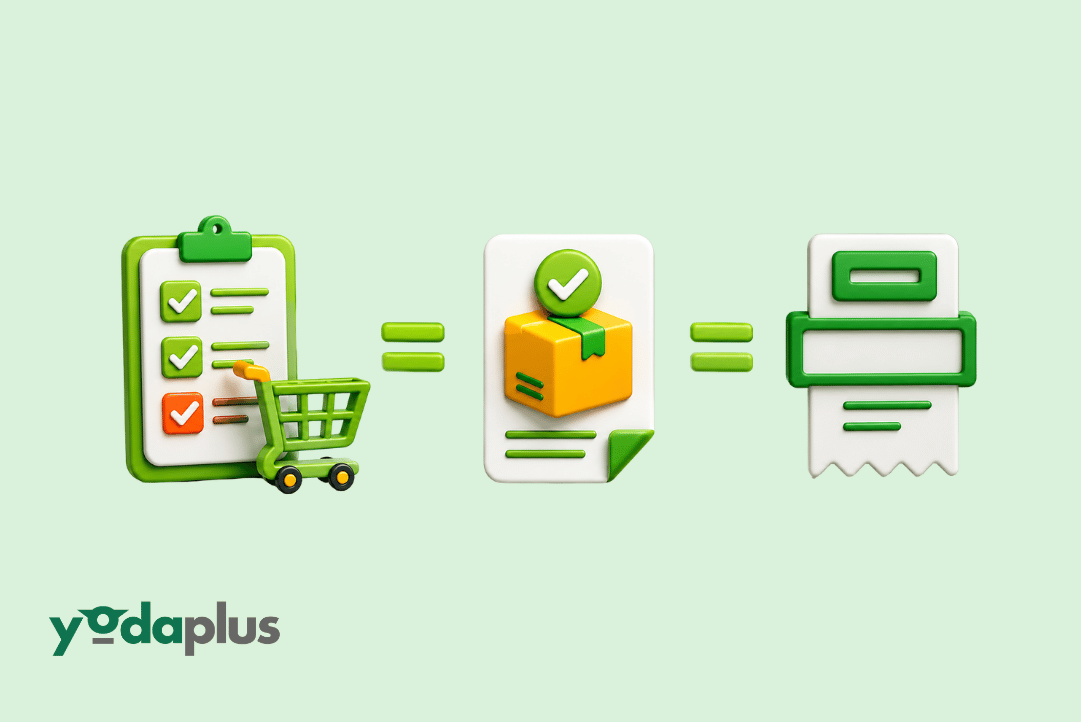
What Is Three-Way Matching in Accounts Payable Automation?
July 16, 2026 By Yodaplus
Three-way matching is an accounts payable control process that verifies a supplier invoice against the purchase order and goods receipt before payment is approved. By confirming that all three documents match, businesses can reduce payment errors, prevent duplicate or fraudulent invoices, and ensure they only pay for goods that were ordered and received.
For retailers, where thousands of purchase orders and supplier invoices are processed every month, manually comparing documents can be slow and prone to errors. Accounts payable automation simplifies this process by automatically matching documents, identifying discrepancies, and routing only exceptions for human review. This helps finance and procurement teams process invoices faster while maintaining stronger financial controls.
As retail supply chains become more complex, three-way matching has become an essential part of procurement automation, helping businesses improve operational efficiency, strengthen supplier relationships, and maintain accurate financial records.
What Is Three-Way Matching?
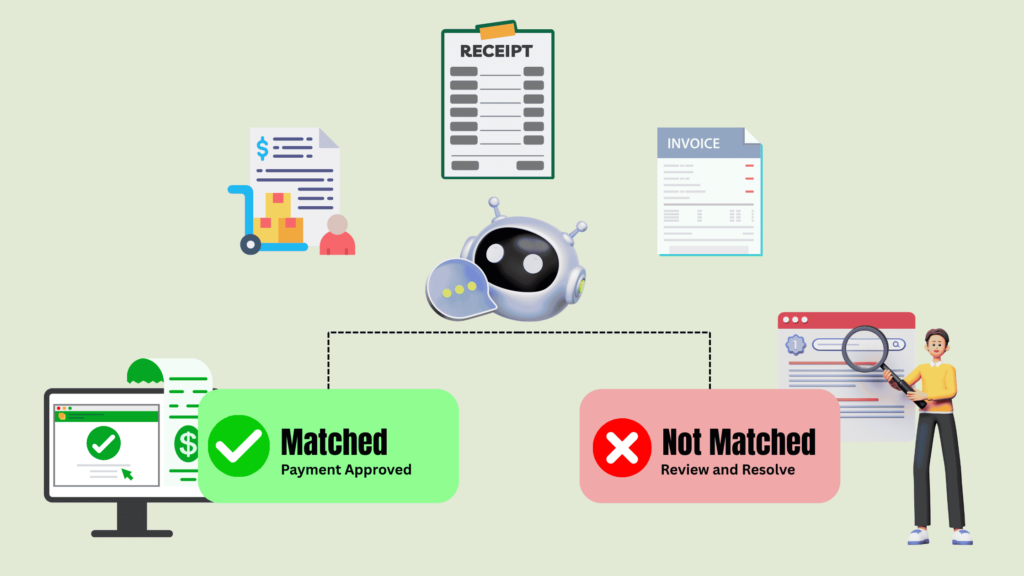
Three-way matching is a validation process used before approving supplier payments.
It compares three important procurement documents:
- Purchase Order (PO)
- Goods Receipt Note (GRN) or Receiving Report
- Supplier Invoice
Payment is approved only when the information across these documents matches according to the organization’s business rules.
If discrepancies are identified, the invoice is flagged for review before payment is released.
Why Is Three-Way Matching Important?
Every purchase made by a retailer follows a series of steps.
A purchase order is created.
The supplier delivers the goods.
The supplier then sends an invoice requesting payment.
Without proper verification, businesses may pay for products that were never ordered, never delivered, or billed incorrectly.
Three-way matching helps prevent issues such as:
- Duplicate payments
- Incorrect invoice amounts
- Unauthorized purchases
- Billing errors
- Payment fraud
- Supplier disputes
This process strengthens financial control while improving confidence in the accounts payable process.
How Does Three-Way Matching Work?
The process follows three simple verification steps.
Step 1: Purchase Order
The purchase order confirms what the retailer agreed to buy, including products, quantities, negotiated prices, and supplier details.
Step 2: Goods Receipt
When products arrive, warehouse or store teams record the quantity and condition of the goods received.
This document confirms whether the supplier delivered the expected items.
Step 3: Supplier Invoice
The supplier submits an invoice requesting payment.
The accounts payable system compares the invoice with both the purchase order and the goods receipt.
If quantities, pricing, supplier information, and other key details match within predefined tolerances, payment moves forward.
If differences are detected, the invoice is held for investigation.
Challenges of Manual Three-Way Matching
Many retailers still perform invoice matching manually.
Finance teams often compare purchase orders, receiving records, and invoices using spreadsheets, emails, printed documents, or multiple business systems.
This approach creates several challenges:
- Slow invoice processing
- Manual data entry
- Higher risk of errors
- Delayed supplier payments
- Limited visibility
- Increased administrative work
As invoice volumes increase, manual matching becomes increasingly difficult to manage efficiently.
How Accounts Payable Automation Improves Three-Way Matching
Accounts payable automation replaces manual verification with intelligent digital workflows.
Instead of comparing documents manually, the system automatically retrieves purchase orders, goods receipt records, and supplier invoices from connected business systems.
The software then validates:
- Supplier information
- Product details
- Quantities
- Unit prices
- Tax calculations
- Purchase order values
Invoices that match predefined rules are approved automatically.
Only invoices with discrepancies are routed to finance teams for review.
This significantly reduces processing time while improving accuracy and financial control.
Benefits of Automated Three-Way Matching
Automating the three-way matching process helps retailers improve both financial control and operational efficiency.
Some of the key benefits include:
- Faster invoice processing
- Fewer manual errors
- Reduced duplicate payments
- Better supplier relationships
- Improved financial accuracy
- Stronger compliance
- Greater visibility into procurement activities
- Lower administrative costs
By reducing manual verification, finance teams can focus on resolving exceptions instead of processing routine invoices.
Common Exceptions in Three-Way Matching
Not every invoice matches perfectly.
Accounts payable teams regularly encounter situations that require additional review before payment can be approved.
Some common exceptions include:
- Invoice quantity differs from the goods received
- Invoice price does not match the purchase order
- Partial deliveries
- Missing purchase orders
- Duplicate invoices
- Incorrect supplier details
- Damaged or rejected goods
- Tax calculation differences
Accounts payable automation identifies these discrepancies immediately and routes them to the appropriate teams for resolution.
This helps prevent incorrect payments while reducing delays.
How AI Improves Accounts Payable Automation
Artificial intelligence is making invoice processing faster and more intelligent.
Instead of simply comparing document fields, AI can understand invoice content, identify unusual patterns, and recommend actions based on historical transactions.
AI can help retailers:
- Extract invoice data automatically
- Identify duplicate invoices
- Detect pricing anomalies
- Validate supplier information
- Classify invoices
- Predict approval delays
- Identify potential fraud
- Prioritize exceptions
This enables finance teams to process larger invoice volumes with greater speed and accuracy.
How Agentic AI Takes Three-Way Matching Further
Traditional accounts payable automation validates documents based on predefined business rules.
Agentic AI goes beyond document matching by coordinating the complete invoice approval process.
For example, if an invoice does not match the purchase order, an Agentic AI system can:
- Retrieve the purchase order and goods receipt
- Compare supplier contracts
- Review previous transactions
- Check inventory receipts
- Notify procurement teams
- Request additional documentation
- Recommend the most appropriate resolution
- Route the invoice for approval once the issue is resolved
Instead of simply identifying problems, Agentic AI helps resolve them while reducing manual coordination between finance, procurement, warehouses, and suppliers.
Best Practices for Three-Way Matching
Retailers can maximize the value of accounts payable automation by following several best practices.
These include:
- Standardize purchase order creation
- Maintain accurate supplier records
- Capture goods receipt information promptly
- Define invoice matching tolerances
- Automate routine approvals
- Monitor exception trends
- Integrate procurement and finance systems
- Regularly review matching policies
These practices improve invoice accuracy while reducing payment delays and supplier disputes.
The Future of Accounts Payable Automation
Accounts payable is becoming increasingly intelligent.
Future AP platforms will combine:
- Artificial intelligence
- Agentic AI
- Intelligent document processing
- OCR technology
- ERP integration
- Real-time supplier collaboration
- Predictive analytics
- Automated workflow orchestration
Instead of simply matching documents, future systems will continuously monitor procurement activities, detect risks, recommend corrective actions, and optimize payment workflows across the retail supply chain.
Conclusion
Three-way matching is one of the most effective financial controls in retail procurement. By verifying purchase orders, goods receipts, and supplier invoices before payment, retailers can reduce errors, prevent duplicate payments, strengthen compliance, and improve supplier relationships. As invoice volumes continue to grow, manual verification is becoming increasingly difficult, making accounts payable automation essential for efficient financial operations.
The next generation of accounts payable combines automation, artificial intelligence, and Agentic AI to move beyond document matching and support complete invoice lifecycle management. By connecting procurement, warehouse, finance, and supplier data, retailers can accelerate approvals, improve financial visibility, and build more resilient supply chain operations.
Yodaplus Agentic AI for Supply Chain & Retail Operations helps retailers modernize procurement and accounts payable through intelligent invoice processing, automated three-way matching, ERP integration, supplier management, AI-powered exception handling, and Agentic AI-driven workflow automation. By connecting procurement, inventory, warehouse, and finance operations into a unified ecosystem, Yodaplus enables retailers to reduce costs, improve operational efficiency, and strengthen end-to-end financial control.
FAQs
Three-way matching is the process of comparing a purchase order, goods receipt, and supplier invoice before approving payment to ensure the information is accurate and consistent.
It helps retailers prevent duplicate payments, detect billing errors, reduce fraud, improve financial accuracy, and ensure they only pay for goods that were ordered and received.
Accounts payable automation automatically compares purchase orders, goods receipts, and invoices, approves matching invoices, and routes exceptions for review, reducing manual work and processing time.
AI extracts invoice data, identifies anomalies, detects duplicate invoices, validates supplier information, and prioritizes exceptions, enabling faster and more accurate invoice processing.
Yodaplus Agentic AI for Supply Chain & Retail Operations combines AI-powered invoice processing, automated three-way matching, ERP integration, supplier collaboration, and Agentic AI-driven workflow automation to help retailers improve financial control, reduce processing costs, and streamline procurement operations.