When Does Traditional Automation Outperform Agentic AI?
July 13, 2026 By Yodaplus
Agentic AI is transforming enterprise automation by enabling intelligent systems to plan tasks, make decisions, adapt to changing conditions, and coordinate complex workflows. However, that does not mean it is the best solution for every business process. Traditional automation continues to outperform Agentic AI in many situations, particularly where processes are repetitive, predictable, and governed by clear business rules. Choosing the right technology depends on the complexity of the task rather than simply adopting the newest AI solution.
Many organizations assume every workflow should be powered by artificial intelligence, but this approach often increases cost and complexity without delivering additional value. Routine activities such as data entry, scheduled report generation, invoice routing, or rule-based approvals usually benefit more from conventional automation than from autonomous AI agents. Understanding where each technology performs best allows businesses to build more efficient and cost-effective automation strategies.
According to Deloitte, organizations are increasingly adopting hybrid automation models that combine traditional automation with enterprise AI, allowing each technology to handle the processes it is best suited for.
Understanding Traditional Automation
Traditional automation follows predefined rules to complete repetitive tasks.
Every action is programmed in advance.
If a specific condition occurs, the automation performs the corresponding action.
Examples include:
- Sending approval emails
- Updating databases
- Generating scheduled reports
- Moving files between systems
- Processing routine invoices
- Triggering notifications
- Synchronizing business applications
These workflows are highly reliable because every step follows clearly defined business logic.
When the process rarely changes, traditional automation delivers consistent performance with minimal maintenance.
Why Traditional Automation Still Matters
Despite rapid advances in Agentic AI and enterprise AI, traditional automation remains an important part of digital transformation.
Not every workflow requires reasoning, planning, or adaptive decision-making.
Many operational processes are repetitive and produce the same outcome every time.
For example:
Generating payroll every month follows the same rules.
Sending purchase orders after approval follows the same workflow.
Creating daily inventory reports requires little variation.
Using autonomous AI agents for these tasks would add unnecessary complexity without improving results.
In these situations, traditional AI automation or rule-based workflows remain the more practical solution.
Situations Where Traditional Automation Performs Better
Certain business processes are especially well suited to traditional automation.
Highly Repetitive Tasks
When every transaction follows identical business rules, traditional automation is often faster and easier to maintain.
Examples include:
- Employee onboarding notifications
- Invoice routing
- Password reset workflows
- Scheduled backups
- Data synchronization
These activities require consistency rather than reasoning.
Stable Business Processes
Some workflows remain unchanged for years.
If business rules are well established and exceptions are rare, organizations gain little benefit from implementing an agentic AI platform.
Rule-based automation provides predictable performance with lower implementation costs.
High-Volume Administrative Work
Organizations often process thousands of routine transactions every day.
Examples include:
- Payroll processing
- Invoice generation
- Purchase order creation
- Document archiving
- Customer notifications
Because these tasks follow standardized procedures, traditional automation delivers high efficiency while minimizing operational costs.
Strict Regulatory Processes
Certain compliance activities require every transaction to follow identical procedures.
Examples include document retention, approval logging, audit record creation, and policy notifications.
Since these activities leave little room for autonomous decision-making, traditional automation provides greater consistency and easier compliance management.
When Agentic AI Becomes the Better Choice
Traditional automation works well when business rules rarely change. However, some workflows involve uncertainty, multiple systems, and frequent decision-making. These situations are where Agentic AI
provides significantly greater value.
For example, a customer service workflow may require gathering information from a CRM, checking inventory, reviewing previous support tickets, generating a personalized response, and scheduling a follow-up. Instead of automating each task separately, AI agents coordinate the entire process to achieve the desired outcome.
Similarly, enterprise research, supply chain planning, procurement, financial analysis, and compliance monitoring often require systems to analyze information, adapt to changing conditions, and make operational decisions. These are tasks where enterprise agentic AI can outperform traditional automation.
Hybrid Automation Is the Future
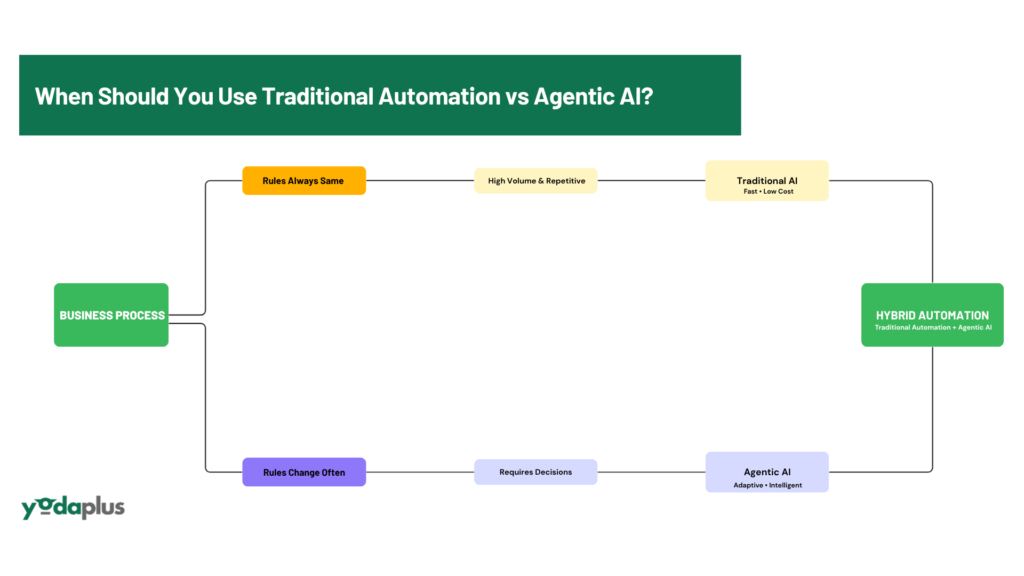
For most organizations, the best solution is not choosing between traditional automation and Agentic AI. It is combining both.
Traditional automation continues handling repetitive, rule-based activities.
Agentic AI manages workflows that require reasoning, adaptability, and coordination across multiple systems.
For example:
- Traditional automation generates invoices automatically.
- Agentic AI investigates invoices with pricing discrepancies.
- Traditional automation sends employee onboarding emails.
- Agentic AI creates personalized onboarding plans based on role, department, and training requirements.
- Traditional automation schedules reports.
- Agentic AI analyzes the reports, identifies business risks, and recommends actions.
This hybrid approach allows organizations to maximize efficiency while keeping implementation costs under control.
Choosing the Right Technology
Before introducing AI into an existing workflow, organizations should evaluate several factors.
Ask questions such as:
- Does the process always follow the same rules?
- Are exceptions rare or frequent?
- Does the workflow require judgment?
- Does it involve multiple business systems?
- Will business rules change regularly?
- Does the process benefit from learning over time?
If the answers indicate a stable and predictable workflow, traditional automation is often sufficient.
If the workflow involves changing information, multiple decisions, and dynamic business conditions, business AI or an agentic AI platform is likely to deliver greater value.
The Cost of Using the Wrong Approach
Using Agentic AI where simple automation is sufficient may increase implementation costs without improving outcomes.
Likewise, relying only on rule-based automation for complex workflows often creates bottlenecks because every possible scenario must be programmed manually.
The objective should not be to replace existing automation.
Instead, organizations should apply the right technology to the right business problem.
This balanced approach creates scalable, cost-effective automation strategies while allowing businesses to expand AI adoption gradually.
The Future of Enterprise Automation
Enterprise automation is moving toward collaborative systems where traditional automation and Agentic AI work together.
Rule-based automation will continue managing predictable operational tasks.
Autonomous AI agents will coordinate more dynamic workflows that involve planning, reasoning, and decision-making.
Over time, organizations will increasingly adopt multi-agent AI environments where multiple intelligent agents collaborate across finance, procurement, customer service, supply chain, HR, and enterprise operations.
Rather than replacing existing automation investments, Agentic AI will build on them, creating more intelligent and adaptive business processes.
Conclusion
Traditional automation and Agentic AI each play an important role in enterprise transformation. Rule-based automation remains the most effective solution for repetitive, predictable, and high-volume processes where consistency and efficiency are the primary goals. Agentic AI delivers greater value when workflows require reasoning, adaptability, cross-system coordination, and intelligent decision-making. The key is not choosing one over the other but understanding where each technology performs best.
As organizations continue investing in digital transformation, many will adopt hybrid automation strategies that combine the speed of traditional automation with the intelligence of Agentic AI. This approach enables businesses to improve operational efficiency while remaining flexible enough to handle increasingly complex workflows.
Yodaplus Agentic AI Services help organizations build intelligent automation strategies that combine artificial intelligence, Agentic AI, AI agents, AI workflow automation, enterprise AI solutions, autonomous AI agents, and multi-agent AI with existing business systems. By integrating intelligent decision-making with proven automation technologies, Yodaplus enables enterprises to automate complex workflows while maximizing efficiency, governance, and long-term business value.
FAQs
Traditional automation is better for repetitive, rule-based tasks with predictable outcomes, such as invoice routing, report generation, scheduled notifications, and data synchronization.
Yes. Many organizations use traditional automation for routine tasks and Agentic AI for workflows that require reasoning, adaptability, and cross-system coordination.
No. Many business processes are already well suited to traditional automation. Agentic AI is most valuable when workflows involve changing conditions, multiple data sources, or complex decision-making.
A hybrid automation strategy combines rule-based automation with Agentic AI, allowing each technology to manage the tasks it performs most effectively.
Yodaplus Agentic AI Services help organizations integrate intelligent AI agents, enterprise AI solutions, workflow automation, and multi-agent AI with existing business systems to automate complex operations while maintaining governance and scalability.