What Is Agentic AI in Simple Terms?
July 1, 2026 By Yodaplus
Agentic AI is artificial intelligence that doesn’t just answer questions—it gets work done. Instead of waiting for instructions at every step, it receives a goal, figures out how to achieve it, uses software tools, makes decisions within defined rules, and adapts if something changes. Rather than acting like a chatbot that responds to prompts, it behaves more like a digital teammate that can complete an entire task from start to finish.
Think of Agentic AI as giving instructions to an experienced employee instead of a search engine. If you ask it to prepare a monthly sales report, it won’t simply explain how to create one. It can gather data from multiple systems, analyze sales trends, identify unusual patterns, generate charts, prepare the report, and send it to the right stakeholders for review. The objective is to complete the work, not just provide information.
This is why businesses are moving beyond generative AI and investing in enterprise AI and AI workflow automation. According to Gartner, by 2028, at least 15% of day-to-day work decisions will be made autonomously through Agentic AI. Organizations are increasingly looking for AI systems that can execute business processes rather than simply assist with individual tasks.
Understanding Agentic AI with a Simple Example
Imagine you want to organize a business trip.
A traditional AI assistant can recommend flights if you ask it. It can also suggest hotels if you ask another question. Then you might ask it to draft an itinerary or estimate expenses.
An Agentic AI system works differently.
You simply tell it:
“Plan my three-day business trip to Singapore.”
It can then:
- Find suitable flights
- Compare hotel options
- Check your calendar
- Schedule meetings
- Book transportation
- Estimate travel costs
- Create a complete itinerary
- Share the plan with your team
Instead of waiting for multiple prompts, it continues working until the goal has been completed.
That is the simplest way to understand Agentic AI.
How Does Agentic AI Work?
Although every agentic AI platform is different, most follow the same basic process.
First, the AI understands the objective. Instead of focusing on one instruction, it identifies the final outcome the user wants.
Next, it creates a plan by breaking the objective into smaller tasks.
It then decides which software tools, databases, or applications it needs to access.
After gathering the required information, it performs each task, checks whether the results are correct, and adjusts its approach if necessary.
Finally, it delivers the completed outcome.
The process looks like this:
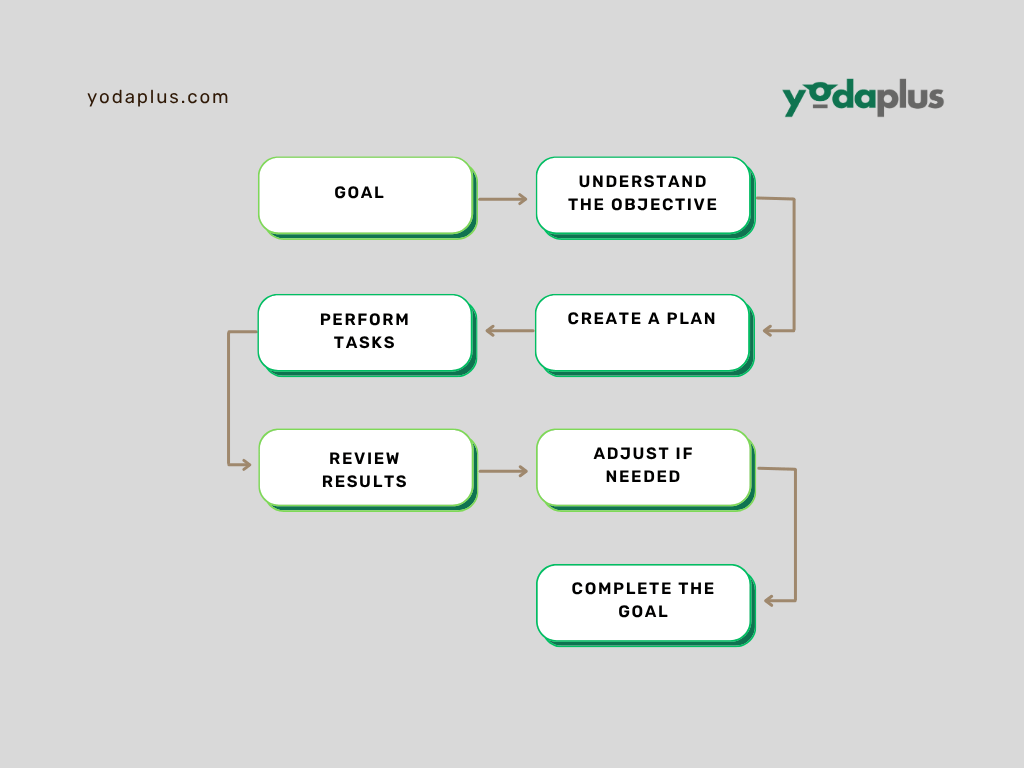
Unlike traditional automation, the system does not stop after one action. It continues until the objective has been achieved.
What Are AI Agents?
An AI agent is an intelligent software system designed to perform a specific task independently.
Instead of relying on one large AI model to handle everything, organizations often build multiple specialized agents.
For example:
- A Research Agent collects information.
- A Finance Agent analyzes numbers.
- A Compliance Agent checks regulations.
- A Reporting Agent prepares summaries.
- A Workflow Agent updates enterprise systems.
Together, these specialized agents form a multi-agent AI system that can solve much larger and more complex business problems than a single AI model working alone.
Think of them as different employees within the same company. Each has a specific responsibility, but they work together to achieve one goal.
Where Is Agentic AI Being Used?
Businesses across industries are already using Agentic AI to automate complex workflows.
Financial Services
Banks use AI process automation to review loan applications, detect fraud, reconcile transactions, prepare compliance reports, and analyze financial data more efficiently.
Retail
Retailers use AI-powered workflows to enrich product data, monitor inventory, optimize pricing, forecast demand, and coordinate supplier information across multiple systems.
Healthcare
Hospitals automate insurance verification, appointment scheduling, patient documentation, and claims processing while reducing administrative work.
Manufacturing
Manufacturers deploy autonomous AI agents to monitor production lines, predict equipment failures, optimize maintenance schedules, and improve quality control.
Customer Support
Instead of simply answering questions, AI agents verify customer information, retrieve orders, issue refunds, update CRM systems, and coordinate with logistics teams to resolve customer requests faster.
Why Are Businesses Investing in Agentic AI?
Most organizations already have ERP systems, CRM platforms, databases, emails, spreadsheets, and document repositories.
The problem is that employees spend a significant amount of time moving information between these systems manually.
Agentic AI connects them into one intelligent workflow.
According to IBM, nearly 90% of enterprise data is unstructured, including contracts, emails, PDFs, reports, manuals, and customer conversations. Agentic AI can understand this information, combine it with structured business data, and turn it into actionable insights.
Businesses are adopting enterprise AI solutions because they help:
- Reduce manual work
- Improve operational efficiency
- Speed up decision-making
- Increase accuracy
- Improve customer experiences
- Scale operations without proportional increases in staffing
Instead of replacing existing software, AI agents makes enterprise software work together more intelligently.
Does Agentic AI Replace Humans?
No.
The purpose of Agentic AI is not to eliminate employees but to eliminate repetitive work.
AI agents are excellent at gathering information, reviewing documents, updating systems, and executing routine workflows.
People remain responsible for strategic thinking, creativity, relationship management, approvals, and high-impact business decisions.
The most successful organizations use Agentic AI to support employees rather than replace them.
What Does the Future Look Like?
As businesses adopt more advanced AI automation, the role of Agentic AI will continue to expand.
Instead of automating individual tasks, organizations will automate complete business processes across finance, procurement, customer service, retail, healthcare, manufacturing, and supply chains.
Future enterprise AI systems will consist of multiple specialized AI agents working together, sharing information, and coordinating work across business applications in real time.
This shift from task automation to intelligent workflow execution is expected to become one of the biggest drivers of enterprise productivity over the next decade.
Conclusion
Agentic AI is easier to understand than it first appears. It is simply artificial intelligence that can work toward a goal instead of waiting for instructions after every step. By combining reasoning, planning, software integrations, and intelligent decision-making, AI agents can automate workflows that previously required multiple people and systems.
As organizations continue investing in enterprise AI, AI workflow automation, and multi-agent AI, Agentic AI will become an essential part of how businesses operate. Companies that adopt it early will be better positioned to improve efficiency, reduce operational costs, and deliver faster, more consistent customer experiences.
If your organization is exploring how to automate complex business processes, Yodaplus Agentic AI Services help enterprises design and deploy intelligent AI agents that integrate with existing systems, automate end-to-end workflows, and deliver measurable business outcomes across finance, retail, supply chain, and maritime operations.
FAQs
Agentic AI is artificial intelligence that can understand a goal, plan the steps needed, use software tools, and complete tasks with minimal human intervention.
No. ChatGPT is primarily a generative AI model that responds to prompts. Agentic AI can use models like ChatGPT but adds planning, decision-making, memory, and workflow execution.
AI agents are software systems that perform specific tasks independently, such as document analysis, financial reporting, research, or workflow automation.
A multi-agent AI system consists of several specialized AI agents working together to complete complex workflows more efficiently than a single AI model.
Financial services, retail, manufacturing, healthcare, logistics, insurance, maritime, and customer support are among the leading industries adopting Agentic AI.
Yes. Small businesses can use Agentic AI for customer support, sales automation, invoice processing, marketing workflows, and administrative tasks without building large AI teams.