
What Is BFSI and How the Three Sectors Work Together
July 9, 2026 By Yodaplus
BFSI stands for Banking, Financial Services, and Insurance, a broad industry that delivers financial products and services to individuals, businesses, and governments. While banking, financial services, and insurance each perform different functions, they operate as an interconnected ecosystem that supports economic activity, manages financial risk, facilitates investments, and enables secure financial transactions. As digital transformation accelerates, these sectors are becoming increasingly integrated through artificial intelligence, automation, cloud computing, blockchain, and advanced data analytics.
The BFSI industry is one of the largest contributors to the global economy. Banks facilitate payments and lending, financial service providers manage investments and capital markets, while insurance companies protect individuals and businesses against financial losses. Together, they create an ecosystem that supports economic growth while helping customers manage money, build wealth, and reduce financial risk.
According to Fortune Business Insights, the global digital banking market alone is expected to grow significantly over the coming years as financial institutions continue investing in AI, automation, and digital transformation. This reflects a broader shift across the entire BFSI sector toward technology-driven financial services.
Understanding the Three Parts of BFSI
Although often grouped together, each component of BFSI serves a distinct purpose.
Banking focuses on managing deposits, providing loans, facilitating payments, and supporting everyday financial transactions.
Financial Services includes investment management, wealth management, brokerage services, capital markets, payment solutions, financial advisory, and asset management.
Insurance helps individuals and organizations manage financial risk by providing protection against uncertain events such as accidents, property damage, health emergencies, or business losses.
Each sector specializes in different financial needs, but they frequently collaborate to deliver complete financial solutions.
How Banking Supports Financial Services
Banks form the operational foundation of much of the financial ecosystem.
They provide payment infrastructure, maintain customer accounts, facilitate lending, and manage liquidity across financial markets.
Financial service providers often rely on banking infrastructure to process transactions, settle investments, distribute financial products, and support payment services.
For example, an investment platform may use banking networks for fund transfers, while a wealth management firm depends on banking systems to facilitate client transactions.
Without banking infrastructure, many financial services would struggle to operate efficiently.
How Financial Services Connect the Ecosystem
Financial services extend beyond traditional banking by helping customers grow, manage, and allocate their financial resources.
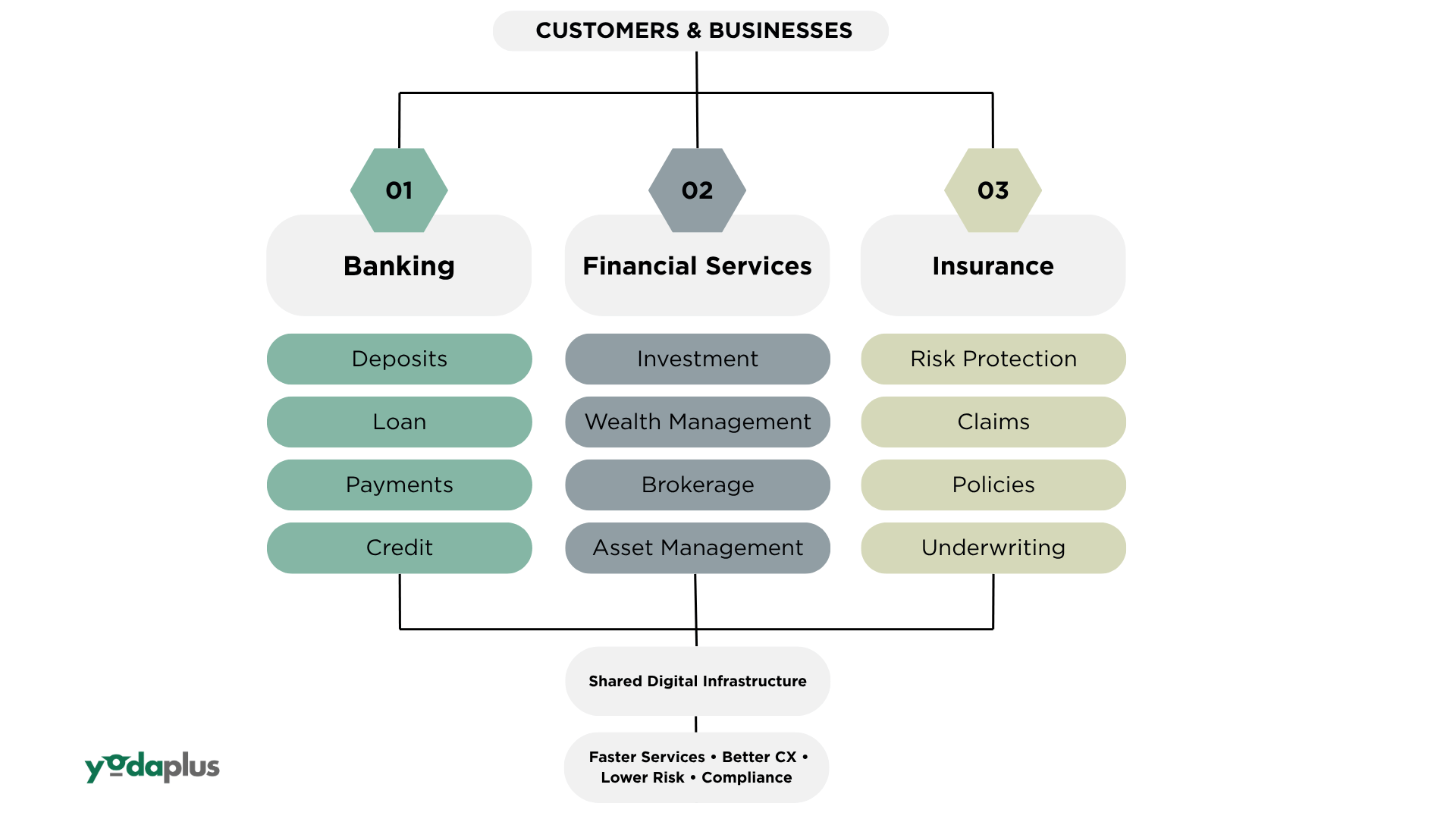
These services include:
- Investment management
- Wealth management
- Brokerage services
- Retirement planning
- Asset management
- Payment processing
- Financial advisory
Businesses also rely on financial services for capital raising, treasury management, mergers and acquisitions, and corporate financing.
Financial service providers frequently work alongside banks and insurers to deliver integrated financial solutions tailored to customer needs.
The Role of Insurance
Insurance complements banking and financial services by reducing financial uncertainty.
Individuals purchase insurance to protect health, property, vehicles, and income.
Businesses insure assets, operations, employees, and liability exposures.
Financial institutions also depend on insurance products to manage operational and financial risks.
For example, mortgage lending often requires property insurance.
Business financing may involve credit insurance.
Investment firms purchase professional liability coverage.
Rather than operating independently, insurance supports the broader financial ecosystem by improving financial resilience for both institutions and customers.
Why the Three Sectors Work Together
Although banking, financial services, and insurance have different responsibilities, customer needs frequently span all three.
Consider someone purchasing a home.
A bank provides the mortgage.
A financial advisor helps plan long-term finances.
An insurance company provides property insurance.
Each organization contributes a different service, yet together they support a single financial objective.
The same collaboration occurs in corporate banking, investment management, retirement planning, commercial lending, and wealth management.
As customer expectations evolve, financial institutions increasingly deliver integrated experiences that combine services across the BFSI ecosystem.
Technology Is Connecting BFSI More Than Ever
Traditionally, banks, financial institutions, and insurance companies often operated on separate systems with limited data sharing.
Digital transformation is changing this model.
Modern technologies enable organizations to connect customer information, automate workflows, improve compliance, and share data securely across business functions.
Today, institutions are investing in:
- Artificial intelligence
- Intelligent automation
- Cloud platforms
- Blockchain
- API-based integration
- Advanced analytics
These technologies improve collaboration while creating faster and more personalized financial services.
AI and Automation Are Transforming BFSI
Technology is reshaping how banks, financial institutions, and insurance companies operate.
Artificial intelligence helps detect fraud, automate customer service, improve credit assessment, and generate business insights.
Automation reduces manual work in areas such as loan processing, claims management, account opening, regulatory reporting, and document verification.
Cloud computing enables institutions to scale services faster, while APIs connect banking systems with payment platforms, fintech applications, and third-party providers.
Together, these technologies help BFSI organizations improve efficiency, reduce operational costs, and deliver better customer experiences.
Benefits of an Integrated BFSI Ecosystem
When banking, financial services, and insurance work together, both institutions and customers benefit.
For customers, integration creates a more seamless financial experience.
Instead of interacting with multiple disconnected organizations, customers can access a wider range of financial services through connected platforms.
For businesses, integration enables:
- Faster financial transactions
- Better customer experiences
- Improved risk management
- More accurate data sharing
- Personalized financial products
- Greater operational efficiency
By sharing data securely and automating workflows, organizations can make faster decisions while improving service quality.
Challenges Facing the BFSI Industry
Despite rapid digital transformation, the BFSI sector continues to face several challenges.
One of the biggest concerns is cybersecurity.
Financial institutions process enormous volumes of sensitive customer and transaction data, making them attractive targets for cyberattacks.
Regulatory compliance is another ongoing priority.
Banks, insurers, and financial service providers must comply with evolving regulations related to data privacy, anti-money laundering (AML), Know Your Customer (KYC), and financial reporting.
Legacy technology also presents challenges.
Many organizations continue to operate on decades-old systems that can be difficult to integrate with modern digital platforms.
In addition, customer expectations continue to evolve.
People increasingly expect instant payments, personalized financial advice, digital onboarding, and seamless experiences across every channel.
Meeting these expectations requires continuous investment in technology and innovation.
The Future of BFSI
The future of BFSI will be defined by greater collaboration between financial institutions and technology.
Artificial intelligence will support faster decision-making.
Automation will streamline operations.
Blockchain will improve transparency and settlement processes.
Open banking will enable secure data sharing between institutions and third-party providers.
Agentic AI will further transform enterprise operations by coordinating complex workflows across banking, lending, insurance, compliance, and financial reporting.
Rather than operating as separate industries, banking, financial services, and insurance will become increasingly connected through intelligent digital ecosystems.
Organizations that modernize their technology infrastructure today will be better positioned to deliver secure, efficient, and customer-centric financial services in the years ahead.
Conclusion
Banking, Financial Services, and Insurance each perform distinct roles, but together they form one of the world’s most important economic ecosystems. Banks enable transactions and lending, financial service providers support investments and wealth creation, while insurance organizations help individuals and businesses manage financial risk. As customer expectations evolve and financial operations become more complex, collaboration across these sectors is becoming essential for delivering faster, safer, and more personalized financial services.
Technology is accelerating this transformation through artificial intelligence, automation, cloud computing, blockchain, and advanced analytics. Financial institutions that embrace digital innovation can improve operational efficiency, strengthen compliance, enhance customer experiences, and remain competitive in an increasingly digital economy.
Yodaplus Agentic AI for Financial Services helps banks, fintechs, lenders, insurers, and other BFSI organizations modernize operations through AI-powered automation, intelligent document processing, blockchain solutions, enterprise integrations, and digital transformation services. By combining deep financial domain expertise with scalable technology solutions, Yodaplus enables organizations to build secure, efficient, and future-ready financial ecosystems.
FAQs
BFSI stands for Banking, Financial Services, and Insurance, a broad industry that provides banking, investment, lending, payment, wealth management, and insurance services.
These sectors work closely together to provide complete financial solutions. Customers often use services from all three sectors throughout their financial journey.
Artificial intelligence, automation, cloud computing, blockchain, APIs, and data analytics are helping institutions improve efficiency, strengthen security, automate processes, and deliver better customer experiences.
Key challenges include cybersecurity threats, regulatory compliance, legacy technology, evolving customer expectations, fraud prevention, and increasing operational complexity.
Digital transformation helps financial institutions improve operational efficiency, reduce costs, enhance customer experiences, accelerate service delivery, and remain competitive in a rapidly changing financial landscape.
Yodaplus Financial Services delivers AI-powered automation, enterprise integration, blockchain development, intelligent document processing, and digital transformation solutions that help financial institutions modernize operations while maintaining security and regulatory compliance.