What Is Agentic AI and How Enterprises Are Using It
July 1, 2026 By Yodaplus
Agentic AI is a type of artificial intelligence that can understand a goal, create a plan, make decisions, use software tools, and execute tasks with minimal human intervention. Unlike traditional AI models that simply answer questions or generate content, agentic AI actively works toward completing an objective. It reasons through problems, adapts when conditions change, collaborates with other AI agents, and continuously evaluates whether the desired outcome has been achieved. This ability to think beyond a single prompt is what makes Agentic AI one of the most significant developments in enterprise technology.
The shift comes at a time when businesses are looking beyond isolated automation projects. According to McKinsey, generative AI has the potential to contribute between $2.6 trillion and $4.4 trillion annually to the global economy. Building on these capabilities, Gartner predicts that by 2028, at least 15% of day-to-day work decisions will be made autonomously through Agentic AI, compared to almost none in 2024. Enterprises are therefore moving from experimenting with chatbots to deploying intelligent systems capable of managing complete business processes.
This evolution is changing how organizations approach AI automation, enterprise AI, and digital transformation. Rather than automating one repetitive task, businesses are deploying intelligent agents that coordinate entire workflows across finance, procurement, customer support, retail, healthcare, manufacturing, and software engineering. The result is faster execution, better decision-making, and significantly less manual effort.
This article explains what Agentic AI is, how it works, how it differs from generative AI, why enterprises are investing in it, and the real-world applications that are transforming business operations.
What Is Agentic AI?
Agentic AI refers to intelligent systems that can independently pursue an objective instead of waiting for step-by-step instructions. An agent receives a goal, determines the tasks required to achieve it, selects the right tools, executes those tasks, evaluates the results, and adjusts its approach whenever necessary. Instead of simply responding to prompts, it behaves more like a digital employee capable of completing meaningful work.
Imagine asking an AI assistant to prepare a quarterly supplier risk report. A traditional AI model may summarize a few documents if prompted. An agentic AI platform, however, would gather supplier contracts, retrieve financial statements, analyze recent news, review payment histories, calculate risk scores, compare suppliers against internal policies, generate a report, and send it for approval without requiring constant human direction.
This ability to reason and act is made possible through planning algorithms, memory, software integrations, and access to enterprise systems. Rather than replacing existing business applications, Agentic AI connects them together through intelligent orchestration, allowing organizations to automate workflows that previously required multiple teams and systems.
Why Agentic AI Is Different from Traditional AI
Traditional automation follows predefined rules. If a specific condition is met, a predefined action is triggered. This approach works well for structured processes but struggles when data is incomplete, unstructured, or constantly changing.
Generative AI represented a major leap by enabling machines to create text, images, code, and other content using natural language prompts. However, it still relies heavily on human guidance. Once it generates a response, its role typically ends.
Agentic AI extends these capabilities by adding reasoning, planning, execution, and continuous monitoring. Instead of producing an answer, it continues working until the objective has been completed. It decides what information it needs, retrieves that information, interacts with software applications, validates outputs, and determines the next action based on the latest results.
This makes Agentic AI particularly valuable for enterprise environments where tasks involve multiple departments, systems, approvals, and large volumes of structured and unstructured information.
Why Enterprises Are Investing in Agentic AI
Organizations are generating more data than ever before. Customer emails, contracts, invoices, regulatory documents, financial reports, product manuals, support tickets, and operational records all contain valuable information. According to IBM, nearly 90% of enterprise data is unstructured, making it difficult to process using traditional automation alone.
Businesses are also facing growing operational complexity. Supply chains span multiple countries, compliance requirements continue to evolve, customers expect faster responses, and employees spend considerable time switching between disconnected systems. Agentic AI addresses these challenges by connecting enterprise applications into intelligent, end-to-end workflows.
Some of the biggest drivers behind enterprise adoption include:
- Reducing operational costs through AI process automation
- Improving employee productivity by eliminating repetitive work
- Accelerating decision-making with intelligent analysis
- Enhancing customer experiences through faster service
- Strengthening compliance and audit readiness
- Scaling operations without proportional increases in headcount
As enterprises continue investing in business AI, the focus is shifting away from isolated AI tools toward coordinated systems capable of managing complete operational processes.
How an Agentic AI Platform Works
Every agentic AI platform has its own implementation, but most enterprise solutions follow a similar architecture built around planning, execution, collaboration, and continuous learning.
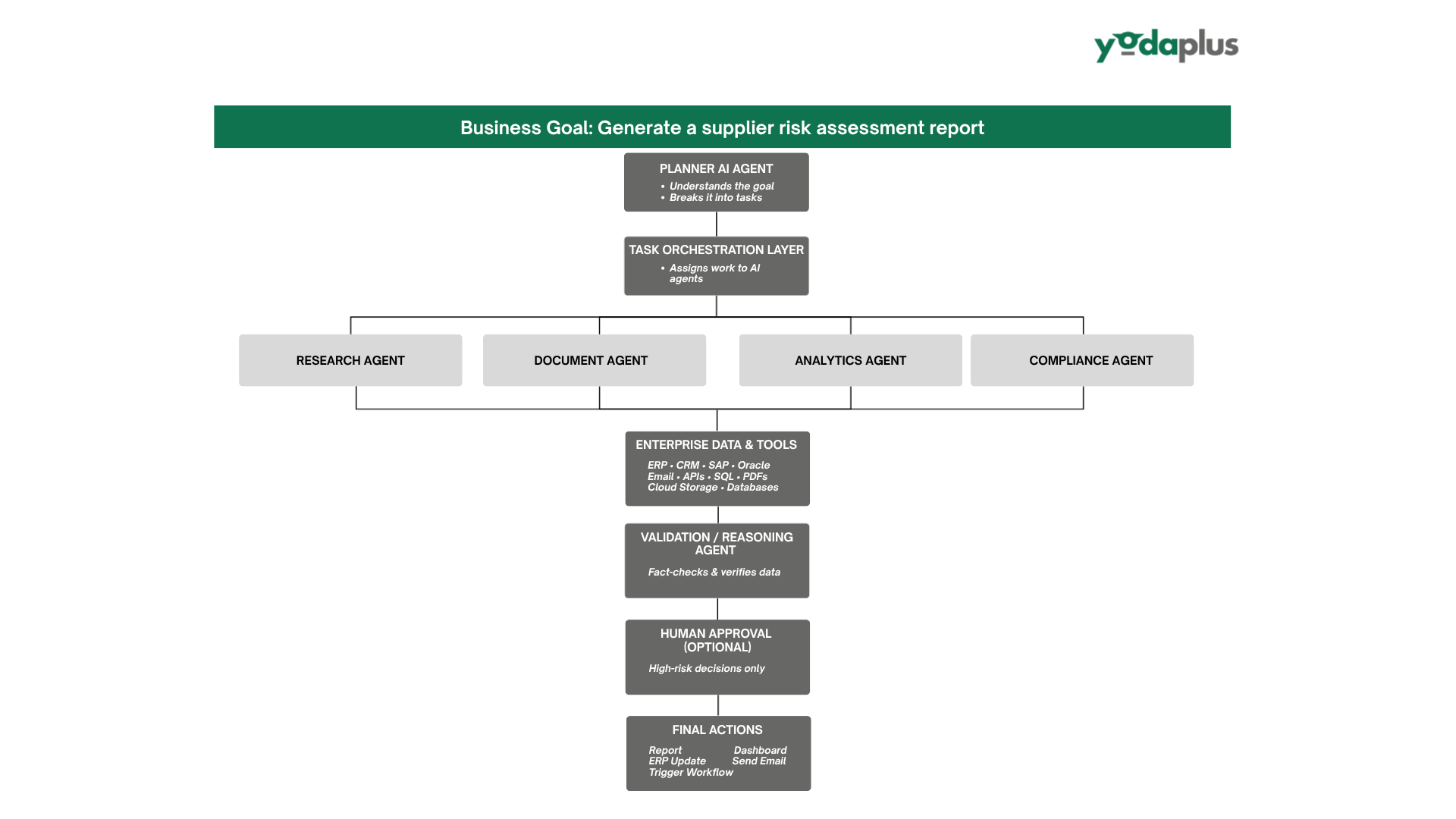
The workflow typically begins when a business user defines an objective rather than a series of individual tasks. This objective is received by a planner agent responsible for understanding the goal and breaking it into smaller executable steps.
The planner then distributes work across specialized AI agents. Each agent performs a specific responsibility such as retrieving documents, analyzing financial information, reviewing compliance requirements, interacting with enterprise software, or generating reports. Because each agent focuses on one area of expertise, organizations can build highly scalable multi-agent AI systems capable of solving much more complex business problems than a single model could manage.
These agents interact with enterprise applications through APIs and software integrations. They retrieve information from ERP systems, CRM platforms, cloud storage, databases, email services, business intelligence tools, and document repositories. Instead of moving data manually between applications, the AI coordinates every interaction automatically.
Before any final action is taken, validation agents review outputs for consistency, missing information, or policy violations. For high-risk workflows involving financial approvals or regulatory compliance, organizations often include human approval before execution. This balance between automation and governance allows enterprises to adopt Agentic AI while maintaining security, accountability, and regulatory compliance.
Enterprise Agentic AI Architecture
Let us assume we want to Generate a supplier risk assessment report. It would look something like this
Real-World Enterprise Use Cases of Agentic AI
Agentic AI is already moving beyond pilot projects into production environments. Enterprises are using AI-powered workflows to automate complex processes that previously required multiple teams, disconnected systems, and extensive manual effort. Unlike traditional AI automation, these systems can coordinate tasks across departments while adapting to changing business conditions.
Financial Services
Banks, lenders, insurance companies, and investment firms process millions of documents and transactions every day. Agentic AI helps automate activities that involve multiple validation steps, regulatory checks, and data sources.
For example, an AI agent can collect customer documents, verify identities, extract financial information, check compliance against regulatory policies, assess risk, generate reports, and notify the appropriate teams. Instead of switching between several applications, employees review completed workflows and focus on exceptions that require human judgment.
Investment firms are also using enterprise AI to automate equity research. Multiple agents can simultaneously analyze earnings reports, regulatory filings, earnings calls, news articles, analyst commentary, and macroeconomic data before generating investment insights for portfolio managers.
Retail and Supply Chain
Retailers manage thousands of products, suppliers, warehouses, and pricing updates every day. Maintaining accurate product information across multiple sales channels is both time-consuming and error-prone.
An agentic AI platform can continuously monitor supplier catalogs, identify inconsistencies, enrich missing product attributes, update pricing information, validate inventory data, and synchronize changes across ERP systems, ecommerce platforms, and marketplaces.
Large retailers are also deploying multi-agent AI for demand forecasting. Different agents monitor sales trends, seasonal patterns, promotions, weather data, and supply chain disruptions to recommend inventory decisions before stock shortages occur.
Manufacturing
Manufacturers generate massive amounts of operational data through machines, quality inspections, maintenance records, and production systems.
Instead of reacting after equipment failures occur, autonomous agents monitor sensor data, maintenance schedules, production quality, and supplier performance simultaneously. When abnormalities appear, the system recommends maintenance activities, updates production schedules, and notifies plant managers automatically.
This reduces downtime while improving operational efficiency.
Customer Service
Traditional chatbots answer questions.
Agentic AI solves problems.
Consider a customer requesting a replacement product. Rather than simply providing instructions, multiple AI agents can verify the customer’s warranty, check inventory availability, create a replacement order, update the CRM, notify logistics partners, generate shipping labels, and send tracking information without requiring manual coordination between departments.
The result is faster resolution times and a significantly better customer experience.
Healthcare
Healthcare organizations process patient records, insurance claims, laboratory reports, appointment scheduling, and compliance documentation every day.
Agentic AI can coordinate these workflows by extracting clinical information, validating insurance coverage, scheduling appointments, generating documentation, and ensuring regulatory compliance before healthcare professionals review the final recommendations.
Medical staff spend less time completing administrative work and more time caring for patients.
Maritime and Logistics
Shipping companies operate in highly regulated environments where crews must constantly reference technical manuals, safety procedures, vessel documentation, inspection records, and international regulations.
Instead of manually searching through thousands of pages, Agentic AI enables crew members to ask questions in natural language while specialized agents retrieve relevant procedures, verify regulatory requirements, summarize technical documents, and provide source citations within seconds.
This improves operational efficiency while reducing compliance risks.
Benefits of Enterprise Agentic AI
The biggest advantage of enterprise agentic AI is that it automates complete business processes rather than isolated activities. Instead of saving a few minutes on one task, organizations redesign entire workflows around intelligent decision-making.
Some of the most significant benefits include:
Higher productivity: Employees spend less time gathering information, updating multiple systems, or coordinating repetitive work between teams.
Faster decision-making: AI agents retrieve information from multiple enterprise systems simultaneously, allowing organizations to respond much more quickly to operational challenges.
Lower operational costs: By automating repetitive administrative work, businesses reduce manual effort while improving overall efficiency.
Better accuracy: Validation agents continuously check outputs before actions are completed, reducing errors caused by manual processing.
Scalable operations: Organizations can process significantly larger workloads without increasing headcount at the same rate.
Improved customer experiences: Faster workflows lead to quicker response times, more accurate information, and better service quality.
Challenges of Implementing Agentic AI
Although the benefits are substantial, successful implementation requires careful planning.
The first challenge is data quality. AI agents can only make reliable decisions when enterprise data is accurate, complete, and well-governed. Poor-quality data often leads to incorrect recommendations regardless of how advanced the AI system is.
Security is equally important. Agentic AI interacts directly with business applications, making role-based access controls, encryption, audit trails, and identity management essential.
Organizations must also establish governance policies that clearly define what AI agents can and cannot do independently. High-risk financial approvals, regulatory filings, and legal decisions should continue to include human oversight.
Another important consideration is explainability. Enterprise users need to understand why an AI agent made a recommendation, especially in regulated industries where decisions may be audited.
The most successful organizations combine intelligent automation with strong governance instead of removing humans entirely from critical workflows.
The Future of Enterprise Agentic AI
The next evolution of artificial intelligence is not a single model becoming smarter. It is networks of specialized AI agents collaborating across entire organizations.
Future enterprises are expected to operate with digital workforces that continuously monitor business operations, identify opportunities, execute routine tasks, and collaborate with employees in real time.
Instead of asking employees to navigate dozens of software applications every day, organizations will increasingly assign business objectives to intelligent agents capable of coordinating work across finance, procurement, operations, customer service, compliance, and supply chains.
As generative AI, AI workflow automation, and multi-agent AI continue to mature, enterprises will shift from task automation to autonomous business operations where AI supports every stage of the workflow while keeping humans in control of strategic decisions.
Conclusion
Agentic AI represents the next stage of enterprise automation. Unlike traditional AI systems that generate content or automate individual tasks, agentic AI can understand business objectives, create execution plans, collaborate with specialized AI agents, interact with enterprise applications, validate results, and complete end-to-end workflows with minimal supervision.
This shift is transforming how organizations approach enterprise AI, allowing businesses to automate complex operations while improving productivity, accuracy, compliance, and customer experiences. From finance and retail to manufacturing, healthcare, logistics, and maritime operations, enterprises are increasingly adopting AI-powered workflows that combine reasoning, planning, and execution into a single intelligent system.
At Yodaplus, we help enterprises move beyond isolated automation by building secure, scalable Agentic AI solutions tailored to real business challenges. Our services combine intelligent document processing, workflow orchestration, enterprise system integrations, and multi-agent architectures to automate financial operations, retail processes, supply chain workflows, maritime documentation, and other mission-critical business functions. Whether you’re looking to modernize legacy operations or build a future-ready AI strategy, Yodaplus delivers enterprise-grade Agentic AI solutions that drive measurable business outcomes.
FAQs
Agentic AI is a type of artificial intelligence that can understand goals, plan tasks, make decisions, interact with software systems, and complete workflows with minimal human intervention.
Generative AI creates content such as text, images, and code. Agentic AI uses reasoning and planning to execute complete business processes and achieve defined objectives.
AI agents are specialized software systems that perform specific tasks such as research, document analysis, reporting, compliance monitoring, or workflow execution while collaborating with other agents when needed.
A multi-agent AI system consists of multiple specialized AI agents working together to solve complex business problems that would be difficult for a single model to handle independently.
Financial services, banking, retail, manufacturing, healthcare, logistics, insurance, maritime, and customer service are among the industries seeing the fastest adoption.
No. Agentic AI is designed to automate repetitive and operational tasks while enabling employees to focus on strategic decisions, innovation, and customer relationships.
An enterprise Agentic AI platform typically combines large language models, workflow orchestration, retrieval systems, APIs, enterprise software integrations, vector databases, memory, planning engines, and governance controls.
Organizations should focus on high-quality data, secure integrations, governance policies, human oversight, measurable business objectives, and scalable architecture to ensure successful deployment.