
Key Challenges Facing the BFSI Sector in 2026
September 17, 2026 By Yodaplus
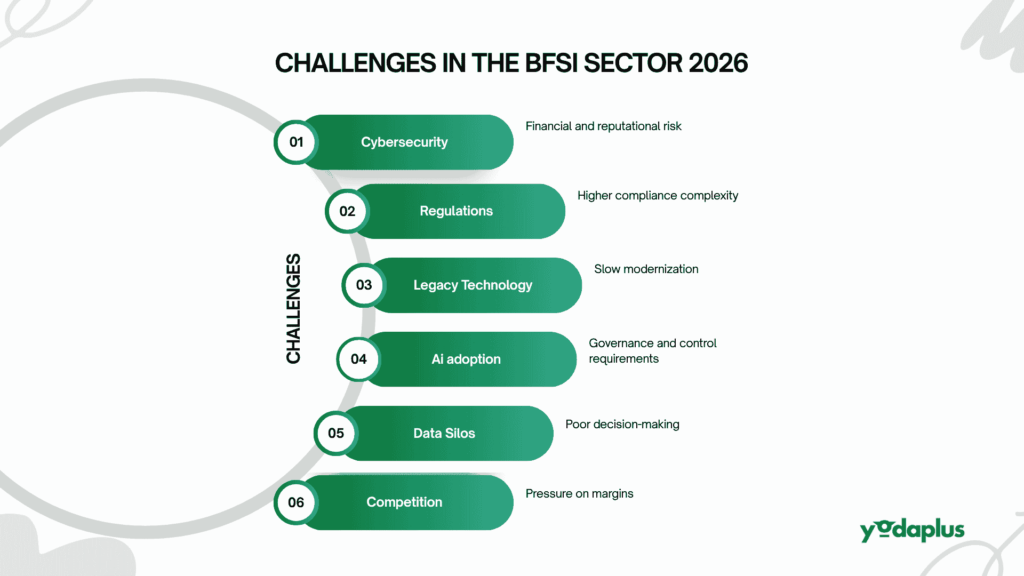
The BFSI sector’s biggest challenge in 2026 isn’t a single crisis. It’s that fraud, legacy technology, compliance, and talent gaps are all straining at once, and most institutions are trying to fix each one separately instead of treating them as one connected problem. Picus Security’s Blue Report 2026 found BFSI’s cyber prevention effectiveness actually fell nine points this year, from 76% to 67%, not because attackers got smarter overnight, but because defences that looked solid months ago quietly drifted out of tune underneath.
That drift is the theme running through nearly every challenge below: things that were working fine a year ago are wearing thin, and the sector is running faster just to hold its position.
Fraud Is Getting Harder to Catch, Not Just More Frequent
Fraud tactics have moved well past stolen card numbers. Voice cloning and synthetic identities, built from a mix of real and fabricated data, are now common enough that banks can no longer rely on the same detection rules that worked even two years ago.
This is one area where artificial intelligence is genuinely pulling its weight. AI agents built for fraud monitoring can flag unusual patterns in real time, something static, rule-based systems were never designed to keep pace with. But the tools on the fraud side are only half the equation. Consumer trust hasn’t caught up, and that gap creates its own friction.
Legacy Infrastructure Is Still the Quiet Tax on Everything
A lot of what looks like a “new” 2026 problem is really an old problem finally showing up in a new place. Core banking systems built decades ago weren’t designed for real-time data, and every AI or automation initiative layered on top of them inherits that limitation.
This shows up constantly in finance automation efforts. A team wants to automate reconciliation or speed up reporting, and the project stalls not because the AI doesn’t work, but because the underlying data is fragmented across systems that were never meant to talk to each other. Reconciliation automation and payment automation both depend on clean, connected data, and legacy infrastructure is usually the actual bottleneck, not the technology meant to fix it.
Trust in AI Hasn’t Caught Up With Adoption
Institutions are moving faster on AI in banking than customers are ready for. Surveys consistently show people are comfortable with AI catching fraud in the background but far more hesitant about AI-driven recommendations or virtual assistants making decisions that touch their money directly.
This isn’t a reason to slow down enterprise AI adoption. It’s a reason to be deliberate about where autonomous AI agents operate with full independence and where a person still needs to be in the loop, particularly for anything customer-facing.
Compliance Keeps Expanding Faster Than Teams Can Absorb It
Regulatory demands aren’t shrinking. KYC requirements, ESG disclosure expectations, and cross-border employment rules for institutions expanding into new regions are all adding up, and most compliance teams are handling this growth with the same headcount they had two years ago.
Individually, each new requirement looks manageable. Together, they create exactly the kind of ambiguity that leads to audit findings and reputational risk down the line. This is precisely where AI process automation earns its keep, not by replacing compliance judgement, but by handling the document review and monitoring volume that used to eat most of a team’s week.
Talent Gaps Are Slowing Execution, Not Just Strategy
BFSI hiring is strong on paper, but talent shortages in AI-relevant skills, digital operations, and regulatory expertise are genuinely slowing how fast institutions can execute on their own roadmaps. A good strategy sitting behind a hiring bottleneck delivers nothing.
This is pushing more institutions toward AI-powered workflows that don’t require a large specialised team to run day to day. A well-built agentic AI platform can absorb a meaningful share of the operational load that would otherwise require hiring, buying time while the talent market catches up.
Where AI Automation Is Actually Closing These Gaps
Despite all of this, 2026 isn’t a story of BFSI falling behind. It’s a story of institutions figuring out which problems AI automation can genuinely solve versus which ones still need a person.
Intelligent document processing is handling the KYC and onboarding paperwork that used to take days. Generative AI is drafting first-pass investment research and equity research reports for analysts to review rather than write from scratch. Banking automation is compressing loan decisions that used to take a week into hours. None of this replaces judgement. It removes the manual grind sitting in front of it.
Best Practices for Navigating These Challenges
- Treat fraud detection and customer trust as one connected problem, not two separate initiatives
- Fix the underlying data fragmentation before layering more automation on top of legacy systems
- Keep humans in the loop for any customer-facing AI decision, even as backend automation scales
- Use AI process automation specifically to absorb rising compliance volume, not to replace compliance judgement
- Deploy an agentic AI platform where talent gaps are the real constraint on execution speed
- Reassess cybersecurity controls continuously rather than assuming last year’s posture still holds
- Apply intelligent document processing to the highest-volume paperwork first, like KYC and onboarding
- Let generative AI draft investment research and reports, with analysts reviewing before anything goes out
- Prioritise reconciliation automation and payment automation where manual error is the costliest
- Revisit AI governance quarterly, since both regulation and threat tactics are moving quickly
Future Outlook
Expect the institutions that pull ahead in 2026 to be the ones treating these challenges as connected rather than separate line items on different teams’ roadmaps. Fraud, legacy infrastructure, trust, compliance, and talent all feed into each other, and fixing one without touching the others tends to just relocate the problem rather than solve it.
Conclusion
BFSI’s challenges in 2026 aren’t new in kind, but they’re compounding in a way that rewards institutions treating fraud, technology, compliance, and talent as one system rather than four separate fires.
Yodaplus helps BFSI institutions build enterprise AI solutions that address this directly, combining AI agents, intelligent document processing, and secure enterprise integrations within a governance-first architecture, so automation closes these gaps instead of quietly adding a new one.
FAQs
No single challenge stands alone. Fraud, legacy infrastructure, compliance growth, and talent shortages are all straining at the same time, and institutions treating them as one connected problem are managing better than those fixing each in isolation.
Picus Security’s Blue Report 2026 found BFSI’s prevention effectiveness fell from 76% to 67%, largely because defences that looked strong months earlier drifted out of tune as threat tactics and infrastructure shifted underneath them.
Consumers are generally comfortable with AI catching fraud in the background but far more hesitant about AI making direct recommendations or decisions involving their money, creating a gap between how fast institutions adopt AI and how ready customers are to trust it.
AI process automation is absorbing the growing volume of document review and monitoring work compliance teams face, freeing staff to focus on judgment calls rather than manual paperwork, without replacing compliance decision-making itself.
Yes. Many AI and automation initiatives stall not because the technology fails, but because the underlying data sits fragmented across legacy systems never designed to share information in real time.