
How Agentic AI Is Transforming Banking Operations
August 11, 2026 By Yodaplus
Banks are adopting Agentic AI to automate complex workflows, not just answer customer questions. Unlike traditional AI assistants, AI agents can analyse documents, retrieve information from multiple systems, coordinate tasks, trigger workflows, and escalate exceptions when needed. The result is faster operations, lower manual effort, and better customer service. According to EY India, 74% of financial institutions have already started Generative AI proof-of-concept projects, 42% are allocating dedicated AI budgets, and banking operations could see productivity gains of up to 46% by 2030.
The biggest opportunity isn’t replacing bankers. It’s removing repetitive work so employees can spend more time serving customers, managing risk, and making better decisions.
Why Banks Are Moving Beyond Traditional Automation
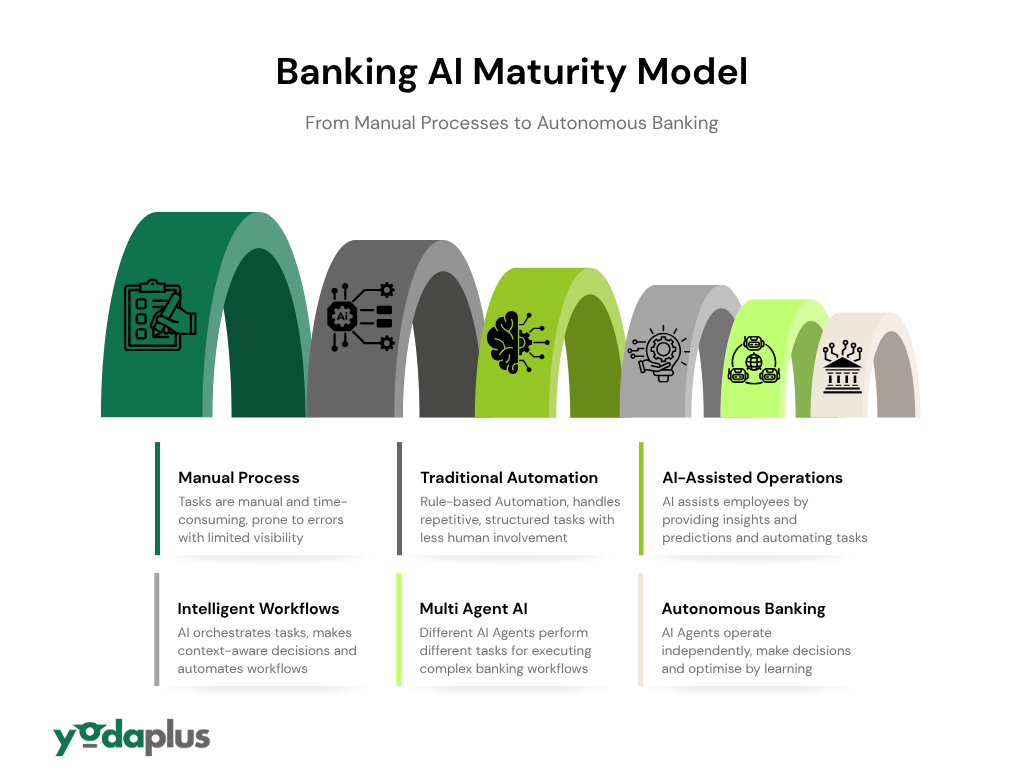
Banks have invested in automation for years through rule-based systems and robotic process automation (RPA).
These technologies work well for repetitive tasks, but they struggle when workflows involve:
- Multiple business systems
- Unstructured documents
- Changing regulations
- Human judgement
- Exception handling
- Context-aware decisions
Agentic AI fills this gap by allowing AI agents to reason, plan, execute actions, and collaborate across enterprise systems instead of following fixed rules.
What Makes Agentic AI Different?
Traditional AI usually performs one task at a time.
Agentic AI can complete an entire workflow.
For example, instead of simply extracting information from a loan application, an AI agent can:
- Read customer documents
- Validate identity
- Check internal policies
- Retrieve credit history
- Calculate risk
- Prepare recommendations
- Send the application for approval
This reduces manual handoffs and shortens processing times.
Customer Onboarding Becomes Faster
Opening an account often requires multiple verification steps.
Agentic AI can automate:
- Identity verification
- Document validation
- KYC checks
- Address verification
- Risk screening
- Customer communication
Instead of employees manually reviewing every document, AI agents complete routine verification while escalating exceptions.
According to Capgemini, customer onboarding is among the top use cases for AI agents in banking, with many financial institutions prioritising it alongside customer service and fraud detection.
Smarter Fraud Detection
Fraud teams review thousands of alerts every day.
Many alerts turn out to be false positives.
Agentic AI helps by:
- Monitoring transactions continuously
- Analysing behavioural patterns
- Retrieving historical activity
- Comparing multiple risk signals
- Prioritising high-risk cases
Instead of replacing fraud analysts, AI helps them investigate the most important cases first.
Faster Loan Processing
Loan approvals involve numerous manual checks.
AI agents can automate:
- Income verification
- Document analysis
- Credit assessment
- Risk scoring
- Compliance validation
- Report generation
Employees continue making final lending decisions while AI accelerates preparation work.
Better Compliance Monitoring
Regulatory compliance consumes significant operational resources.
Agentic AI can assist with:
- Policy monitoring
- Regulatory reporting
- Audit preparation
- AML reviews
- Transaction monitoring
- Internal documentation
This reduces administrative effort while improving consistency.
Investment Research and Financial Analysis
Analysts spend hours collecting information from:
- Annual reports
- Earnings calls
- Market news
- Financial statements
- Industry research
AI agents can retrieve, summarise, compare, and organise this information before analysts begin their work.
Instead of replacing research teams, Agentic AI allows them to spend more time interpreting data and developing investment insights.
Customer Service That Goes Beyond Chatbots
Most banking chatbots answer predefined questions.
Agentic AI goes further.
It can:
- Retrieve customer information
- Update account details
- Check application status
- Schedule follow-ups
- Trigger workflows
- Escalate complex cases
Customers receive faster responses without switching between multiple departments.
Treasury and Financial Operations
Treasury teams manage:
- Liquidity
- Cash positions
- Payments
- Reconciliations
- Financial reporting
Agentic AI helps automate:
- Cash forecasting
- Reconciliation
- Treasury reporting
- Exception handling
- Workflow approvals
This improves visibility while reducing repetitive work.
Document Intelligence
Banks process millions of documents every year.
Examples include:
- Loan applications
- Customer forms
- Contracts
- Financial reports
- Compliance documents
- Insurance records
AI agents can:
- Extract information
- Validate documents
- Compare records
- Generate summaries
- Route approvals
This significantly reduces manual document processing.
Human Oversight Remains Essential
Agentic AI does not eliminate the need for human expertise.
Banks still rely on employees for:
- Credit approvals
- Investment advice
- Risk management
- Regulatory decisions
- Exception handling
- Customer relationships
The goal is to automate repetitive work while keeping people responsible for high-value decisions.
Challenges Banks Must Address
Before scaling Agentic AI, financial institutions should address:
- Data quality
- Legacy systems
- Cybersecurity
- Regulatory compliance
- AI governance
- Employee training
- Model monitoring
- Enterprise integration
Successful implementations begin with strong governance rather than large-scale automation.
Best Practices for Banks
Banks adopting Agentic AI should:
- Start with one high-impact workflow.
- Build cross-functional implementation teams.
- Integrate AI with existing banking systems.
- Maintain human approval for critical decisions.
- Measure business outcomes rather than AI usage.
- Strengthen governance and security.
- Train employees alongside deployment.
- Scale gradually after successful pilots.
- Continuously monitor AI performance.
- Improve data quality before automation.
What’s Next for Banking?
Banks are moving from isolated AI tools to connected AI ecosystems where specialised agents collaborate across departments. Relationship managers, compliance officers, operations teams, and analysts will increasingly work alongside AI agents that retrieve information, execute routine tasks, and coordinate workflows. McKinsey describes this as a shift from AI as a productivity tool to a new operating model for banking, particularly in customer-facing and operational functions.
Conclusion
The next generation of banking is not about replacing employees with AI—it’s about giving them intelligent digital teammates. Agentic AI helps banks automate customer onboarding, fraud detection, lending, compliance, financial reporting, and document processing while maintaining governance and human oversight. Financial institutions that start with focused, high-value use cases and scale strategically will be best positioned to improve efficiency, customer experience, and operational resilience.
Yodaplus Agentic AI for Financial Operations helps banks, insurers, FinTech companies, and financial institutions automate complex workflows through intelligent AI agents, document intelligence, regulatory reporting, investment research, enterprise integrations, and secure workflow orchestration. By combining Agentic AI, AI workflow automation, and enterprise-grade governance, Yodaplus enables financial organisations to modernise operations while maintaining compliance and control.
FAQs
Agentic AI uses intelligent AI agents that can analyse information, make context-aware decisions, execute workflows, and collaborate across banking systems with minimal human intervention.
Customer onboarding, KYC verification, fraud detection, loan processing, compliance monitoring, financial reporting, treasury operations, and investment research are among the most common use cases.
No. It automates repetitive and time-consuming tasks while allowing employees to focus on customer relationships, complex decisions, compliance, and strategic work.
AI agents can retrieve customer information, resolve requests, trigger workflows, update records, and escalate complex issues, providing faster and more personalised service.
Banks should focus on data quality, enterprise integrations, cybersecurity, governance, regulatory compliance, employee training, and starting with high-impact pilot projects before scaling AI across the organisation.