
Types of Capital Markets: Primary vs Secondary Markets
November 16, 2026 By Yodaplus
Capital markets play an important role in connecting businesses and governments that need funding with investors looking for opportunities to grow their wealth. They help organizations raise long-term capital, support investment activities, and contribute to economic development.
However, not every transaction in the capital market serves the same purpose.
Some transactions involve companies issuing securities to investors for the first time. Others involve investors buying and selling securities that have already been issued.
These activities take place in two major types of capital markets: the primary market and the secondary market.
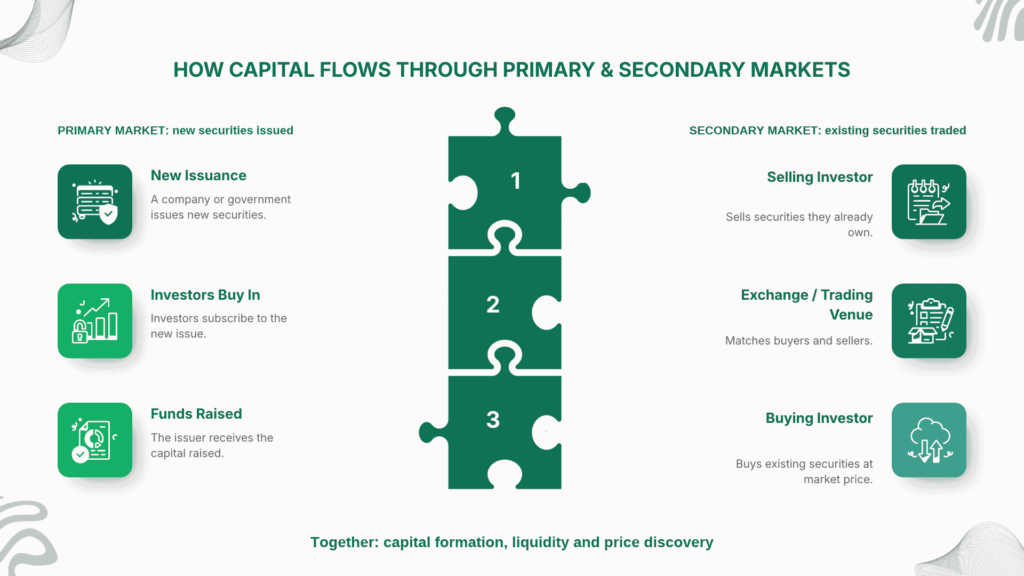
The primary market allows companies and governments to raise capital by issuing new securities. The secondary market allows investors to trade existing securities with one another.
Both markets are essential to the financial system. While the primary market supports capital formation, the secondary market provides liquidity, facilitates price discovery, and enables continued investment activity.
Understanding how these markets operate helps investors, financial analysts, and businesses make better financial decisions.
What Are Capital Markets?
Capital markets are financial markets where businesses, governments, and other institutions raise and invest long-term funds through financial instruments such as stocks and bonds.
They connect entities that require capital with investors who have funds available for investment.
For example, a company planning to expand its operations may need significant funding. Instead of relying entirely on bank loans, it may issue shares or bonds to raise money from investors.
Investors purchase these securities based on their financial objectives, risk tolerance, and expectations about future returns.
Capital markets support this exchange of funds and provide the infrastructure required for securities issuance, trading, settlement, and ownership.
The two major types of capital markets are the primary market and the secondary market.
Although they perform different functions, they operate together to support capital formation and investment.
What Is the Primary Market?
The primary market is the part of the capital market where new securities are issued and sold to investors.
Its main purpose is to help companies, governments, and other issuers raise funds.
When a company issues shares for the first time through an Initial Public Offering (IPO), the transaction takes place in the primary market.
Similarly, when a government issues new bonds to raise funds, those securities enter the market through a primary issuance.
The money raised through the sale of newly issued securities generally goes to the issuer, after applicable expenses.
For example, a company may issue new shares to raise ₹500 crore for business expansion.
Investors subscribe to the offering, and the company receives the proceeds from the newly issued shares.
The company can then use the funds for purposes such as infrastructure development, research, acquisitions, or debt repayment.
The primary market therefore plays a direct role in helping organizations access capital.
How Does the Primary Market Work?
The primary market follows a structured issuance process.
A company or government first determines how much capital it needs and which financial instruments it intends to issue.
For companies issuing shares, this process may involve appointing investment bankers, preparing financial disclosures, obtaining regulatory approvals, and determining an appropriate offering structure.
The issuer then makes the securities available to eligible investors.
Depending on the offering, investors may subscribe at a fixed price or participate in a book-building process.
Once the offering is completed, the securities are allotted according to the applicable rules.
For example, a company conducting an IPO may offer shares to institutional investors, retail investors, and other eligible participants.
After allotment, the shares may be listed on a stock exchange, allowing investors to trade them in the secondary market.
The primary market establishes the initial distribution of newly issued securities.
Types of Primary Market Issuances
The primary market includes several methods through which organizations raise capital.
Initial Public Offering (IPO)
An Initial Public Offering occurs when a company offers shares to the public for the first time and becomes publicly listed.
Companies may conduct IPOs to raise capital, support business expansion, improve access to funding, or provide liquidity to existing shareholders.
An IPO may include newly issued shares, shares sold by existing shareholders, or both. Only the fresh issue portion directly raises capital for the company.
Follow-on Public Offering (FPO)
A Follow-on Public Offering occurs when an already listed company offers additional shares to the public.
Companies may use an FPO to raise funds for expansion, reduce debt, or strengthen their financial position.
As with an IPO, an offering may involve new shares or the sale of existing shareholders’ holdings.
Rights Issue
A rights issue allows a company to offer additional shares to its existing shareholders, usually in proportion to their current ownership.
Shareholders may choose to subscribe according to the terms of the offering.
This method helps companies raise additional equity capital while giving existing investors an opportunity to maintain their ownership percentage.
Private Placement
Private placement involves issuing securities to a selected group of investors rather than offering them broadly to the public.
These investors may include financial institutions, investment funds, and other eligible participants.
Private placements are commonly used when issuers want to raise capital from a defined investor group.
What Is the Secondary Market?
The secondary market is where investors buy and sell securities that have already been issued.
Unlike a primary issuance, a typical secondary market transaction does not provide new capital to the company that originally issued the securities.
Instead, ownership transfers between investors.
For example, suppose an investor purchases shares of a listed company through the National Stock Exchange (NSE).
The investor buys those shares from another market participant who is willing to sell them.
The company does not receive the purchase amount from this transaction.
The secondary market allows investors to adjust their portfolios, respond to market developments, and convert securities into cash when buyers are available.
It also supports continuous price discovery through trading activity.
How Does the Secondary Market Work?
Secondary market transactions generally take place through organized exchanges or over-the-counter arrangements.
In exchange-based trading, investors place buy and sell orders through authorized brokers or trading platforms.
Orders are matched according to the exchange’s trading rules.
Once a trade is executed, clearing and settlement processes facilitate the transfer of securities and funds between the relevant parties.
For example, an investor may purchase 100 shares of a listed company at the prevailing market price.
The transaction is completed through the trading infrastructure, and ownership is transferred according to the applicable settlement process.
Prices change as market participants respond to financial performance, economic conditions, company announcements, interest rates, and expectations about future developments.
This continuous trading activity makes the secondary market an important source of market information.
Types of Secondary Markets
Secondary market trading can occur through different market structures.
Stock Exchanges
Stock exchanges provide organized platforms where eligible securities can be traded under established rules.
Examples include the National Stock Exchange (NSE), Bombay Stock Exchange (BSE), New York Stock Exchange (NYSE), and Nasdaq.
These exchanges provide trading infrastructure and support market transparency.
Over-the-Counter (OTC) Markets
Over-the-counter markets involve securities transactions arranged through dealer networks or negotiated directly between counterparties rather than through a centralized exchange order book.
OTC trading is common in several bond and derivatives markets.
The level of transparency, liquidity, and standardization can vary depending on the instrument and market structure.
Primary Market vs Secondary Market: Key Differences
The most important distinction between the primary and secondary markets is the purpose of the transaction.
The primary market supports the issuance of securities and capital raising.
The secondary market supports the trading of securities that investors already own.
In the primary market, the issuer plays a central role in offering securities to investors.
In the secondary market, investors generally transact with other investors or market intermediaries.
Pricing also works differently.
For primary issuances, the offering price may be determined through fixed pricing, book building, auctions, or other issuance mechanisms.
In secondary markets, prices are continuously influenced by trading activity, market conditions, and investor expectations.
Another important difference involves liquidity.
Primary market investors may need to wait until securities become eligible for trading before they can sell their holdings.
Secondary markets provide opportunities to buy and sell eligible securities, although liquidity is not guaranteed.
Despite these differences, both markets are closely connected.
Why Is the Primary Market Important?
The primary market helps organizations access funding for long-term activities.
Companies may require capital to develop products, build facilities, enter new markets, or acquire other businesses.
Governments may issue securities to finance public expenditure and manage borrowing requirements.
By allowing investors to purchase newly issued securities, the primary market connects available savings with funding needs.
It also supports broader participation in investment opportunities.
For example, an IPO allows eligible public investors to participate in a company’s ownership, subject to the offering terms.
The primary market therefore contributes to capital formation and the financing of economic activity.
Why Is the Secondary Market Important?
The secondary market provides liquidity and supports the ongoing valuation of securities.
Without opportunities to sell investments, investors may be less willing to purchase newly issued securities.
Secondary markets help address this concern by providing trading mechanisms through which ownership can change.
They also contribute to price discovery.
When investors buy and sell shares based on financial information and market expectations, trading activity helps establish observable market prices.
These prices provide useful information to investors, analysts, and companies.
Secondary market activity also supports portfolio management.
Investors can adjust their holdings based on investment objectives, risk exposure, and changing financial conditions.
However, market liquidity varies, and investors may not always be able to sell securities quickly at their preferred prices.
How Primary and Secondary Markets Work Together
The primary and secondary markets are interconnected parts of the capital market ecosystem.
Consider a company that wants to raise capital through an IPO.
The company issues new shares in the primary market, allowing investors to subscribe to the offering.
After the shares are listed, eligible investors can trade them through the secondary market.
The company receives capital from the fresh issuance, while subsequent trading provides opportunities for investors to transfer ownership.
An active secondary market can also make primary market investments more attractive because investors have a potential route to exit their positions.
Secondary market prices may influence how investors evaluate future securities offerings.
For example, a listed company considering another share issuance may examine prevailing market prices when planning its offering.
This relationship helps capital markets support both fundraising and ongoing investment activity.
Who Participates in Primary and Secondary Markets?
Capital markets involve several types of participants.
Companies and governments act as issuers when raising funds through securities offerings.
Investment banks and other intermediaries may assist with structuring, underwriting, distribution, and regulatory processes.
Institutional investors, including mutual funds, pension funds, insurance companies, and asset managers, participate in both primary issuances and secondary trading.
Retail investors also purchase securities according to their financial objectives and eligibility.
Stock exchanges, clearing corporations, custodians, and depositories support trading and post-trade activities.
Regulators oversee market conduct and establish requirements intended to support investor protection and orderly markets.
Each participant contributes to the functioning of the broader capital market system.
What Risks Should Investors Consider?
Both primary and secondary market investments involve financial risks.
In the primary market, investors may have limited trading history available when evaluating newly listed securities.
An offering price may not accurately reflect the price at which a security subsequently trades.
Investors must therefore examine the issuer’s financial condition, business model, disclosures, and valuation.
Secondary market investments are exposed to price fluctuations caused by economic developments, company performance, interest rates, and changing investor sentiment.
Liquidity risk is another consideration.
Some securities may have limited trading activity, making it difficult to execute transactions at favorable prices.
Investors should also understand the characteristics of the instruments they purchase.
Equity securities represent ownership interests, while debt securities generally involve contractual payment obligations and credit risk.
Careful research and risk assessment are important in both markets.
How Technology Supports Modern Capital Markets
Technology plays an increasingly important role in primary and secondary market activities.
Issuers, intermediaries, and investors rely on digital platforms for information management, transaction processing, analytics, and regulatory reporting.
In primary markets, technology supports document preparation, investor information management, subscription processing, and issuance-related workflows.
In secondary markets, trading systems process orders, market data platforms distribute information, and post-trade infrastructure supports clearing and settlement.
Financial institutions also use analytics and automation to process large volumes of market information.
AI-powered applications can assist with financial document analysis, research preparation, risk monitoring, and operational reporting.
For example, an investment analyst evaluating a newly listed company may use automated research tools to organize financial disclosures and compare performance with listed peers.
Similarly, operations teams may use intelligent automation to investigate transaction discrepancies and prepare reconciliation information.
These technologies help financial institutions manage information-intensive processes while maintaining appropriate oversight.
The Role of AI in Capital Market Research
Investment research is essential for evaluating securities in both primary and secondary markets.
Analysts examine financial statements, company performance, industry conditions, management commentary, and valuation information.
During a primary offering, research may focus on the issuer’s financial position, growth prospects, offering structure, and valuation.
For securities trading in the secondary market, analysts continuously monitor company developments and market conditions.
AI can support these activities by retrieving documents, extracting financial information, organizing research materials, and preparing preliminary analysis.
However, financial interpretation and investment recommendations require appropriate professional judgment.
Yodaplus, an AI-powered equity research and financial reporting solution, supports information-intensive research workflows by helping analysts organize financial data and prepare structured reports.
By reducing repetitive research activities, such tools can allow investment professionals to focus more attention on analysis and decision-making.
Conclusion
Primary and secondary markets are essential components of the global financial system.
The primary market enables companies and governments to raise funds through securities issuance, while the secondary market allows investors to trade existing securities and supports liquidity and price discovery.
Although their functions differ, both markets depend on accurate financial information, reliable technology infrastructure, and efficient operational processes.
As transaction volumes and reporting requirements increase, financial institutions must find ways to manage complex workflows without compromising accuracy or regulatory compliance.
Yodaplus Agentic AI for Financial Operations supports this transformation by helping organizations develop intelligent automation solutions for financial document processing, enterprise integration, exception management, and operational workflows.
By combining AI-driven capabilities with established financial controls, institutions can improve operational efficiency across the capital market ecosystem.
FAQs
The two main types of capital markets are the primary market and the secondary market. The primary market facilitates the issuance of securities, while the secondary market enables trading of previously issued securities.
The primary market helps issuers raise capital through securities offerings. The secondary market allows investors to buy and sell existing securities, with proceeds generally going to the selling investors.
Yes. An IPO is a primary market offering process. It may include newly issued shares, existing shares sold by shareholders, or both. Freshly issued shares raise capital for the company.
The secondary market provides opportunities to trade securities, supports price discovery, and allows investors to adjust their portfolios. However, liquidity and prices depend on market conditions.
Yes. A company can issue securities through the primary market and have those securities traded in the secondary market. A listed company may also raise additional capital through subsequent securities offerings.