
What Are the Biggest Challenges Facing BFSI in 2026?
September 17, 2026 By Yodaplus
The biggest challenge facing BFSI in 2026 is that loan demand is outpacing the funding needed to support it, forcing institutions to compete harder for deposits while margins get squeezed from both sides. Piper Sandler’s Q2 2026 Bank Earnings Summary found deposits grew just 0.5% while loans grew 1.7%, pushing the industry’s average loan-to-deposit ratio toward 90%. That single number explains a lot of what’s actually driving decisions inside banks and NBFCs right now, from pricing to where they’re placing their automation bets.
Everything below connects back to that same pressure: institutions trying to grow while their cheapest source of funding stops growing with them.
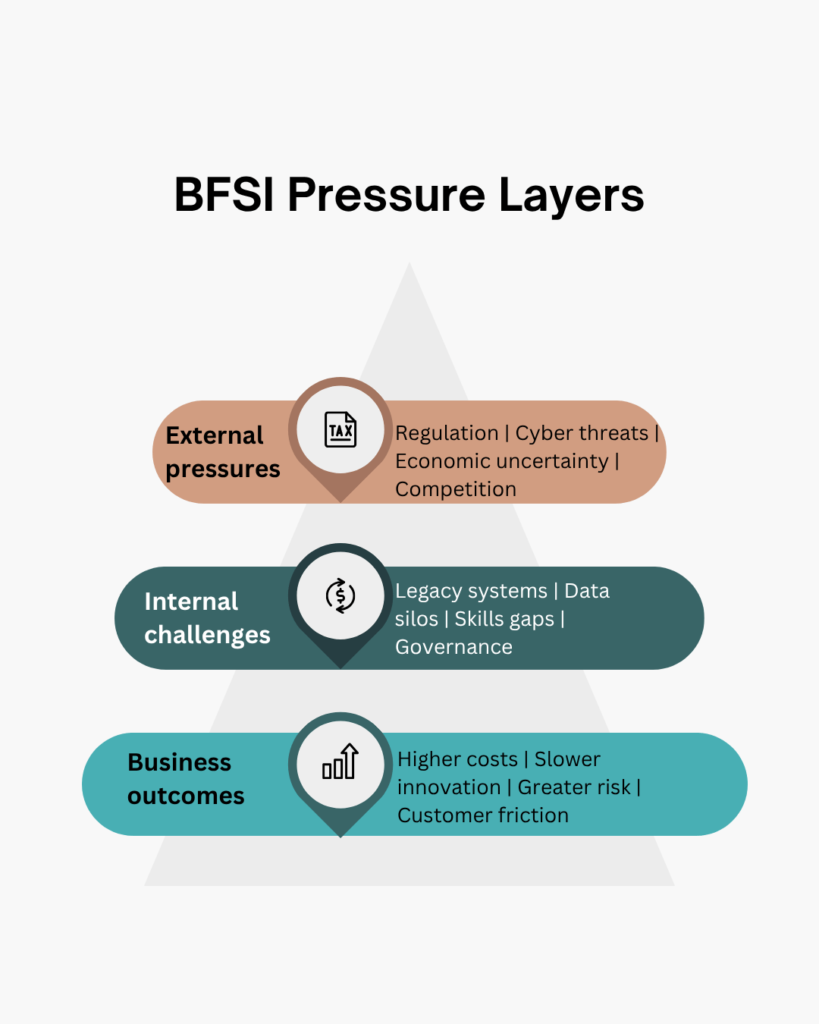
The Funding Squeeze Banks Can No Longer Ignore
For years, deposits and loans grew roughly together, so funding wasn’t something CFOs had to think about constantly. That assumption doesn’t hold anymore. Deposits can no longer be counted on to grow alongside lending activity, and that shift changes how treasury teams plan, price products, and think about customer retention.
The practical effect shows up in things like rising retail term deposit rates as banks compete harder to hold on to funding and a renewed focus on lower-cost, sticky deposit relationships instead of just chasing volume. It’s a slower, less visible problem than fraud or a compliance deadline, but it’s shaping nearly every other decision in the sector this year.
Neobanks Are Competing on More Than Onboarding Speed
Neobanks used to compete almost entirely on customer acquisition, cheap accounts, fast signup, and seamless apps. That phase is largely over. Neobanks are now expanding into lending, investing, and insurance, moving from pure growth mode toward building real profitability and broader BFSI ecosystems.
For traditional institutions, this raises the bar in a way that a simple digital banking upgrade doesn’t fully answer. It’s no longer about matching a neobank’s app experience. It’s about matching the breadth of what a neobank now offers while carrying legacy cost structures a newer competitor doesn’t have.
The Wealth Transfer Is Both an Opportunity and a Threat
A generational wealth transfer estimated at $45 trillion is reshaping who firms need to serve and how. Wealth management fees are expected to keep climbing in 2026 as banks expand advisory offerings for affluent clients, which sounds like straightforward good news.
The harder part is that the next generation of wealth holders doesn’t automatically stay loyal to their parents’ bank or advisor. Firms that treat this purely as a fee-growth opportunity, without rethinking how they engage a younger, more digitally native client base, risk losing exactly the relationships this transfer was supposed to deepen.
NBFCs Are Splitting Into Winners and Losers
Not every NBFC is facing 2026 the same way. Larger NBFCs with stronger credit ratings are refinancing high-cost borrowings at lower rates faster than smaller peers, widening the gap between well-capitalised players and everyone else. Diversified lenders and vehicle financiers are showing strong growth, while smaller, less diversified NBFCs face a tougher funding environment with less room to manoeuvre.
This bifurcation matters because it’s reshaping who has the balance sheet capacity to invest in automation and AI in banking at all. A well-funded NBFC can absorb the cost of building proper enterprise AI solutions. A smaller one is often just trying to hold its funding costs steady.
Margin Pressure Is Forcing Harder Automation Choices
With margins under pressure from both the asset and funding sides, institutions are getting more selective about where they invest in technology. Blanket digital transformation budgets are giving way to narrower questions: does this specific initiative pay for itself in a year the margin can’t absorb much more?
This is actually pushing more institutions toward practical BFSI automation rather than ambitious, harder-to-justify projects. Reconciliation automation, payment automation, and intelligent document processing all have a clearer, faster payback than a broad AI agents rollout with no defined use case, which is exactly why they’re winning budget approval more easily this year.
Where AI Is Actually Helping Institutions Respond
None of the pressures above get solved by AI alone, but AI automation is genuinely changing the math on a few fronts. Generative AI is helping equity research and investment research teams produce faster first drafts, freeing analysts for the parts of the job that actually require judgement. AI agents are helping treasury teams monitor funding costs and deposit flows in closer to real time, rather than waiting for a monthly report to notice a trend that’s already cost the institution money. And agentic AI platforms are increasingly handling the document-heavy, repetitive work in lending and onboarding that used to require adding headcount every time volume grew.
The institutions getting real value aren’t necessarily the ones spending the most on AI process automation. They’re the ones matching specific tools to specific pressure points, funding costs, research capacity, and onboarding volume, rather than buying a platform and hoping it helps everywhere at once.
Best Practices for Navigating 2026’s Pressures
- Treat deposit funding as strategically as important as loan growth, not a background treasury function
- Reassess neobank competition on the full range of services they now offer, not just onboarding experience
- Build a genuine engagement strategy for next-generation wealth clients, not just a fee-growth assumption
- Match automation investment to margin-tight priorities like reconciliation and payment automation first
- Use AI agents to monitor funding costs and deposit flows closer to real time
- Apply generative AI to draft investment research and equity research reports, with analysts reviewing before publication
- Prioritise intelligent document processing where onboarding or lending volume is growing fastest
- Evaluate any new AI initiative against a margin-conscious payback timeline, not an open-ended roadmap
- Watch NBFC funding bifurcation closely if your institution partners with or lends to smaller NBFCs
- Revisit pricing and retention strategy quarterly as deposit competition remains elevated
Future Outlook
Expect deposit competition and margin pressure to remain a defining feature of BFSI through the rest of 2026, even as rate cuts gradually ease some of the funding cost burden. Institutions that treat AI automation as a targeted response to specific pressure points, rather than a broad transformation initiative, are likely to show the clearest returns as the year plays out.
Conclusion
BFSI’s biggest challenge in 2026 isn’t a single event. It’s a funding and competitive squeeze playing out across deposits, neobank rivalry, generational wealth transfer, and NBFC funding gaps all at once, and it’s reshaping where institutions choose to spend on technology.
Yodaplus helps BFSI institutions respond to exactly this kind of pressure with enterprise AI solutions built around clear, measurable payback. From reconciliation automation and payment automation to intelligent document processing and AI-powered research support, our approach focuses on the initiatives that actually move the needle when margins are tight, not the ones that just look impressive on a roadmap.
FAQs
Loan growth is outpacing deposit growth, with deposits rising just 0.5% against 1.7% loan growth in Q2 2026, pushing loan-to-deposit ratios toward 90% and forcing institutions to compete harder and pay more for funding they used to take for granted.
Neobanks have moved beyond fast onboarding and cheap accounts into lending, investing, and insurance, forcing traditional institutions to compete on the breadth of services offered rather than just digital experience.
The $45 trillion wealth transfer brings a new advisory fee opportunity, but the next generation of wealth holders doesn’t automatically stay loyal to their parents’ advisor, so firms that don’t actively engage younger clients risk losing the relationship entirely.
No. Larger, higher-rated NBFCs are refinancing at better rates faster than smaller peers, creating a widening gap in funding costs and, in turn, in how much each can invest in automation and technology.
With margins under pressure, institutions are favouring automation with clear, fast payback, like reconciliation and payment automation, over open-ended AI transformation projects without a defined return timeline.