
Business Processes Best Suited for Agentic AI: A Complete Guide
July 13, 2026 By Yodaplus
Agentic AI is transforming enterprise automation by enabling intelligent systems to complete entire business processes instead of individual tasks. Unlike traditional automation, which follows predefined rules, Agentic AI can understand goals, reason through problems, coordinate multiple systems, adapt to changing conditions, and make operational decisions within defined boundaries. This makes it particularly valuable for business processes that involve dynamic information, multiple stakeholders, and continuous decision-making.
Many organizations already use automation for repetitive activities such as sending emails, generating reports, or updating records. While these workflows remain important, businesses increasingly need automation that can respond to exceptions, analyze information from multiple sources, and complete complex workflows without constant human intervention. This is where Agentic AI, AI agents, and enterprise AI solutions provide the greatest value.
According to Gartner, enterprise AI is shifting from task automation to autonomous business execution, with organizations increasingly adopting intelligent agents that coordinate work across multiple enterprise systems.
What Makes a Business Process Suitable for Agentic AI?
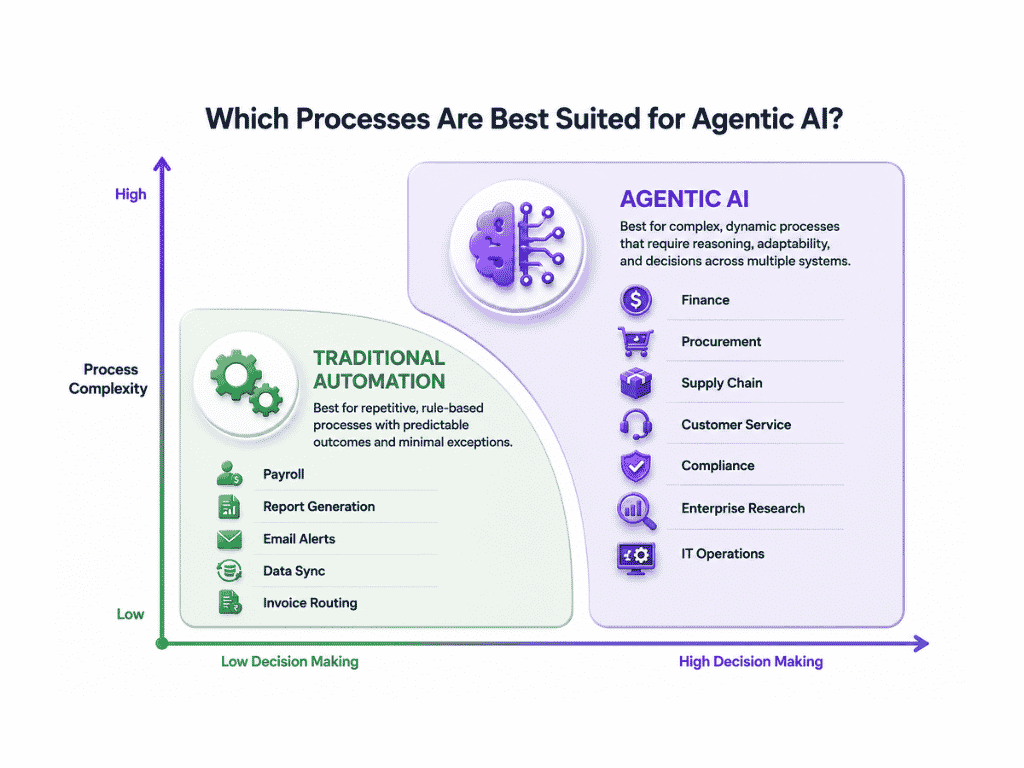
Not every business process requires intelligent decision-making.
Some workflows follow the same rules every time and are better suited to traditional automation.
Agentic AI delivers the greatest value when business processes involve:
- Multiple business systems
- Frequent exceptions
- Large volumes of information
- Human-like reasoning
- Dynamic decision-making
- Continuous adaptation
- Cross-functional collaboration
These characteristics allow AI agents to use their reasoning capabilities instead of simply following predefined instructions.
Characteristics of Ideal Agentic AI Workflows
Organizations should evaluate workflows based on their complexity rather than simply introducing AI everywhere.
Business processes are well suited for Agentic AI when they:
Require Information From Multiple Sources
Enterprise decisions rarely depend on a single application.
A procurement workflow may require information from:
- ERP systems
- Supplier portals
- Inventory platforms
- Contract repositories
- Financial systems
Agentic AI can gather information from each source, analyze it, and determine the appropriate next action without requiring employees to coordinate every step manually.
Involve Frequent Exceptions
Rule-based automation performs well when every transaction follows identical patterns.
However, many business operations involve unexpected situations.
Examples include:
- Supplier delays
- Missing documents
- Customer complaints
- Inventory shortages
- Regulatory changes
Instead of stopping whenever an exception occurs, Agentic AI evaluates the situation, retrieves additional information, and recommends or executes the next appropriate action.
Require Operational Decisions
Some workflows require more than simple automation.
Finance teams evaluate financial risks.
Supply chain managers respond to disruptions.
Customer support agents prioritize cases based on urgency.
These activities involve reasoning rather than repetitive execution.
Agentic AI supports these decisions by analyzing available information before determining the best course of action.
Finance Operations
Finance is one of the strongest candidates for Agentic AI because financial workflows combine structured data, regulatory requirements, document processing, and operational decision-making.
AI agents can assist with:
- Financial reconciliation
- Risk assessment
- Regulatory reporting
- Budget analysis
- Accounts payable
- Financial forecasting
- Fraud detection
Rather than automating individual tasks, Agentic AI coordinates complete financial workflows while escalating only high-risk situations for human review.
Procurement and Supply Chain
Procurement rarely follows a perfectly predictable process.
Supplier availability changes.
Inventory levels fluctuate.
Purchase priorities shift.
Contracts vary.
Agentic AI helps procurement teams by:
- Comparing supplier quotations
- Monitoring inventory
- Evaluating procurement risks
- Coordinating approvals
- Recommending suppliers
- Tracking purchase execution
Instead of managing isolated procurement activities, AI agents coordinate the entire purchasing process from requisition to supplier payment.
Customer Service
Customer service teams manage large volumes of requests across multiple communication channels.
Many customer interactions require more than simply answering a question. They often involve retrieving customer history, checking product availability, reviewing previous support tickets, updating CRM systems, coordinating with logistics teams, and scheduling follow-ups.
Agentic AI can manage these workflows from start to finish.
Instead of responding to individual prompts, AI agents gather information from multiple systems, recommend solutions, execute approved actions, and keep customers informed throughout the process.
This reduces response times while allowing customer service teams to focus on complex cases that require empathy and human judgment.
Human Resources
HR teams handle processes that involve employees, managers, payroll systems, compliance requirements, and training platforms.
These activities often require information from multiple business systems.
Agentic AI can assist with:
- Employee onboarding
- Leave management
- Recruitment screening
- Training coordination
- Policy compliance
- Employee document management
For example, when a new employee joins, an AI agent can coordinate document collection, create system accounts, schedule training, notify managers, and monitor onboarding progress without requiring HR teams to manually coordinate every activity.
IT Operations
Modern IT departments manage hundreds of applications, cloud platforms, security tools, and monitoring systems.
Agentic AI helps IT teams automate workflows such as:
- Incident response
- User access management
- Infrastructure monitoring
- Software provisioning
- System health analysis
- Ticket prioritization
Rather than waiting for engineers to investigate every alert manually, AI agents can collect diagnostic information, identify likely causes, recommend solutions, and execute approved remediation steps automatically.
This reduces downtime while improving operational efficiency.
Compliance and Risk Management
Compliance is another area where Agentic AI delivers significant value.
Organizations must continuously monitor changing regulations, review internal policies, maintain audit trails, and identify operational risks.
Agentic AI can:
- Monitor regulatory updates
- Review compliance documents
- Identify policy deviations
- Generate compliance reports
- Flag operational risks
- Coordinate approval workflows
Instead of reviewing every document manually, compliance teams receive prioritized recommendations supported by AI analysis.
This improves efficiency while strengthening governance.
Enterprise Research and Business Intelligence
Business research often involves gathering information from multiple sources, identifying trends, comparing competitors, analyzing financial reports, and preparing recommendations.
Agentic AI can coordinate these activities by collecting information from:
- Internal knowledge bases
- Enterprise systems
- Financial reports
- News sources
- Market research
- Regulatory filings
It then synthesizes this information into structured insights, allowing analysts to focus on interpretation rather than information gathering.
This capability is particularly valuable for financial research, market intelligence, strategic planning, and executive reporting.
When Agentic AI Is Not the Right Choice
Although Agentic AI is highly capable, it is not the best solution for every business process.
Traditional automation often performs better when workflows are:
- Highly repetitive
- Rule-based
- Stable over long periods
- Low risk
- Predictable
- Independent of multiple systems
Examples include:
- Scheduled report generation
- Password reset notifications
- Data synchronization
- Invoice numbering
- Routine email alerts
Using Agentic AI for these activities may increase implementation complexity without delivering meaningful business benefits.
Organizations should evaluate each workflow based on business requirements rather than assuming every process requires intelligent automation.
Building a Hybrid Enterprise
The most successful organizations combine traditional automation with Agentic AI.
Routine operational activities remain automated using predefined workflows.
More complex processes are coordinated by intelligent AI agents capable of reasoning, planning, and adapting to changing business conditions.
For example:
- Traditional automation processes payroll every month.
- Agentic AI investigates payroll exceptions.
- Traditional automation generates procurement reports.
- Agentic AI analyzes supplier performance and recommends sourcing strategies.
- Traditional automation archives customer documents.
- Agentic AI reviews customer history and recommends retention actions.
This hybrid model allows businesses to maximize efficiency while introducing intelligence only where it creates measurable value.
Conclusion
Agentic AI delivers the greatest value in business processes that involve multiple systems, dynamic information, frequent exceptions, and operational decision-making. Functions such as finance, procurement, supply chain, customer service, human resources, compliance, IT operations, and enterprise research benefit from intelligent AI agents that can coordinate complete workflows instead of automating isolated tasks. At the same time, traditional automation continues to play an important role for repetitive and predictable processes. The most effective enterprise automation strategies combine both approaches to achieve greater efficiency, flexibility, and scalability.
As enterprise AI continues to evolve, organizations will increasingly adopt intelligent automation that connects people, data, and systems across the business. Rather than replacing existing technologies, Agentic AI enhances enterprise operations by enabling faster decisions, better collaboration, and more adaptive workflows.
Yodaplus Agentic AI Services help organizations implement artificial intelligence, Agentic AI, AI agents, AI workflow automation, enterprise AI, enterprise AI solutions, autonomous AI agents, and multi-agent AI to automate complex business processes across finance, procurement, supply chain, customer service, compliance, and enterprise operations. By combining intelligent decision-making with seamless enterprise integration, Yodaplus enables businesses to build scalable, secure, and future-ready AI-powered workflows.
FAQs
Finance, procurement, supply chain, customer service, compliance, HR, IT operations, and enterprise research are among the business functions that benefit most from Agentic AI.
AI agents gather information from multiple systems, make operational decisions, coordinate workflows, adapt to changing conditions, and complete business objectives with minimal human intervention.
No. Repetitive, predictable, and rule-based workflows are often better suited to traditional automation. Agentic AI is most valuable where reasoning and adaptability are required.
Yes. Most enterprises use a hybrid approach where traditional automation handles routine tasks and Agentic AI manages complex workflows involving multiple systems and decision-making.
A multi-agent AI system consists of multiple AI agents that collaborate, share information, and coordinate tasks to achieve broader business objectives across enterprise operations.
Yodaplus Agentic AI Services design and implement intelligent AI solutions that integrate with enterprise systems, automate complex workflows, improve operational efficiency, and support scalable digital transformation.