How Is Agentic AI Different From RPA and Rule-Based Automation?
July 8, 2026 By Yodaplus
Agentic AI differs from Robotic Process Automation (RPA) and rule-based automation because it can understand business goals, make decisions, adapt to changing situations, and coordinate complex workflows across multiple systems. Rule-based automation follows predefined instructions, while RPA automates repetitive user actions within software applications. Agentic AI goes a step further by reasoning through problems, choosing the best course of action, and completing end-to-end business processes with minimal human intervention.
For many years, businesses have relied on automation to improve efficiency. Rule-based systems automated repetitive tasks, while RPA eliminated manual work by mimicking human interactions with software. These technologies continue to deliver value, particularly for structured and predictable processes. However, as enterprise operations become more dynamic, organizations are increasingly looking for solutions that can handle exceptions, work across multiple systems, and support business decisions rather than simply executing instructions.
According to Deloitte’s State of Generative AI in the Enterprise report, organizations are shifting their focus from isolated automation projects toward AI initiatives that improve end-to-end business operations. This shift is accelerating interest in Agentic AI and intelligent workflow automation.
Understanding Rule-Based Automation
Rule-based automation is the simplest form of business automation.
It works by following predefined rules created by developers or business users.
For example:
- If an invoice total is below a certain amount, approve it automatically.
- If inventory falls below a predefined threshold, create a replenishment request.
- If a customer submits a completed application, forward it to the next department.
Every possible action must be defined before the workflow begins.
If an unexpected situation occurs, the automation cannot determine what to do. Instead, it stops and waits for human intervention.
Rule-based automation works extremely well for repetitive processes with little variation, but it becomes less effective when business conditions change frequently.
What Is Robotic Process Automation (RPA)?
Robotic Process Automation builds on rule-based automation by interacting with software applications the same way a human employee would.
An RPA bot can:
- Log into applications
- Copy and paste information
- Move files between systems
- Generate reports
- Populate forms
- Process routine transactions
Instead of integrating systems through APIs, RPA often works directly through user interfaces.
This makes it useful for organizations operating older applications that cannot easily exchange data with modern software.
RPA has helped organizations automate thousands of repetitive administrative tasks, reducing manual effort while improving operational consistency.
However, RPA still depends on predefined workflows.
If screen layouts change, data formats differ, or unexpected exceptions occur, bots usually require updates before they can continue operating.
How Agentic AI Changes Enterprise Automation
Agentic AI approaches automation differently.
Instead of following a fixed sequence of instructions, it begins with a business objective.
The system determines how that objective can be achieved by gathering information, planning actions, making decisions, using enterprise tools, and adapting whenever conditions change.
Rather than asking:
“Which rule should I execute?”
Agentic AI asks:
“What is the best way to achieve this business goal?”
This shift allows intelligent AI agents to manage workflows that previously required continuous human oversight.
For example, if supplier information is incomplete during a procurement process, an Agentic AI system can search approved enterprise databases, validate available records, request missing information when necessary, and continue processing the transaction instead of stopping immediately.
This ability to reason and adapt is what distinguishes Agentic AI from earlier automation technologies.
The Biggest Difference Is Decision-Making
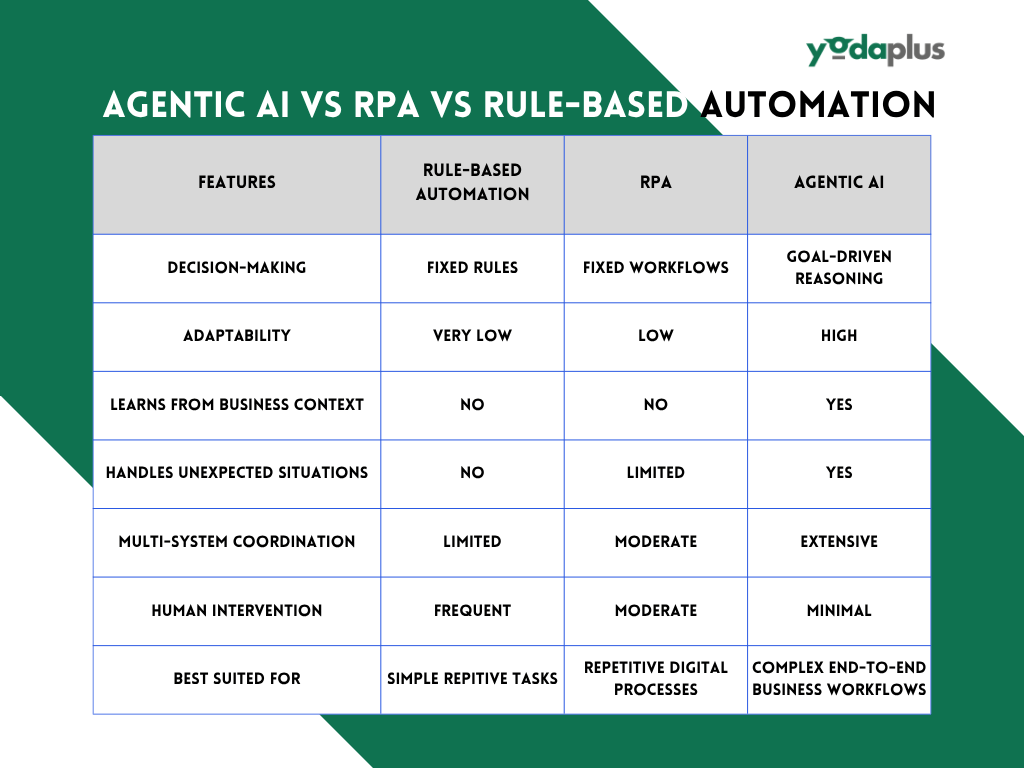
The most significant difference between these technologies lies in how they handle decisions.
Rule-based automation makes no decisions.
It simply executes predefined rules.
RPA automates user actions but still depends on predetermined workflows.
Agentic AI evaluates business context before deciding how to proceed.
It can prioritize tasks, respond to changing information, coordinate multiple enterprise systems, and escalate only those situations that genuinely require human judgment.
As enterprise workflows become more complex, this capability allows businesses to automate activities that were previously considered too dynamic for traditional automation.
Agentic AI vs RPA vs Rule-Based Automation
Real Enterprise Examples
The differences between rule-based automation, RPA, and Agentic AI become much clearer when applied to real business operations.
Consider invoice processing.
With rule-based automation, the system approves invoices only if predefined conditions are met. If the invoice amount is below a certain threshold and all required fields are complete, it moves to the next step. Any deviation stops the workflow.
With RPA, a software bot logs into the ERP system, copies invoice details, enters the information into the accounting platform, updates records, and generates payment requests. The process is faster than manual work, but the bot still follows a fixed sequence of actions.
With Agentic AI, intelligent agents analyze the invoice, validate supplier information, compare purchase orders, identify discrepancies, retrieve missing data from connected systems, recommend the appropriate action, and continue processing while escalating only complex exceptions to finance teams.
The same progression can be seen in customer service, procurement, compliance, HR, and supply chain operations.
When Should Businesses Use Each Approach?
There is no single automation technology that fits every business process.
The right choice depends on the complexity of the workflow and the level of decision-making involved.
Rule-based automation works best when:
- Business rules rarely change.
- Processes follow a predictable sequence.
- Every possible scenario can be predefined.
- Decision-making is minimal.
Examples include sending scheduled notifications, updating records, or triggering simple approvals.
RPA is ideal when:
- Employees perform repetitive tasks across multiple applications.
- Legacy systems lack modern integrations.
- Information must be copied between systems.
- Existing user interfaces need to be automated.
Typical use cases include invoice entry, report generation, payroll updates, and customer record management.
Agentic AI becomes the preferred option when:
- Workflows involve multiple enterprise systems.
- Decisions depend on changing business conditions.
- Large volumes of structured and unstructured data must be analyzed.
- Exceptions occur frequently.
- The objective is to automate complete business processes rather than individual tasks.
This makes Agentic AI particularly valuable for finance, procurement, supply chain management, customer operations, regulatory compliance, and enterprise research.
Can Agentic AI and RPA Work Together?
Absolutely.
Many organizations are not replacing RPA or rule-based automation. Instead, they are combining these technologies to build more intelligent automation ecosystems.
In this model, each technology performs the work it handles best.
Rule-based automation manages simple business rules.
RPA executes repetitive interactions with enterprise applications.
Agentic AI acts as the decision-making layer that coordinates workflows, determines priorities, resolves exceptions, and orchestrates activities across multiple systems.
For example, during supplier onboarding, an Agentic AI system may collect documents, validate supplier information, determine the appropriate approval path, and then instruct RPA bots to update ERP, procurement, and finance applications automatically.
This layered approach allows businesses to extend the value of existing automation investments while introducing intelligent decision-making where it creates the greatest impact.
The Future of Enterprise Automation
Enterprise automation is evolving beyond individual workflows toward intelligent operational systems.
Instead of automating isolated tasks, organizations are beginning to automate complete business outcomes.
Future automation platforms will combine Agentic AI, RPA, traditional automation, predictive analytics, and intelligent document processing into unified enterprise ecosystems.
Employees will increasingly assign objectives such as preparing financial reports, onboarding suppliers, resolving customer issues, or completing compliance reviews.
Intelligent AI agents will coordinate the required systems, gather information, execute workflows, adapt to changing conditions, and involve employees only when strategic judgment or regulatory approval is required.
This evolution will allow organizations to improve operational efficiency while remaining agile in increasingly complex business environments.
Conclusion
Rule-based automation, RPA, and Agentic AI each play an important role in enterprise automation, but they solve different business challenges. Rule-based automation excels at executing predefined instructions, while RPA automates repetitive interactions with digital systems. Agentic AI builds on these capabilities by introducing reasoning, adaptability, and goal-oriented execution that allows businesses to automate complete workflows rather than individual tasks. As enterprise operations become more complex, organizations are increasingly combining these technologies to create automation strategies that are both efficient and intelligent.
Yodaplus Agentic AI Services help enterprises move beyond traditional automation by building intelligent, outcome-driven AI solutions tailored to complex business operations. By combining Agentic AI, autonomous AI agents, workflow orchestration, intelligent document processing, enterprise integration, and real-time analytics, Yodaplus enables organizations to automate finance, supply chain, retail, maritime, and other enterprise workflows while maintaining governance, transparency, and measurable business value.
FAQs
Rule-based automation follows predefined instructions for every scenario, while Agentic AI understands business goals, evaluates context, makes decisions, and adapts workflows when conditions change.
RPA automates repetitive interactions with software applications by following fixed workflows. Agentic AI goes further by reasoning through problems, coordinating multiple systems, and managing end-to-end business processes.
Not entirely. RPA remains valuable for repetitive, structured tasks. Many organizations combine RPA with Agentic AI to automate both execution and decision-making.
Finance, procurement, supply chain, customer service, compliance, HR, IT operations, and enterprise research benefit significantly because these functions involve dynamic workflows and frequent decision-making.
Yes. Rule-based automation remains effective for predictable, repetitive processes with clearly defined rules, such as notifications, approvals, and routine data updates.
As business operations become more complex, organizations need automation that can adapt to changing conditions, coordinate multiple enterprise systems, and handle exceptions with minimal human intervention. Agentic AI provides these capabilities while improving efficiency, scalability, and decision-making.