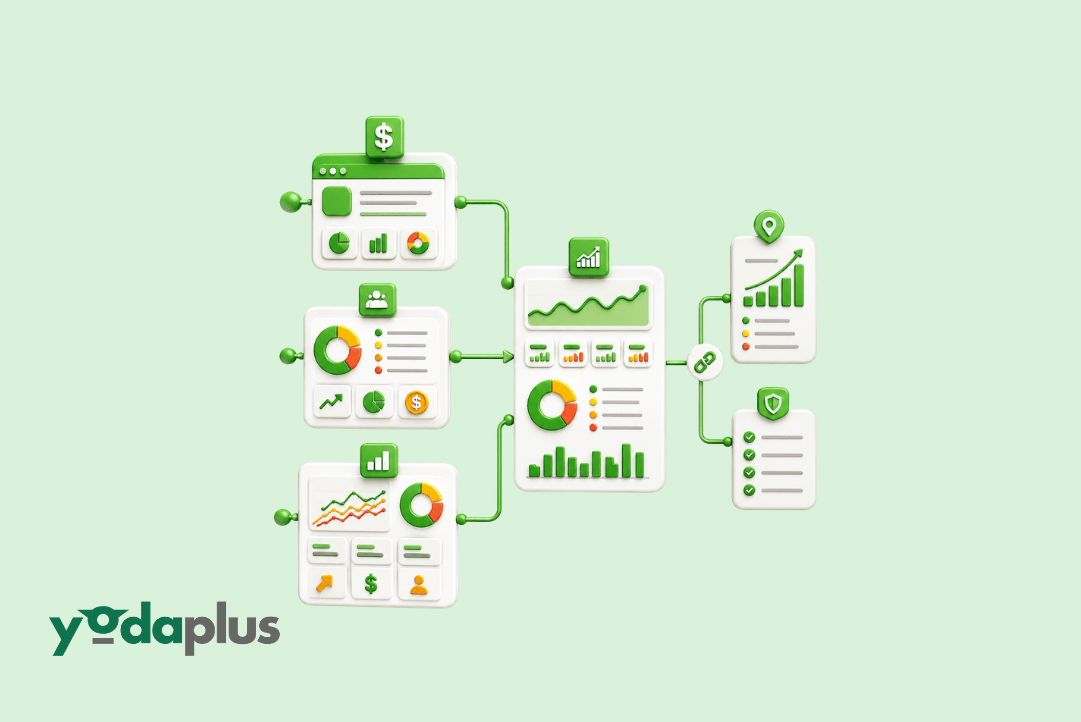
Human-in-the-Loop Governance in Banking Automation
May 26, 2026 By Yodaplus
Human-in-the-loop governance in banking automation refers to automation systems where humans remain actively involved in monitoring, validating, approving, or escalating critical workflows instead of allowing fully autonomous execution. As banks increasingly deploy RPA, AI systems, and intelligent automation across operational workflows, human oversight is becoming one of the most important safeguards against operational instability, compliance failures, and governance risk.
Modern banks now automate workflows involving:
- KYC verification
- transaction monitoring
- fraud detection
- customer onboarding
- reconciliation
- compliance reporting
- payment processing
- loan operations
- document verification
According to Deloitte, financial institutions continue increasing automation investment because operational efficiency and scalability remain major priorities across BFSI environments. However, regulators increasingly expect banks to maintain accountability and explainability even when automation systems make operational decisions.
This explains why fully autonomous banking automation remains rare in highly regulated environments.
Why Human Oversight Still Matters
Automation systems are highly effective for:
- repetitive workflows
- rules-based processing
- structured decision-making
- high-volume operational tasks
However, banking operations often involve situations requiring:
- judgment
- context interpretation
- ethical evaluation
- regulatory understanding
- escalation handling
For example:
- suspicious transactions may require investigation
- unusual customer activity may need manual review
- conflicting documents may require contextual interpretation
Bots and AI systems may identify patterns, but humans still make many final operational decisions.
This strengthens the importance of governance-focused financial services automation.
What Human-in-the-Loop Governance Actually Includes
Human-in-the-loop governance typically involves:
- manual approvals
- escalation workflows
- operational review checkpoints
- exception handling
- compliance validation
- decision overrides
- audit supervision
The goal is not to slow automation unnecessarily.
The goal is to ensure critical workflows remain:
- explainable
- accountable
- compliant
- operationally stable
within modern banking process automation ecosystems.
Exception Handling Is the Biggest Reason Humans Remain Necessary
Banking workflows constantly encounter exceptions such as:
- incomplete customer documentation
- suspicious transaction activity
- inconsistent financial records
- integration failures
- regulatory escalation requirements
Automation systems often struggle when situations fall outside predefined logic.
Without human oversight, bots may:
- stop processing unexpectedly
- escalate incorrectly
- bypass controls
- create incomplete workflows
This explains why modern banks increasingly combine:
- automation efficiency
- human judgment
- operational governance
inside intelligent automation ecosystems.
Compliance Oversight Requires Human Accountability
Banks operate under strict regulations involving:
- AML compliance
- KYC obligations
- reporting standards
- data privacy requirements
- fraud monitoring rules
Regulators increasingly expect institutions to explain:
- how decisions were made
- why workflows behaved a certain way
- how escalations were handled
- who approved exceptions
This means humans still play a central role in:
- compliance interpretation
- workflow approval
- operational accountability
within modern financial process automation environments.
AI Integration Makes Human Oversight More Important
Modern banks increasingly combine automation with:
- AI systems
- machine learning
- predictive analytics
- intelligent document processing
- automated decision engines
This improves scalability but also introduces governance concerns involving:
- explainability
- bias detection
- model drift
- adaptive behavior
AI systems may generate outcomes that are statistically accurate but operationally inappropriate in specific contexts.
Human oversight helps institutions:
- validate decisions
- review anomalies
- prevent escalation failures
- maintain ethical accountability
within modern finance automation ecosystems.
Financial Risk Assessment Now Includes Automation Oversight Risk
Modern institutions increasingly integrate automation governance into broader:
- operational risk programs
- resilience planning
- cyber risk frameworks
- compliance governance
This strengthens modern financial risk assessment significantly.
Institutions now evaluate risks involving:
- over-automation
- operational dependency
- governance gaps
- escalation failure
- automation bias
because poorly supervised automation can create systemic operational exposure.
Macroeconomic Outlook Influences Automation Pressure
The broader macroeconomic outlook also affects automation strategy.
During periods involving:
- cost pressure
- inflation
- recession concerns
- staffing constraints
- margin compression
banks often accelerate automation aggressively.
However, excessive automation without human oversight may increase operational fragility.
This explains why mature institutions increasingly focus on balancing:
- automation scale
- governance quality
- operational resilience
within BFSI transformation strategies.
Market Sentiment Analysis Matters for Customer Trust
Trust remains central to financial services.
Operational failures involving automation can affect:
- customer confidence
- investor trust
- regulatory relationships
- institutional reputation
This strengthens the importance of:
- Market Sentiment Analysis
- governance transparency
- operational accountability
within modern banking environments.
Customers generally trust institutions more when they know human oversight still exists for sensitive decisions.
Scenario Analysis Helps Improve Governance Resilience
Modern institutions increasingly use:
- Scenario Analysis
- Sensitivity analysis
- operational stress testing
- resilience simulations
to evaluate automation governance risks.
Banks may test scenarios involving:
- workflow outages
- AI prediction errors
- escalation failures
- compliance breakdowns
- operational anomalies
This improves overall financial risk mitigation and operational resilience.
AI-Powered Monitoring Supports Human Governance
Modern institutions increasingly use:
- ai data analysis
- predictive monitoring systems
- automated anomaly detection
- intelligent workflow analytics
to support operational oversight.
AI systems can monitor:
- unusual workflow behavior
- compliance deviations
- operational bottlenecks
- escalation inconsistencies
- transaction anomalies
much faster than manual monitoring systems.
However, humans still review and interpret many high-risk outcomes.
This creates a balanced governance model between automation and oversight.
Human Oversight Improves Operational Accountability
One major governance advantage of human-in-the-loop systems is accountability clarity.
Banks can define:
- who reviews workflows
- who approves escalations
- who manages exceptions
- who validates decisions
This improves:
- auditability
- governance transparency
- operational resilience
- compliance visibility
inside modern banking automation systems.
Why Fully Autonomous Banking Systems Remain Unlikely
Banking operations involve:
- regulatory complexity
- ethical considerations
- customer sensitivity
- operational unpredictability
This makes fully autonomous banking systems difficult to govern safely.
Most institutions will likely continue using hybrid operational models involving:
- automation
- AI assistance
- human oversight
- governance frameworks
rather than completely autonomous workflows.
Conclusion
Human-in-the-loop governance has become essential because banking automation now operates across highly regulated, operationally sensitive, and customer-facing environments. As financial institutions continue scaling automation and AI adoption, human oversight helps maintain accountability, operational resilience, compliance visibility, and customer trust.
The future of financial services automation will likely depend on balancing intelligent automation with structured governance, operational transparency, AI-assisted monitoring, and resilient human oversight frameworks.
This is where Yodaplus Agentic AI for Financial Operations helps organizations modernize BFSI workflows through governance-focused automation strategies, intelligent operational monitoring, adaptive AI-driven workflows, and scalable enterprise automation frameworks designed for modern banking and financial services environments.