
Sell-Side vs Buy-Side Equity Research Models Explained
July 15, 2026 By Yodaplus
Equity research is one of the most important functions in financial markets, helping investors evaluate companies, understand risks, and make informed investment decisions. However, not all equity research is created for the same purpose. The two primary research models used across the investment industry are sell-side equity research and buy-side equity research. While both involve analyzing companies, financial statements, industry trends, and valuations, they differ significantly in their objectives, audience, and approach.
Understanding these differences is important for investors, analysts, financial institutions, and businesses seeking to interpret research reports correctly. Sell-side analysts focus on providing investment recommendations to clients and generating market insights, while buy-side analysts conduct proprietary research to support investment decisions within their own organizations. Both contribute to capital markets, but they measure success in different ways.
As financial markets become more data-driven, artificial intelligence and automation are also changing how both buy-side and sell-side research teams collect data, build financial models, and generate investment insights.
What Is Sell-Side Equity Research?
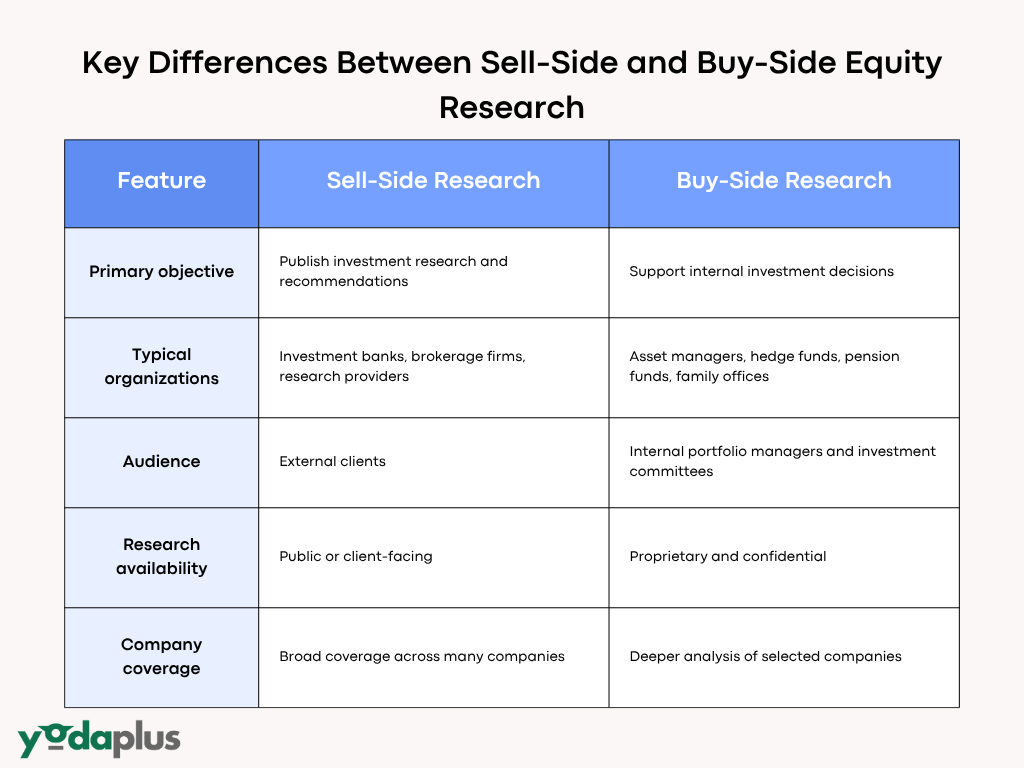
Sell-side equity research is produced by investment banks, brokerage firms, and independent research providers.
The primary objective is to provide investment recommendations and market insights to external clients such as institutional investors, wealth managers, mutual funds, pension funds, and retail investors.
Sell-side analysts typically publish research reports covering:
- Company performance
- Earnings analysis
- Industry trends
- Financial models
- Valuation analysis
- Target prices
- Buy, Hold, or Sell recommendations
These reports help investors understand a company’s outlook while supporting trading and investment decisions.
What Is Buy-Side Equity Research?
Buy-side equity research is conducted by organizations that invest directly in financial markets.
These include:
- Asset management companies
- Mutual funds
- Hedge funds
- Pension funds
- Sovereign wealth funds
- Family offices
Unlike sell-side research, buy-side analysis is proprietary.
The research is produced exclusively for internal portfolio managers and investment committees.
Instead of publishing reports publicly, buy-side analysts use their findings to decide whether an investment should be added to, removed from, or maintained within a portfolio.
Different Objectives
The biggest difference between the two research models lies in their objectives.
Sell-side research aims to inform external investors by providing market commentary, investment recommendations, and company analysis.
Buy-side research aims to generate investment ideas that improve portfolio performance.
Because the research serves different audiences, analysts often approach the same company from different perspectives.
For example, a sell-side analyst may publish a report explaining why a stock deserves a Buy rating.
A buy-side analyst may review the same company but ultimately decide that the stock does not fit the fund’s investment strategy or risk profile.
Research Depth
Both models involve detailed financial analysis, but the depth of research often differs.
Sell-side reports typically provide broad coverage across multiple companies and industries.
Analysts regularly publish:
- Quarterly earnings updates
- Target price revisions
- Industry reports
- Company initiation reports
- Market outlooks
Buy-side analysts usually cover fewer companies but perform deeper analysis.
Their work often includes:
- Proprietary financial models
- Scenario analysis
- Management meetings
- Supply chain research
- Alternative data analysis
- Portfolio impact assessments
Because their investment decisions directly affect portfolio performance, buy-side teams often spend considerably more time evaluating each opportunity.
Financial Modeling
Financial modeling is central to both research models.
Analysts commonly build:
- Discounted Cash Flow (DCF) models
- Comparable company analysis
- Precedent transaction analysis
- Sensitivity analysis
- Earnings forecasts
The difference lies in how the models are used.
Sell-side models support published recommendations.
Buy-side models support actual capital allocation decisions.
As a result, buy-side financial models are often updated more frequently to reflect changing market conditions and portfolio exposures.
Performance Measurement
Success is measured differently across the two models.
Sell-side analysts are often evaluated based on:
- Research quality
- Forecast accuracy
- Client relationships
- Market reputation
- Institutional Investor rankings
- Trading support
Buy-side analysts are evaluated based on how well their research contributes to investment performance.
Their recommendations directly influence portfolio returns, making investment outcomes a critical measure of success.
Information Sources
Both sell-side and buy-side analysts rely on many of the same information sources, but they often use them differently.
Common sources include:
- Annual reports and financial statements
- Quarterly earnings releases
- Earnings call transcripts
- Investor presentations
- Regulatory filings
- Industry reports
- Economic data
- Company announcements
- Market news
Buy-side analysts frequently go a step further by incorporating proprietary research, alternative data, channel checks, supplier discussions, customer surveys, and direct meetings with company management to validate investment ideas.
This additional research helps them develop differentiated investment insights that are not publicly available through standard research reports.
How AI Is Changing Both Research Models
Artificial intelligence is transforming both sell-side and buy-side equity research by reducing manual work and accelerating analysis.
Instead of spending hours collecting and organizing information, analysts can use AI to process large volumes of financial and market data in minutes.
AI supports activities such as:
- Financial statement analysis
- Earnings call summarization
- News monitoring
- Industry research
- Valuation support
- Financial modeling
- Risk identification
- Report generation
Rather than replacing analysts, AI improves productivity by allowing research teams to spend more time interpreting insights, validating assumptions, and making investment decisions.
Which Research Model Is Better?
Neither model is inherently better because they serve different purposes.
Sell-side research is valuable for investors seeking broad market coverage, company updates, earnings analysis, and investment recommendations across multiple sectors.
Buy-side research is designed for organizations making investment decisions with their own capital. It generally involves deeper analysis tailored to specific portfolio objectives, investment strategies, and risk tolerance.
Many institutional investors use both.
They review sell-side reports to understand market consensus while relying on their own buy-side research before making investment decisions.
Together, these approaches contribute to a more informed and efficient investment process.
The Future of Equity Research
Technology is reshaping both research models.
Artificial intelligence, automation, alternative data, and cloud-based analytics are enabling analysts to evaluate companies more efficiently while improving research quality.
Future equity research platforms will increasingly combine:
- Artificial intelligence
- Automated financial modeling
- Real-time market intelligence
- Alternative data analysis
- Portfolio risk analytics
- Scenario modeling
- Continuous company monitoring
- Agentic AI-powered research workflows
Instead of producing static reports, future research platforms will generate dynamic insights that update automatically as new information becomes available.
Conclusion
Sell-side and buy-side equity research both play essential roles in capital markets, but they are designed for different objectives. Sell-side analysts focus on providing research, recommendations, and market insights to external clients, while buy-side analysts conduct proprietary analysis to support portfolio decisions and long-term investment performance. Understanding these differences helps investors interpret research more effectively and appreciate how investment decisions are developed.
As financial markets become increasingly data-driven, artificial intelligence and automation are improving every stage of the research process, from data collection and financial modeling to valuation analysis and report generation. These technologies enable analysts to focus more on strategic thinking while reducing the time spent on repetitive tasks.
Tools like GenRPT Finance by Yodaplus Agentic AI for Financial Services helps investment banks, asset managers, family offices, wealth managers, and institutional investors modernize equity research through AI-powered financial modeling, automated company analysis, valuation support, earnings analysis, scenario modeling, portfolio intelligence, and end-to-end research automation. By combining advanced analytics with Agentic AI, GenRPT Finance enables research teams to produce faster, deeper, and more consistent investment insights.
FAQs
Sell-side research provides investment recommendations and market analysis to external clients, while buy-side research supports internal investment decisions for organizations that manage investment portfolios.
Sell-side research is typically produced by investment banks, brokerage firms, and independent research providers.
Buy-side research is used by asset managers, hedge funds, pension funds, sovereign wealth funds, mutual funds, and family offices to support portfolio management.
AI helps analysts automate financial statement analysis, summarize earnings calls, monitor news, support valuation models, identify risks, and generate research reports more efficiently.