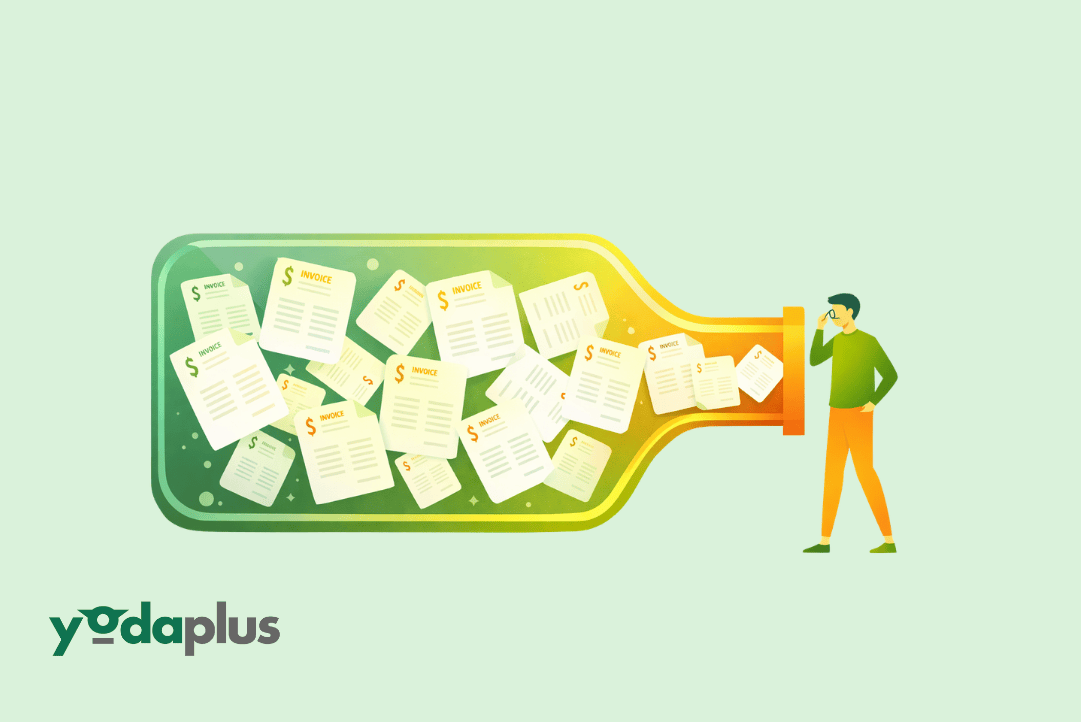
Why Invoice Volume Is Not the Real AP Bottleneck
February 18, 2026 By Yodaplus
Many finance leaders believe that high invoice volume is the main reason accounts payable teams struggle. When thousands of invoices arrive every week, it feels obvious that volume is the problem.
But is invoice volume really the bottleneck?
After implementing accounts payable automation, many organizations discover that volume alone does not slow the system. Instead, hidden process gaps, inconsistent data, and poor integration create friction. Even moderate invoice volumes can overwhelm AP teams if upstream processes are weak.
The real bottleneck is rarely the number of invoices. It is how those invoices interact with the broader procure to pay ecosystem.
Volume Is Visible, Process Gaps Are Not
Invoice volume is easy to measure. Dashboards show how many invoices are received, processed, and approved. Leaders often assume that adding accounts payable automation software will automatically solve the issue.
Invoice processing automation combined with OCR for invoices can handle large volumes quickly. Intelligent document processing extracts header and line level data in seconds. Data extraction automation reduces manual keying effort.
So why do AP teams still experience delays?
Because the system slows down at exception points, not at intake.
Exceptions, Not Volume, Create Delays
In most environments, the majority of processing time is spent on exceptions.
Common triggers include:
- Price mismatches
- Quantity mismatches
- Missing GRN
- Incomplete purchase order creation
- Incorrect tax codes
Even with automated invoice matching software, mismatches push invoices into manual review queues.
If procurement process automation allows inconsistent purchase order automation rules, invoice matching becomes fragile. One unclear description or missing reference can block the invoice.
This is where the bottleneck emerges.
High invoice volume with clean data flows smoothly. Low invoice volume with messy data creates constant friction.
Upstream Weaknesses Slow Down AP
Accounts payable automation depends heavily on procure to pay automation.
If purchase order automation lacks structure, invoices cannot match properly. If GRN entries are delayed in manufacturing automation environments, the system cannot validate receipt.
AP teams quickly discover that they are managing upstream issues rather than invoice volume.
For example:
A supplier sends an invoice referencing a purchase order. The goods have been delivered, but the GRN was not recorded. Invoice matching software blocks the invoice. The AP team must follow up with warehouse teams.
The delay is not caused by invoice volume. It is caused by incomplete process alignment.
Data Quality Is a Bigger Constraint
Intelligent document processing and OCR for invoices can extract invoice details accurately. But automation cannot fix poor master data.
Supplier records may contain outdated bank details. Tax codes may not align across regions. Contract pricing may not be reflected properly in procurement automation systems.
When data extraction automation captures invoice values, the system still depends on accurate reference data.
Accounts payable automation software works efficiently only when data standards are strong.
AP teams often discover that cleaning supplier master data has a bigger impact than reducing invoice count.
Integration Gaps Create Invisible Friction
In many enterprises, procure to pay process automation spans multiple platforms:
- ERP
- Procurement tool
- Warehouse system
- Payment platform
If integration is delayed or incomplete, invoice processing automation stalls.
For example:
- GRN updates are not synced in real time
- Supplier updates do not reflect immediately
- Payment status does not update in reporting systems
Even in retail automation environments with high transaction volume, integration gaps cause more issues than invoice count.
Volume is manageable when systems communicate well. Poor integration creates artificial bottlenecks.
Governance and Approval Logic Matter More
Another discovery AP teams make is that approval logic drives cycle time more than volume.
If approval thresholds are unclear, invoices escalate unnecessarily. If too many approvers exist, workflow automation slows down.
Agentic AI workflows can recommend optimized approval paths based on risk and historical patterns. But governance must define clear policies first.
A company processing 5,000 invoices with streamlined approval rules may operate faster than one processing 2,000 invoices with rigid or unclear hierarchies.
The bottleneck is governance, not volume.
Risk Controls Must Be Balanced
Accounts payable automation also includes fraud controls. Duplicate invoice detection, vendor validation, and bank detail verification are critical.
Financial services automation environments require detailed audit trails. Banking automation contexts demand explainability and traceability.
If controls are poorly designed, the system blocks legitimate invoices excessively.
Agentic AI workflows help balance control and speed. Instead of blocking every variance, the system evaluates context and historical patterns.
This reduces unnecessary exceptions while maintaining compliance.
Again, the bottleneck shifts from volume to policy design.
Cross Functional Alignment Drives Efficiency
AP teams often sit at the intersection of procurement automation, manufacturing process automation, and finance automation.
If these teams do not align, invoice matching suffers.
In manufacturing automation setups, goods may be received in stages. In retail automation ai environments, promotional discounts create pricing variances.
Without coordinated policy across procure to pay automation and order to cash automation systems, inconsistencies multiply.
Volume simply amplifies existing weaknesses.
When cross functional alignment is strong, even high invoice volume flows smoothly.
Rethinking the Real Constraint
If invoice volume is not the true bottleneck, what is?
It is:
- Poor purchase order creation discipline
- Weak procurement process automation
- Inconsistent master data
- Integration delays
- Overly rigid approval structures
Addressing these factors reduces exception rates significantly.
Once exception rates drop, invoice processing automation scales naturally.
FAQs
1. Does higher invoice volume always increase AP delays?
Not necessarily. Clean data and strong procure to pay automation can handle high volumes efficiently.
2. Why does invoice matching fail frequently?
Mismatches often stem from poor purchase order automation or delayed GRN updates.
3. Can intelligent document processing solve bottlenecks?
It improves data capture, but governance and integration must also improve.
4. How do agentic AI workflows help?
They evaluate context instead of relying only on rigid thresholds, reducing unnecessary exceptions.
Conclusion
Invoice volume feels like the obvious culprit when AP teams face delays. But automation reveals a deeper truth.
The real bottleneck lies in process gaps, inconsistent data, and weak integration across procure to pay automation and finance automation systems.
Organizations that strengthen purchase order automation, intelligent document processing, and workflow automation reduce friction significantly.
When AP is supported by contextual agentic AI workflows and aligned procurement automation, volume becomes manageable instead of overwhelming.
Yodaplus Supply Chain & Retail Workflow Automation helps enterprises build connected, context aware accounts payable automation that removes structural bottlenecks and delivers measurable performance improvements.