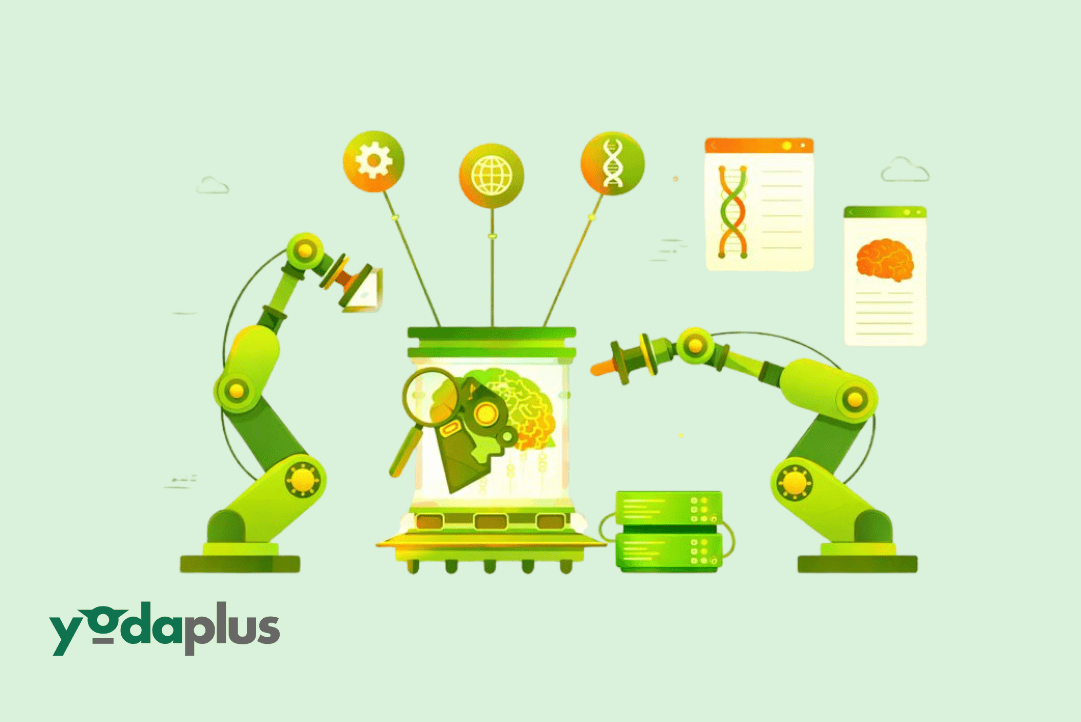
Automation has existed for decades, but its role is changing rapidly. Earlier automation focused on repetitive tasks and fixed rules. Today, automation is becoming intelligent, adaptive, and goal-driven. To understand this shift, many organisations now ask a simple question: what is the future of automation across industries?
The answer lies in Artificial Intelligence, especially agentic AI and autonomous systems. These technologies are redefining how work gets done across sectors such as finance, logistics, manufacturing, healthcare, and enterprise IT.
This blog explains how automation is evolving, what technologies are driving this change, and why the future looks more intelligent than ever.
From basic automation to intelligent systems
Traditional automation relied on scripts and rules. Systems followed predefined instructions and stopped when conditions changed. This approach worked well for stable environments but failed in complex and dynamic systems.
Modern automation uses AI technology to adapt. Instead of fixed rules, systems learn patterns using machine learning, deep learning, and neural networks. This allows automation to respond to new situations without manual reprogramming.
This shift marks the foundation of the future of automation.
Role of Artificial Intelligence in modern automation
To understand this evolution, it helps to revisit what is AI and what is artificial intelligence in automation. Artificial Intelligence in business enables systems to observe, learn, reason, and act.
Key AI capabilities driving automation include:
-
AI-driven analytics for real-time decision-making
-
Data mining to identify patterns and risks
-
AI models trained through AI model training
-
Self-supervised learning for continuous improvement
These capabilities allow automation systems to move beyond task execution and into decision support.
Agentic AI and autonomous automation
One of the most important shifts is the rise of agentic AI. Unlike traditional automation, agentic systems are goal-oriented. They use AI agents that can plan, act, and coordinate.
In an agentic framework, agents work together as multi-agent systems. Each agent handles a specific responsibility and shares context with others. This creates automation that manages entire workflows, not just tasks.
Autonomous agents can monitor systems, detect issues, and trigger actions without constant human oversight. This makes automation scalable across industries.
AI agents and workflow automation
Workflow agents are central to modern automation. They manage processes that span multiple tools and teams.
For example, in enterprise IT, agents monitor system health and trigger fixes. In operations, agents track workflow progress and resolve delays. In analytics, agents generate insights using AI applications.
This approach reduces coordination overhead and improves execution speed.
Generative AI and conversational automation
Generative AI is reshaping how humans interact with automated systems. With generative AI software and LLM, automation becomes conversational.
Teams can use conversational AI to ask questions in natural language, request reports and summaries, and trigger workflows through simple commands.
This reduces complexity and improves adoption across non-technical teams.
Semantic intelligence and knowledge systems
Modern automation also relies on semantic understanding. Using semantic search, vector embeddings, and knowledge-based systems, AI can understand meaning rather than keywords.
This allows automation systems to retrieve relevant information across systems, connect related data points, and support better decision-making.
These capabilities are critical for industries with large volumes of unstructured data.
Automation across key industries
The future of automation spans every industry, with AI adapting to specific needs.
In finance and enterprise systems, automation supports reporting, compliance, and risk management using AI-powered automation and autonomous AI.
In logistics and supply chain, AI in logistics and AI in supply chain optimization help detect disruptions, optimize routing, and manage inventory.
In manufacturing and operations, autonomous systems monitor equipment health, predict failures, and optimize production flows.
In healthcare and services, AI-driven automation supports scheduling, documentation, and decision support while maintaining compliance.
Across these sectors, agentic AI use cases show how automation improves resilience and productivity.
Explainable and responsible automation
As automation becomes more autonomous, trust becomes critical. Explainable AI ensures that systems can justify decisions and actions.
Responsible AI practices help organizations avoid bias, reduce errors, and protect data. Strong AI risk management ensures automation behaves as expected.
This focus supports reliable AI adoption across regulated and high-risk industries.
Technical foundations shaping the future
Behind intelligent automation sit strong technical foundations such as AI frameworks, AI agent frameworks, and MCP for managing context, memory, and roles across agents.
Other foundations include prompt engineering for guiding LLM behavior and scalable AI systems that support long-running automation.
Together, these elements enable adaptive and resilient automation.
The future of work with automation
The future of AI in automation is collaborative. Humans focus on goals, creativity, and judgment. Automation handles execution, monitoring, and optimization.
Autonomous systems will increasingly self-correct, retrain, and improve without manual input. This will redefine productivity and operational scale.
FAQs
What is the future of automation across industries?
The future of automation is intelligent, adaptive, and driven by AI agents that manage workflows and decisions.
How does agentic AI improve automation?
Agentic AI uses goal-driven agents that plan, act, and collaborate, enabling automation across complex processes.
What role do AI agents play in automation?
AI agents monitor systems, execute tasks, coordinate workflows, and adapt to change in real time.
Is automation only about cost reduction?
No. Modern automation focuses on productivity, resilience, speed, and better decision-making.
Why is explainable AI important in automation?
Explainability builds trust by showing why systems take specific actions or decisions.
Conclusion
The future of automation across industries is intelligent, autonomous, and deeply integrated with business workflows. Powered by Artificial Intelligence, AI agents, and agentic AI frameworks, automation is evolving into a strategic capability rather than a cost-saving tool.
Organizations looking to build scalable and intelligent automation solutions can rely on Yodaplus Automation Services to design and implement future-ready systems that align technology, processes, and people.