
Intelligent Document Processing in Finance and Banking Automation
January 21, 2026 By Yodaplus
Documents sit at the center of financial operations. Every transaction, approval, audit, and report depends on them. Yet for many banks and financial institutions, documents remain slow, manual, and fragmented. This is where intelligent document processing is changing how finance works. Combined with banking automation and AI in banking, it allows financial teams to move beyond manual document handling and toward structured, explainable automation.
This blog explains what intelligent document processing means in finance, how it fits into financial process automation, and why it has become a foundational layer for modern automation in financial services.
Why documents are a bottleneck in finance
Finance runs on documents. Invoices, statements, contracts, disclosures, research notes, and regulatory filings shape daily operations. Despite advances in systems, documents often arrive as PDFs, scans, emails, or spreadsheets.
Manual handling creates delays. Teams rekey data. Errors slip in. Reviews slow down decisions. These issues affect everything from banking process automation to equity research.
Traditional automation struggled with documents because documents are unstructured. They do not follow strict formats. They vary by source, region, and purpose. This made documents resistant to automation for years.
What intelligent document processing really means
Intelligent document processing uses artificial intelligence in banking to read, understand, and structure documents.
Unlike basic OCR, IDP does not just extract text. It identifies document types, understands context, validates data, and routes information into workflows. It combines machine learning, natural language processing, and rules-based logic.
In finance, IDP becomes a bridge between documents and systems. It turns unstructured information into structured data that automation can use.
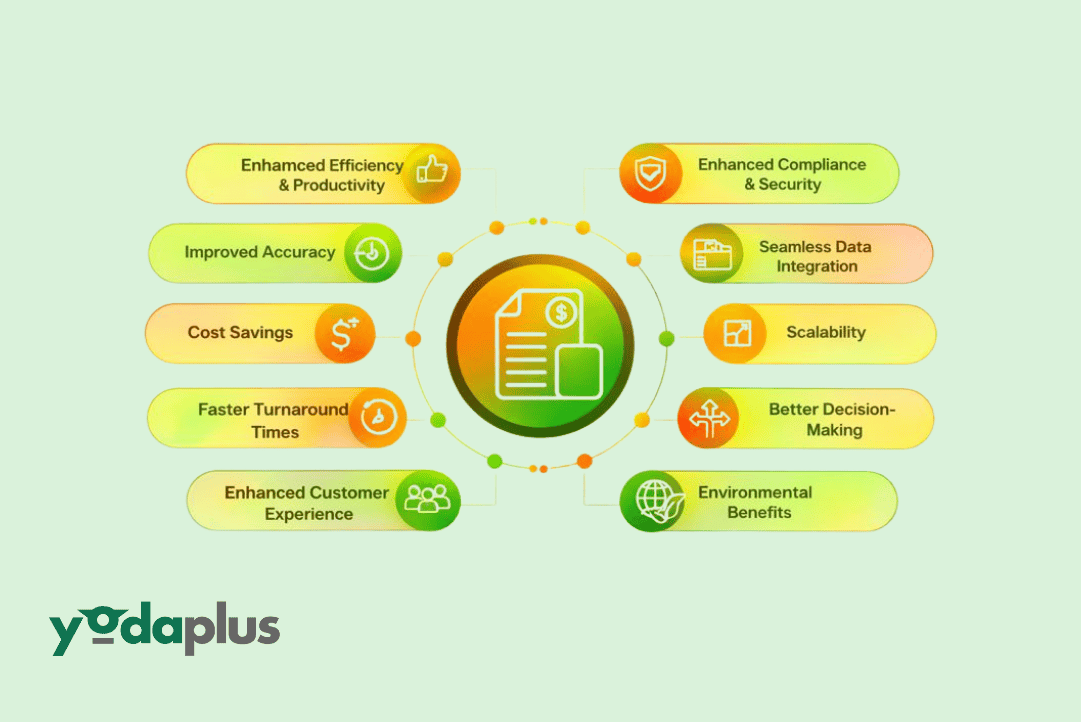
This capability is what makes large-scale finance automation practical.
How IDP fits into financial process automation
IDP is not a standalone tool. It is part of financial services automation.
Once documents are processed, the extracted data feeds into workflow automation. Approvals trigger automatically. Exceptions route to reviewers. Reports update without manual effort.
This connection allows banking automation to extend beyond transactions into decision workflows. Documents no longer sit outside the system. They become active inputs.
This is why IDP is central to modern automation in financial services.
IDP in banking operations
In core banking operations, intelligent document processing supports onboarding, compliance, and transaction review.
Account opening relies on document verification. IDP validates forms, extracts key details, and flags inconsistencies. Compliance teams benefit from structured audit trails and searchable records.
In transaction-heavy environments, banking AI systems use document data to support approvals and risk checks. This reduces processing time while improving consistency.
By embedding IDP into banking process automation, banks reduce manual handoffs without losing control.
IDP in investment and equity research
Documents play a critical role in investment research and equity research.
Analysts rely on filings, earnings transcripts, research notes, and disclosures. Manual review limits scale and slows insight generation.
With AI in investment banking, intelligent document processing extracts financial metrics, identifies themes, and structures qualitative insights. This supports faster creation of an equity research report while preserving analyst judgment.
An automated equity report does not replace expertise. It reduces repetitive work so analysts can focus on interpretation and strategy.
This balance is essential in ai in banking and finance.
Reducing operational risk through structured documents
Manual document handling introduces risk. Missing data, incorrect values, and inconsistent formats affect downstream decisions.
IDP reduces these risks by enforcing validation rules. It checks completeness. It flags anomalies. It creates traceable records.
In financial process automation, this improves accuracy and audit readiness. Decisions become easier to explain because the document trail is structured and searchable.
For regulated environments, this control is as valuable as speed.
IDP and accountability in automated finance
As automation increases, accountability shifts.
When documents are processed manually, responsibility is clear. When automation handles them, accountability must be designed into the system.
IDP supports accountability by maintaining document lineage. Every extracted field links back to a source. Every decision references structured data.
This transparency matters for audits, reviews, and regulatory inquiries. AI banking systems that cannot explain document-based decisions create risk.
Well-designed IDP strengthens accountability rather than weakening it.
Why basic OCR is not enough
Many financial institutions believe they already use document automation because they use OCR. That is rarely enough.
OCR extracts text. It does not understand meaning. It does not validate data. It does not integrate naturally with workflow automation.
Intelligent document processing goes further. It understands document intent. It adapts to variations. It improves over time.
This difference explains why OCR-heavy systems struggle at scale, while IDP-based financial services automation systems continue to expand.
Human oversight still matters
IDP does not remove humans from finance. It changes how humans work.
Exceptions still need review. Models need monitoring. Rules need updates. In banking automation, human oversight remains essential.
The value of IDP lies in removing low-value manual work, not eliminating responsibility. Analysts, reviewers, and managers remain accountable for outcomes.
This balance is critical for trust in ai in banking systems.
Designing IDP for long-term success
Successful IDP implementations focus on integration, not just accuracy.
Documents must connect cleanly to downstream systems. Workflows must support escalation. Monitoring must detect drift and errors.
When IDP is treated as a foundation for financial process automation, it scales safely. When treated as a standalone tool, it often stalls.
Banks that invest thoughtfully see lasting value across operations, compliance, and research.
Conclusion
Intelligent document processing is reshaping finance by turning documents into structured, usable data. When combined with banking automation, AI in banking, and workflow automation, IDP enables faster decisions without sacrificing control.
For financial institutions, IDP is no longer optional. It is a core layer of automation in financial services that supports accuracy, accountability, and scale.
At Yodaplus Automation Services, we help banks and financial teams design intelligent document processing solutions that integrate seamlessly with broader automation strategies. Our focus is not just efficiency, but clarity, governance, and long-term resilience.