How Much Faster Is Automated Matching Than Manual AP Review?
July 27, 2026 By Yodaplus
Accounts payable teams spend a significant amount of time comparing purchase orders, invoices, and goods receipts before approving payments. While this process is essential, reviewing every document manually slows invoice processing, increases the chance of errors, and creates bottlenecks.
Automated three-way matching completes this task in seconds instead of the hours or even days often required for manual review. As businesses process higher invoice volumes and work with larger supplier networks, automation has become an important part of improving efficiency across finance and supply chain operations.
Companies investing in supply chain automation, warehouse automation, and inventory automation are also modernising their accounts payable processes because procurement, inventory, and finance all rely on accurate purchasing data.
What Is Manual AP Review?
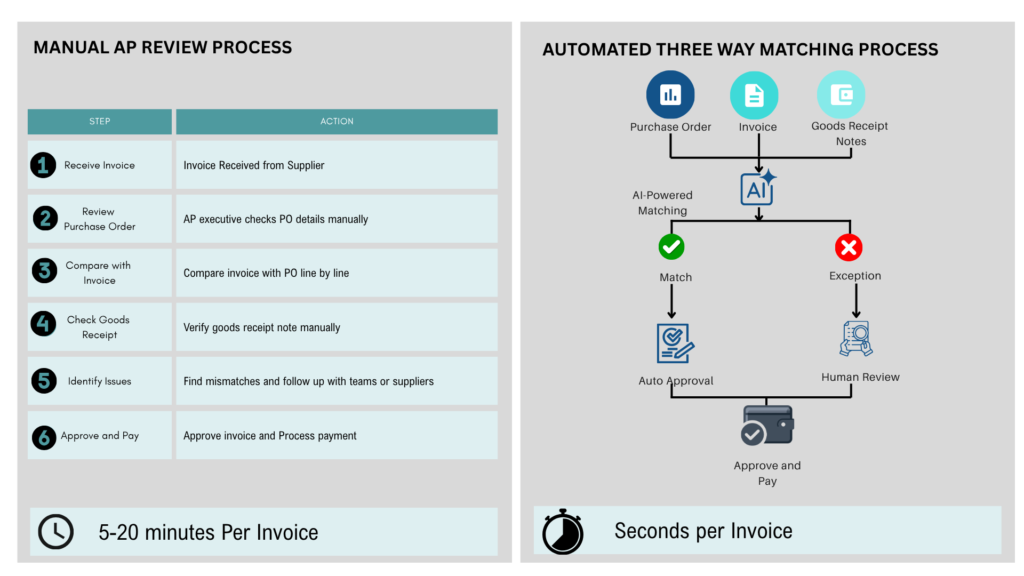
In a manual process, an accounts payable executive compares three documents:
- Purchase Order (PO)
- Goods Receipt Note (GRN)
- Supplier Invoice
The reviewer checks that:
- Product descriptions match
- Quantities are correct
- Prices are accurate
- Taxes are applied correctly
- Delivery has been completed
If everything matches, the invoice is approved for payment. If not, someone must contact procurement or the supplier to resolve the issue.
For businesses processing hundreds or thousands of invoices every month, this can become time-consuming.
How Automated Three-Way Matching Works
Automated matching uses predefined business rules to compare the same documents electronically.
The software automatically checks:
- PO details
- Invoice values
- Quantity received
- Unit pricing
- Tax calculations
- Vendor information
If everything matches within the company’s approval limits, the invoice moves forward automatically. Only exceptions are sent to the finance team for review.
This allows accounts payable professionals to focus on resolving genuine issues instead of reviewing every invoice.
How Much Time Can Automation Save?
The biggest advantage is speed.
A manual review may take anywhere from 5 to 20 minutes per invoice depending on complexity.
Automated matching usually completes the same validation in a few seconds.
For example, consider a company processing 2,000 invoices every month.
With manual review:
- Average review time: 10 minutes
- Total review time: 20,000 minutes
- More than 330 hours of work every month
With automated matching:
- Most invoices are matched automatically
- Finance teams only investigate exceptions
- Invoice approvals happen much faster
The exact savings depend on invoice volume and business rules, but many organisations reduce manual effort by more than 70%.
Faster Payments Strengthen Supplier Relationships
Delays in invoice approval often lead to delayed payments.
Late payments can:
- Affect supplier trust
- Increase payment disputes
- Miss early payment discounts
- Interrupt procurement cycles
Automated matching shortens approval times, allowing businesses to pay suppliers on schedule while maintaining healthy cash flow.
This becomes even more valuable for organisations using distribution automation, secondary sales automation, and order automation, where supplier relationships directly affect product availability.
Better Accuracy Means Fewer Costly Errors
Manual reviews are vulnerable to mistakes.
An invoice might be approved despite:
- Incorrect pricing
- Duplicate invoices
- Quantity differences
- Missing receipts
- Incorrect supplier details
Automated matching checks every invoice using the same validation rules every time.
This improves consistency while reducing duplicate payments and accounting errors.
Better Visibility Across the Business
Modern AP automation platforms integrate with ERP systems, procurement software, and inventory systems.
This provides real-time visibility into:
- Invoice status
- Outstanding approvals
- Supplier payments
- Purchase orders
- Goods receipts
That visibility also supports inventory replenishment, helping procurement teams understand which purchases have been received and processed.
When combined with warehouse automation and logistics automation, businesses gain better control over both financial and operational workflows.
Supporting Supply Chain Efficiency
Three-way matching is not only a finance process.
It depends on accurate purchasing, receiving, and inventory data.
Businesses investing in supply chain AI often connect AP automation with:
- Procurement systems
- Inventory management
- Warehouse operations
- Supplier portals
- ERP platforms
This creates smoother information flow across departments and reduces delays caused by missing or incorrect data.
The Role of AI in Automated Matching
Modern solutions are moving beyond simple rule-based automation.
AI can:
- Identify unusual invoice patterns
- Detect duplicate invoices
- Recommend approval actions
- Learn common supplier behaviours
- Prioritise high-risk exceptions
Instead of checking every invoice manually, finance teams review only those that genuinely need attention.
This intelligent approach fits naturally alongside sales automation, sales intelligence, and broader retail automation initiatives that improve decision-making across the business.
More Than Just Faster Invoice Processing
Three-way matching automation also supports broader operational improvements.
Businesses can combine AP automation with:
- Demand forecasting for purchasing decisions
- Omnichannel order management for inventory visibility
- FMCG automation for faster distribution
- Supply chain automation for connected workflows
- Inventory automation for real-time stock updates
- Logistics AI for shipment visibility
- Distributor management for supplier coordination
Instead of treating accounts payable as an isolated finance function, organisations can make it part of an integrated business operation.
Conclusion
Automated three-way matching is significantly faster than manual invoice review because it validates purchase orders, invoices, and goods receipts in seconds rather than minutes. Beyond saving time, it improves accuracy, reduces duplicate payments, accelerates approvals, and strengthens supplier relationships. As organisations continue investing in digital operations, automated matching becomes an important building block for efficient finance and supply chain processes.
Yodaplus Agentic AI for Supply Chain & Retail Operations
Yodaplus helps retailers, distributors, manufacturers, and FMCG businesses modernise finance and supply chain operations with Agentic AI. Our intelligent automation solutions streamline three-way matching, invoice processing, procurement workflows, inventory management, logistics, and supplier collaboration. By connecting finance with broader supply chain automation, Yodaplus enables businesses to reduce manual work, improve operational visibility, and make faster, data-driven decisions.
FAQs
Automated matching validates invoices in seconds, while manual reviews often take between 5 and 20 minutes per invoice, depending on complexity.
No. It automatically approves matching invoices and sends only exceptions to finance teams for manual investigation.
Yes. Automated validation helps identify duplicate invoices, pricing mismatches, quantity differences, and missing receipts before payment is approved.
Retailers, manufacturers, distributors, FMCG companies, wholesalers, and organisations processing high invoice volumes benefit the most.
Yes. Most modern AP automation solutions integrate with ERP, procurement, inventory, and warehouse systems to provide real-time visibility and faster invoice processing.