
How Intelligent Document Processing Impacts Financial Automation
January 21, 2026 By Yodaplus
Financial automation has improved how banks handle transactions, approvals, and reporting. Yet many automation initiatives stall before delivering full value. The reason is rarely technology alone. It is documents. Documents sit at the center of financial workflows. Until they are handled intelligently, finance automation remains incomplete. This is where intelligent document processing has a direct and lasting impact.
This blog explains how intelligent document processing changes financial automation in real terms and why it has become essential for automation in financial services.
Financial automation still breaks at documents
Banks automate structured data well. Transactions, balances, and records move smoothly through systems. But documents do not.
Invoices, contracts, statements, disclosures, and research files arrive in varied formats. They require reading, interpretation, and validation. Humans step in. Automation pauses.
This is why banking automation often covers only part of the workflow. Documents interrupt the flow and slow decisions.
Without addressing documents, financial services automation cannot scale.
What intelligent document processing changes
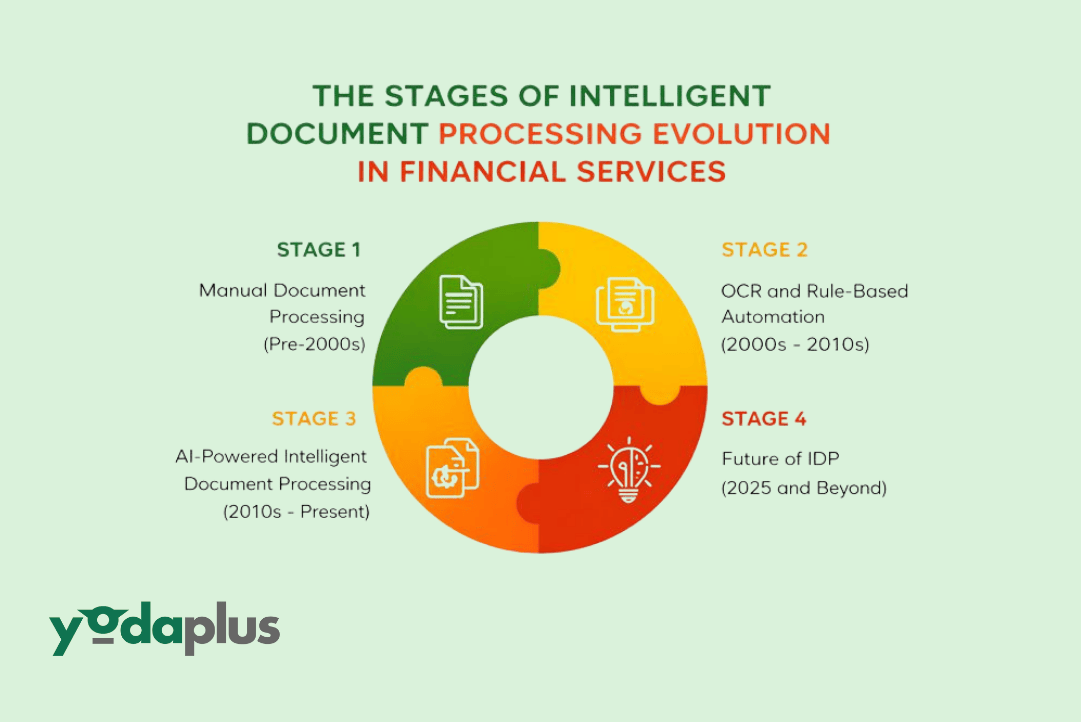
Intelligent document processing uses artificial intelligence in banking to convert documents into structured data.
Instead of treating documents as static files, IDP reads them, understands context, extracts key information, and validates accuracy. The output is usable data that systems can act on.
This shift turns documents into active inputs for workflow automation.
The impact is immediate. Manual steps reduce. Processing time improves. Errors decrease.
IDP as a trigger for end to end automation
Financial automation works best when workflows move without interruption.
IDP enables this by feeding clean data directly into banking process automation. Approvals trigger automatically. Exceptions route correctly. Reports update without rework.
This allows financial process automation to extend beyond transactions into decision workflows.
Automation stops being partial and becomes continuous.
Impact on banking operations
In core banking operations, IDP improves speed and consistency.
Customer onboarding becomes faster when documents are validated automatically. Compliance workflows benefit from structured, searchable records. Operations teams handle fewer manual checks.
By integrating IDP with banking AI, banks reduce friction without losing control.
This balance is critical in regulated environments.
Impact on investment and equity research
Documents are central to investment research and equity research.
Analysts work with filings, earnings transcripts, and disclosures. Manual review limits scale and slows insight generation.
With ai in investment banking, intelligent document processing extracts financial metrics and organizes qualitative information. This supports faster creation of an equity research report.
An automated equity report helps analysts focus on interpretation instead of document handling.
IDP improves productivity without replacing expertise.
Reducing risk in automated workflows
Manual document handling introduces risk. Data may be incomplete or inconsistent. Errors travel downstream unnoticed.
IDP reduces this risk through validation and traceability. Every extracted value links back to a source document. Anomalies are flagged early.
In financial process automation, this improves accuracy and audit readiness.
Automation becomes safer, not just faster.
Improving accountability and transparency
As automation expands, accountability becomes more important.
IDP strengthens accountability by maintaining document lineage. Decisions reference structured inputs. Reviews trace back to original documents.
In ai in banking and finance, this transparency supports audits, regulatory reviews, and internal governance.
Automation that can explain itself earns trust.
Why OCR alone limits automation impact
Many banks believe they automate documents because they use OCR. OCR extracts text but does not understand meaning.
OCR output still requires manual interpretation. It does not validate context or integrate naturally with workflow automation.
Intelligent document processing goes further. It understands structure, intent, and relevance.
This difference explains why OCR-based automation stalls while IDP-based financial services automation continues to grow.
Human oversight remains essential
IDP does not remove humans from financial workflows.
Exceptions still require review. Models require monitoring. Business rules evolve.
In banking automation, humans remain accountable for outcomes. IDP removes repetitive work so people can focus on decisions.
This balance ensures sustainable automation.
IDP as a strategic automation layer
Intelligent document processing is no longer optional for financial institutions.
As volumes grow and regulations tighten, manual document handling becomes unsustainable. IDP enables scale without sacrificing control.
Combined with AI in banking and finance automation, IDP becomes a strategic layer that supports long-term efficiency.
Conclusion
Intelligent document processing has a direct impact on financial automation by removing the biggest bottleneck in financial workflows. It converts documents into structured data that systems can use reliably.
When combined with banking automation, workflow automation, and AI in banking, IDP enables end to end automation that is faster, safer, and more transparent.
At Yodaplus Automation Services, we help financial institutions design intelligent document processing solutions that strengthen automation across operations, compliance, and research. Our focus is on automation that works in real financial environments, not just in theory.