
How Did Unbundling Change the Way Equity Research Gets Paid For?
July 23, 2026 By Yodaplus
Research unbundling transformed equity research from a bundled service attached to trading commissions into a standalone product with a transparent price. Before MiFID II, investment firms typically paid brokers a single commission that covered both trade execution and research. After the regulation took effect, research had to be priced and paid for separately, forcing investment banks, asset managers, and independent research firms to rethink their business models.
The change was more than an accounting adjustment. It reshaped how research budgets were managed, how analysts demonstrated value, and how investment firms decided which research providers to retain.
How Equity Research Was Paid Before Unbundling
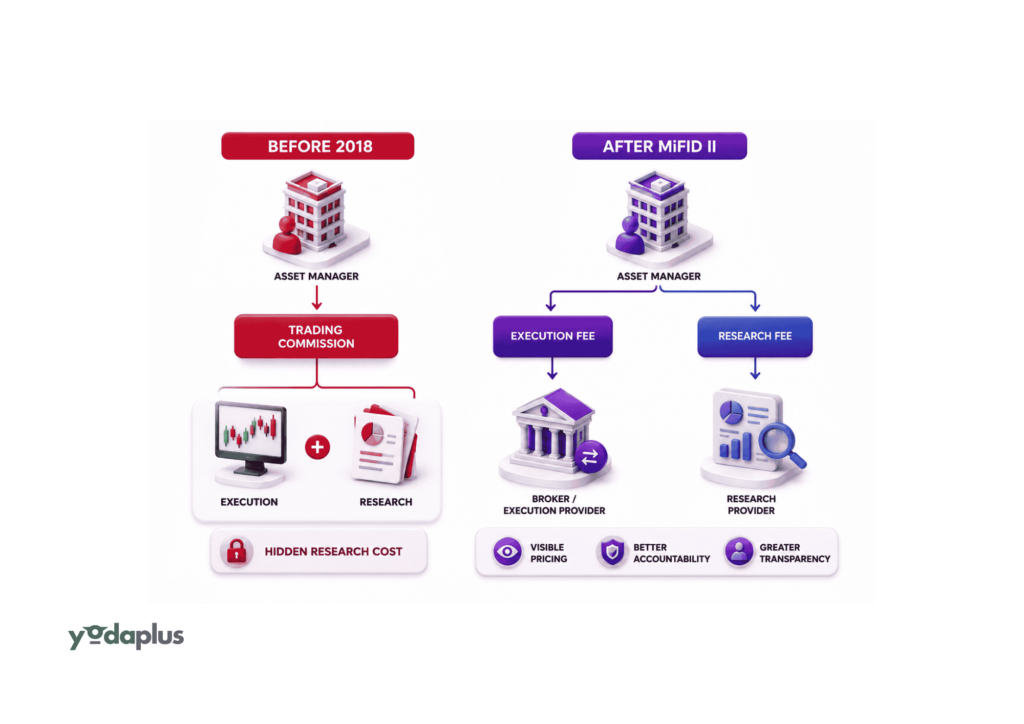
For many years, research was bundled with execution services.
When an asset manager executed trades through a broker, they paid a commission that covered:
- Trade execution
- Equity research
- Analyst meetings
- Company access
- Market commentary
Research did not have a separate invoice or subscription fee. Instead, its cost was embedded within trading commissions.
This meant many firms had only limited visibility into how much they were actually spending on research.
Why Regulators Changed the Model
European regulators believed the bundled model created several issues.
Research appeared “free,” even though investors ultimately paid for it through trading costs.
This raised concerns about:
- Limited pricing transparency
- Conflicts of interest
- Excessive trading activity
- Difficulty evaluating research quality
MiFID II introduced research unbundling to make research spending visible and encourage more informed purchasing decisions.
What Changed Under MiFID II?
The biggest change was straightforward.
Trade execution and research became two separate services.
Investment firms could no longer pay for research using bundled trading commissions.
Instead, firms had to either:
- Pay directly from their own operating budgets.
- Use a Research Payment Account (RPA) funded transparently on behalf of clients.
Research providers now needed clear pricing models rather than relying on execution revenue.
Research Became a Product Instead of a Perk
Once research carried an explicit price, firms evaluated it much more carefully.
Questions that previously received little attention became central to purchasing decisions.
For example:
- Does this research improve investment performance?
- Is this analyst worth the subscription cost?
- Which sectors require external research?
- Can internal research replace external providers?
Research became a measurable business service rather than an automatic part of trading relationships.
Asset Managers Took Greater Control of Research Budgets
Research budgets became far more disciplined after unbundling.
Instead of paying for large research packages, asset managers increasingly focused on providers delivering consistent value.
Many firms:
- Reduced the number of research subscriptions.
- Negotiated pricing more aggressively.
- Measured research usage.
- Prioritized specialist providers.
- Built internal research capabilities.
The emphasis shifted from quantity to quality.
Investment Banks Had to Justify Their Research
Research departments experienced significant commercial pressure.
Since research revenues were no longer linked to trading commissions, investment banks had to demonstrate why clients should pay for their analysis.
Many organizations responded by:
- Launching subscription models.
- Offering premium analyst access.
- Producing more specialized research.
- Investing in technology.
- Consolidating analyst coverage.
Research increasingly operated like an independent business unit.
Independent Research Providers Found New Opportunities
Unbundling also benefited smaller research firms.
Without bundled execution relationships dominating the market, specialist providers could compete based on expertise alone.
Many focused on areas such as:
- Sector-specific research
- ESG analysis
- Alternative data
- Regional markets
- Quantitative research
Clients gained greater flexibility to combine research from multiple independent providers.
Technology Became Essential
Lower research budgets meant analysts had to produce more work with fewer resources.
Technology became an important productivity tool.
Research teams increasingly adopted platforms that automate:
- Financial data collection
- Earnings monitoring
- Company filings
- News tracking
- Peer comparisons
- Financial modeling
- Report formatting
This reduced manual work and shortened report preparation time.
AI Is Further Changing Research Economics
Artificial intelligence is accelerating another shift in how research is produced.
AI can quickly analyze:
- Annual reports
- Quarterly filings
- Earnings transcripts
- Regulatory announcements
- Industry news
- Financial statements
Rather than spending hours gathering information, analysts can concentrate on interpreting results, evaluating risks, and developing investment recommendations.
For firms operating under tighter research budgets, AI provides a practical way to improve productivity without sacrificing research quality.
Has Research Quality Improved?
Research quality is now judged more directly because clients pay for it separately.
Investment firms increasingly evaluate research providers based on:
- Accuracy
- Timeliness
- Sector expertise
- Original insights
- Data quality
- Investment relevance
Providers producing differentiated, high-quality research are better positioned to retain long-term client relationships.
The Long-Term Impact
Research unbundling permanently changed the economics of equity research.
It encouraged:
- Transparent pricing
- Better budget control
- Greater competition
- More efficient research production
- Increased technology adoption
Although the transition created challenges for traditional research business models, it also encouraged innovation throughout the investment research industry.
Conclusion
Research unbundling fundamentally changed how equity research is financed by separating research payments from trading commissions. What was once considered an included service became a standalone product with measurable value and transparent pricing. This forced investment banks to rethink research pricing, encouraged asset managers to manage research budgets more carefully, and created opportunities for independent research providers. It also accelerated investment in automation and AI, enabling research teams to deliver higher-quality analysis with greater efficiency.
Yodaplus Agentic AI for Financial Operations helps investment banks, asset managers, wealth managers, and institutional research teams modernize equity research through intelligent automation. Using Agentic AI, financial data processing, document intelligence, workflow orchestration, and automated report generation, Yodaplus enables organizations to streamline research production, reduce manual effort, accelerate report delivery, and improve the consistency and quality of investment insights.
FAQs
Research unbundling is the separation of research payments from trade execution fees, allowing investment firms to purchase research independently.
MiFID II introduced unbundling to improve pricing transparency, reduce conflicts of interest, and give investors greater visibility into research costs.
Asset managers became more selective about the research they purchased, negotiated pricing more carefully, and monitored research budgets more closely.
Yes. Investment banks had to develop new pricing models for research, justify the value of their analysis, and improve operational efficiency.
AI automates data collection, document analysis, financial modeling, report generation, and research workflows, allowing analysts to spend more time on investment analysis and strategic decision-making.