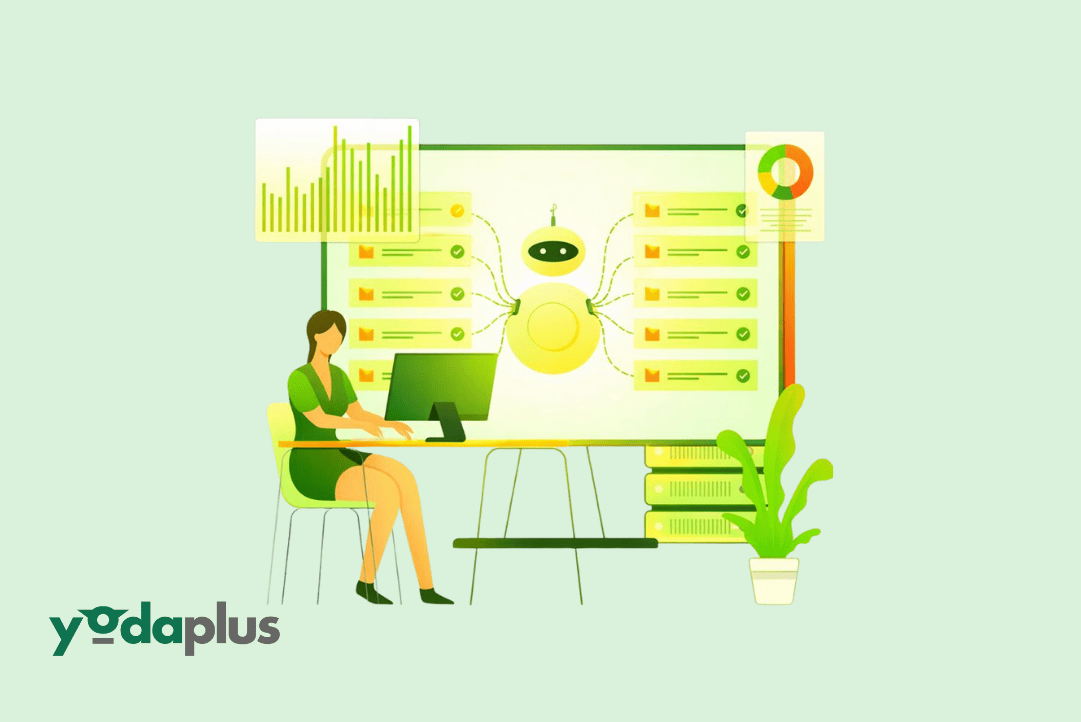
Productivity across teams often breaks down because work is fragmented. Tasks move between tools, approvals take time, and people spend hours coordinating instead of executing. This is where Agentic AI is starting to change how organisations work.
According to Gartner’s view on intelligent agents in AI, modern systems are moving beyond simple automation. Intelligent agents can plan, act, learn, and collaborate with humans and other agents. This shift explains why many enterprises now see agentic AI as a productivity multiplier rather than just another AI technology trend.
To understand this impact, it helps to revisit artificial intelligence in today’s workplace. Artificial Intelligence now operates as an active participant in work, not just a background tool.
From automation to agentic work
Traditional AI-powered automation focuses on single tasks. It automates one step in a process and then waits for the next instruction. This improves efficiency but does not transform how teams work together.
Agentic AI operates differently. It uses AI agents that can understand goals, break work into steps, and coordinate actions. These autonomous agents do not just execute tasks. They manage workflows.
This shift supports higher productivity across teams because work moves forward without constant handoffs.
What makes agentic AI different
Agentic systems are built on an agentic framework. This framework allows agents to reason, act, and collaborate. Gartner describes intelligent agents as systems that combine reasoning, memory, and action.
Key capabilities include:
-
Goal awareness using knowledge-based systems
-
Learning through machine learning and self-supervised learning
-
Decision-making powered by AI models and LLM
-
Coordination through multi-agent systems
These capabilities allow AI agents to support real work, not just automation scripts.
How agentic AI boosts team productivity
Productivity improves when teams spend less time coordinating and more time executing. Agentic AI productivity gains come from several areas.
First, workflow agents reduce manual coordination. Agents track task status, dependencies, and priorities. This removes the need for constant updates and follow-ups.
Second, AI-driven analytics help teams focus on high-impact work. Agents analyze data, flag risks, and surface insights without manual reporting.
Third, conversational AI improves access to information. Teams can ask questions in natural language instead of searching dashboards or documents.
Cross-team collaboration with AI agents
Modern organisations rely on cross-functional teams. This often creates delays due to misaligned priorities and unclear ownership.
Multi-agent systems solve this problem by assigning agents to teams or functions. Each agent understands its role and shares updates with others. This shared context improves collaboration without extra meetings.
Using semantic search and vector embeddings, agents retrieve relevant information across tools and systems. This ensures everyone works with the same data.
Role of generative AI and LLMs
Generative AI plays a key role in productivity improvements. Generative AI software helps teams summarize updates, draft responses, and generate insights.
LLM-powered agents translate complex data into clear explanations. This reduces cognitive load and speeds up decision-making.
With prompt engineering, organizations guide how agents respond and act. This ensures consistency across teams and workflows.
Agentic AI in everyday business operations
Artificial Intelligence in business now supports daily operations across departments.
Examples include:
-
Operations teams using AI applications to monitor workflows
-
Finance teams using AI-powered automation for reporting
-
IT teams using autonomous systems for system health checks
-
Product teams using AI innovation for faster feedback loops
These agentic AI use cases show how productivity scales without increasing headcount.
Explainability and trust in agentic systems
For teams to rely on agents, trust is essential. Explainable AI ensures agents can explain their actions. Teams need to understand why a task was prioritized or an alert was raised.
Responsible AI practices also support adoption. Clear boundaries, transparent decision logic, and strong AI risk management help teams work confidently with agents.
This focus supports reliable AI across enterprise environments.
Technical foundations behind productivity gains
Agentic productivity relies on strong technical foundations:
-
AI agent frameworks for coordination
-
MCP for managing context, memory, and roles
-
AI model training to adapt to workflows
-
AI systems designed for scalability
Together, these elements create agentic AI platforms that support teams at scale.
Preparing teams for the future of work
The future of AI at work is collaborative. Humans define goals and strategy. Agents handle execution, monitoring, and optimization.
As AI frameworks mature, teams will rely more on autonomous AI to manage routine work. This frees people to focus on creativity, problem-solving, and growth.
Conclusion
Agentic AI improves productivity across teams by reducing coordination overhead, accelerating decisions, and enabling continuous execution. With AI agents, agentic AI frameworks, and AI-powered automation, organizations can scale work without increasing complexity.
For enterprises looking to adopt agentic systems that align people, processes, and technology, Yodaplus provides the expertise to design and implement intelligent, scalable, and responsible AI-driven productivity solutions.