
Banking vs Financial Services vs Insurance: Key Differences Explained
July 21, 2026 By Yodaplus
Banking, financial services, and insurance are closely connected but serve different purposes within the BFSI ecosystem. Banking focuses on managing money through deposits, lending, and payments. Financial services cover a broader range of offerings such as investments, wealth management, capital markets, and advisory services. Insurance helps individuals and businesses manage financial risk by providing protection against unforeseen events.
Although these sectors have distinct responsibilities, they increasingly rely on the same technologies to improve efficiency, strengthen compliance, and deliver better customer experiences. With rising customer expectations, growing regulatory requirements, and increasing operational complexity, organizations across the BFSI industry are turning to Agentic AI for Financial Operations to automate workflows, improve decision-making, and reduce manual effort.
Understanding the differences between banking, financial services, and insurance helps organizations identify the right technology investments while recognizing how AI can support every part of the financial ecosystem.
What Is Banking?
Banking refers to financial institutions that accept deposits, provide loans, facilitate payments, and offer everyday financial services to individuals and businesses.
Common banking services include:
- Savings and current accounts
- Personal and business loans
- Credit cards
- Mortgages
- Payment processing
- Foreign exchange
- Digital banking
Banks generate revenue primarily through interest income, transaction fees, and lending activities.
Today, banks also compete on customer experience, digital services, and operational efficiency, making automation and AI increasingly important.
What Are Financial Services?
Financial services is a much broader category that includes banking along with many other financial activities.
It covers organizations such as:
- Investment banks
- Asset management firms
- Wealth management companies
- Stock brokers
- Mutual fund providers
- Financial advisors
- Payment companies
- Fintech platforms
These organizations help individuals and businesses invest capital, manage wealth, raise funds, trade securities, and access financial products.
Unlike traditional banks, financial services companies often specialize in investment management, advisory services, portfolio management, or capital markets.
What Is Insurance?
Insurance focuses on protecting individuals and businesses against financial losses.
Insurance companies assess risk, collect premiums, and compensate policyholders when covered events occur.
Common insurance products include:
- Health insurance
- Life insurance
- Motor insurance
- Property insurance
- Marine insurance
- Cyber insurance
- Business insurance
Insurers rely heavily on risk assessment, underwriting, claims management, and fraud detection to remain profitable.
Banking vs Financial Services vs Insurance
Although these industries overlap, their primary objectives differ.
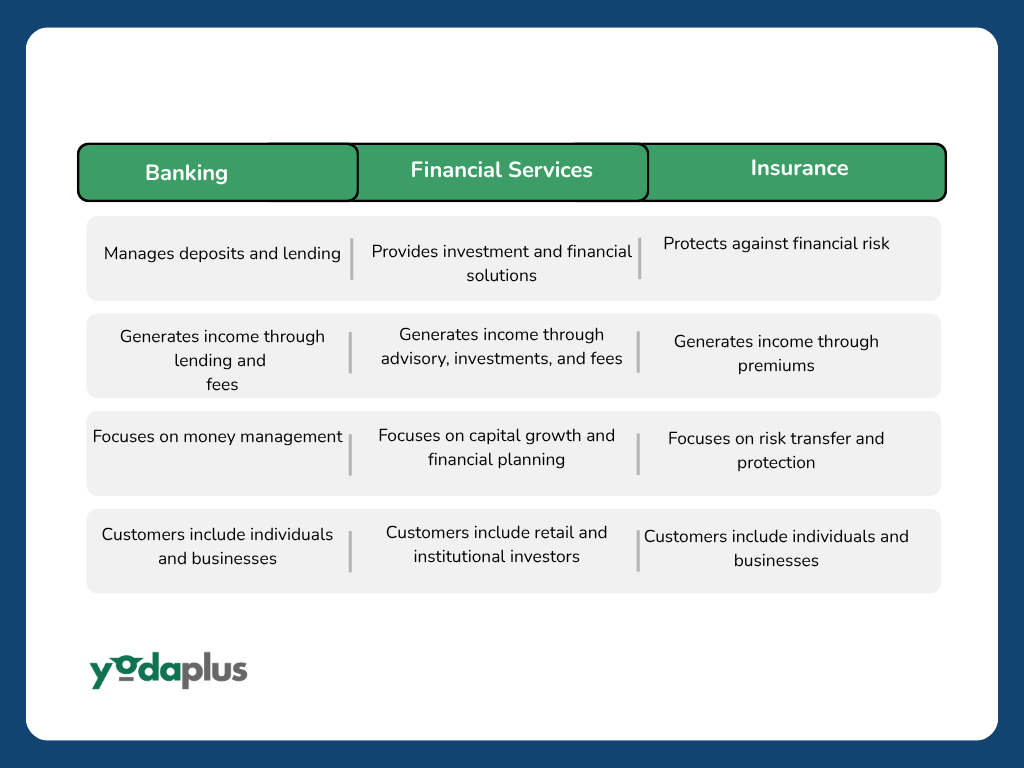
Together, these sectors form the backbone of the BFSI industry.
Challenges Across the BFSI Sector
Despite serving different purposes, banking, financial services, and insurance organizations face many common operational challenges.
These include:
- Increasing regulatory requirements
- Large volumes of financial data
- Manual approval processes
- Fraud risks
- Customer onboarding delays
- Complex reporting obligations
- Legacy systems
- Rising customer expectations
Managing these challenges requires more than isolated automation. It requires intelligent systems that can coordinate complex financial workflows across multiple departments and enterprise applications.
How Agentic AI Is Transforming Financial Operations
Traditional automation performs predefined tasks such as generating reports or validating transactions.
Agentic AI goes much further.
It can understand business objectives, gather information from multiple systems, make operational decisions within defined policies, coordinate workflows, and adapt when new information becomes available.
Instead of automating individual activities, Agentic AI automates complete financial processes.
Applications of Agentic AI in Banking
Banks manage thousands of transactions and customer interactions every day.
Agentic AI can support banking operations by:
- Automating customer onboarding
- Coordinating loan processing
- Monitoring fraud risks
- Managing compliance workflows
- Generating regulatory reports
- Supporting credit assessments
- Automating document verification
- Managing dispute resolution
Rather than requiring employees to manually coordinate every step, intelligent agents keep workflows moving while escalating exceptions when necessary.
Applications in Financial Services
Financial institutions depend on timely information and accurate analysis.
Agentic AI can assist by:
- Preparing investment research
- Monitoring market developments
- Supporting portfolio analysis
- Automating financial reporting
- Conducting due diligence
- Managing client onboarding
- Tracking regulatory obligations
- Generating performance reports
This reduces administrative work and allows analysts to focus on strategic decisions.
Applications in Insurance
Insurance operations involve multiple stakeholders, documents, and approvals.
Agentic AI can help automate:
- Policy issuance
- Claims processing
- Underwriting support
- Fraud detection
- Customer service
- Compliance reporting
- Renewal management
- Risk assessment
Claims that previously required manual coordination across several departments can move through the process much faster with intelligent workflow orchestration.
Why Agentic AI Is Different From Traditional Automation
Traditional automation follows predefined rules.
For example:
- Send payment reminders.
- Generate monthly compliance reports.
- Validate standard forms.
Agentic AI coordinates complete financial workflows.
For example, during a commercial loan application it can:
- Collect customer documents.
- Verify identity.
- Retrieve credit history.
- Assess financial risk.
- Request missing information.
- Route approvals.
- Generate loan documentation.
- Notify customers of the outcome.
The system continuously adapts if information changes or approvals are delayed, making it far more effective for complex financial operations.
Choosing the Right AI Strategy for BFSI
Not every financial process requires Agentic AI.
Organizations should prioritize workflows that involve:
- Multiple systems
- Frequent approvals
- Regulatory requirements
- High transaction volumes
- Manual coordination
- Complex decision-making
Examples include:
- Customer onboarding
- Loan origination
- KYC verification
- Claims management
- Regulatory reporting
- Fraud investigations
- Portfolio monitoring
- Financial reconciliations
These processes offer the greatest opportunity for intelligent automation.
Conclusion
Banking, financial services, and insurance each play a distinct role within the BFSI ecosystem, but they share a common need for greater efficiency, stronger compliance, and faster decision-making. As financial operations become more complex, organizations need more than traditional automation. They need intelligent systems that can coordinate workflows across departments, applications, and regulatory processes. Agentic AI enables this by automating end-to-end financial operations while helping teams respond quickly to changing business conditions.
Yodaplus Agentic AI for Financial Operations helps banks, financial institutions, insurers, and fintech companies automate complex workflows using Agentic AI, banking automation, financial services technology, insurance automation, and enterprise AI. From customer onboarding and KYC verification to regulatory reporting, fraud monitoring, claims processing, and financial analysis, Yodaplus enables BFSI organizations to improve operational efficiency, strengthen compliance, and deliver better customer experiences through intelligent automation.
FAQs
Banking focuses on deposits, lending, and payments. Financial services include investments, wealth management, capital markets, and advisory services, while insurance protects individuals and businesses against financial risks.
They all provide financial products and services, operate under similar regulatory frameworks, and increasingly rely on shared technologies for digital transformation and operational efficiency.
Agentic AI automates complex workflows such as customer onboarding, KYC verification, loan processing, fraud detection, regulatory reporting, claims management, portfolio analysis, and compliance monitoring.
Yes. Agentic AI can gather data from multiple systems, validate information, prepare reports, monitor deadlines, and coordinate compliance workflows while maintaining audit trails and governance.
Yodaplus develops Agentic AI for Financial Operations that integrates with core banking platforms, insurance systems, ERP applications, CRM software, and regulatory tools to automate end-to-end financial workflows, improve decision-making, and enhance operational efficiency.