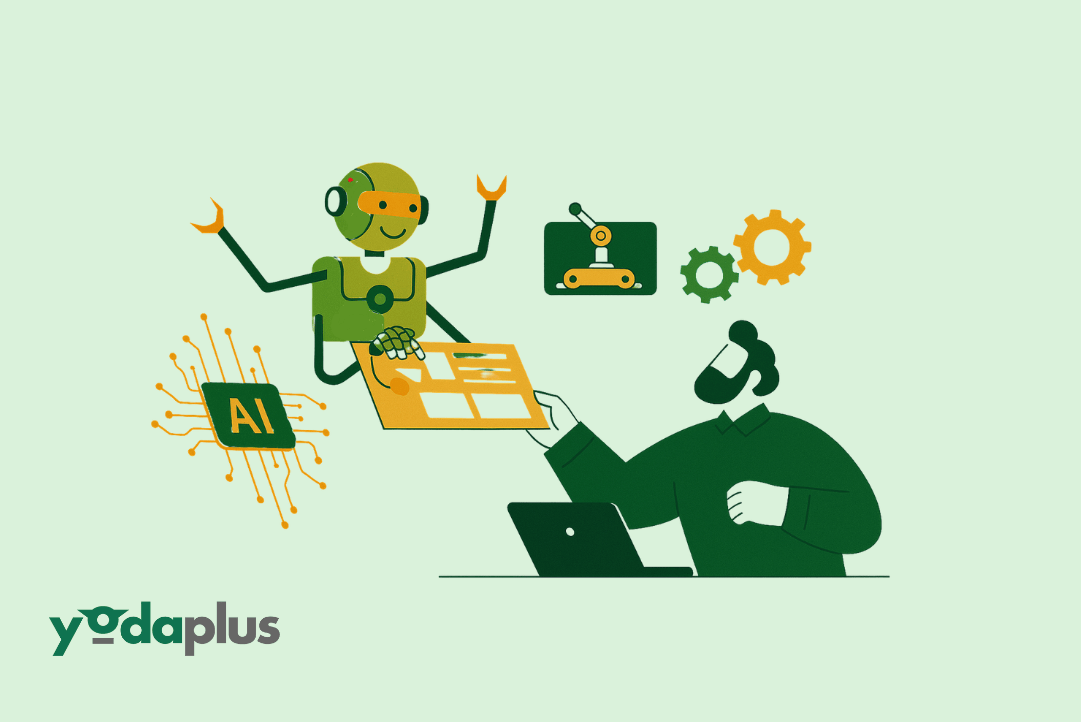
AI Driven Workflow Automation with Agentic AI
December 2, 2025 By Yodaplus
AI-driven workflow automation is becoming one of the most important shifts in modern technology. Companies in retail, supply chain, logistics, and finance are moving from isolated tools to intelligent automation powered by artificial intelligence. This transformation is possible because of agentic AI, crew AI, MCP, and agentic AI platforms that can understand goals, plan steps, and complete tasks with very little manual help. Workflow automation is no longer about simple triggers. It now includes AI agents that think, coordinate, and improve results in real time.
Many organizations that use retail supply chain software and retail technology solutions are beginning to see that automation alone is not enough for the speed required today. Traditional workflows depend on human intervention at many points. When tasks move slowly or get stuck, operations suffer. With agentic AI applications and agentic ops, workflows can run faster, adapt to change, and support teams that handle everything from inventory optimization to retail supply chain management.
This blog explains how AI driven workflow automation works, why agentic AI is the next major step, and how industries can take advantage of tools such as agentic AI frameworks, MCP, LangChain, Autogen, and role AI for better end to end operations.
Understanding AI Driven Workflow Automation
Workflow automation used to be rule based. A task would move from one step to another based on fixed logic. This model works for predictable tasks but fails when conditions change. Modern supply chain technology, retail and supply chain operations, commerce platforms, and global logistics networks require systems that can learn and make decisions. This is where artificial intelligence helps.
AI driven workflow automation combines structured workflows with intelligence from AI agents. These AI agents can read data, detect patterns, choose the best path, and coordinate with other tools. They can support areas like retail supply chain digitization, retail supply chain services, and digital retail solutions where processes need constant adjustment.
Agentic AI capabilities allow systems to understand goals instead of waiting for rigid instructions. For example, an AI agent in a retail supply chain can notice when stock levels drop, check delivery schedules, predict delays, and recommend replenishment. This is what creates an autonomous supply chain that can react without manual involvement.
Why Agentic AI Changes Workflow Automation
Agentic AI is different from traditional AI. It does not only classify data or generate content. It can move through steps, plan actions, pick tools, and complete tasks. This approach is powered by agentic frameworks and agentic AI tools that help create flexible workflows.
Benefits include:
1. Autonomous decision making
AI agents in supply chain teams can monitor supplier performance, delivery speed, and route disruptions. They can take action inside retail supply chain automation software to adjust scheduling or escalate urgent issues.
2. Coordination among many systems
Modern businesses use many platforms. Agentic AI platforms allow communication across CRM systems, ERP systems, WMS systems, and retail logistics supply chain networks. AI agents can connect these data sources in real time.
3. Better visibility and control
When workflows run through agentic AI, teams get cleaner dashboards, faster alerts, and stronger tracking. This helps reduce errors that normally happen in manual or semi automated environments.
4. Faster response to changing demand
Retail supply chain digital transformation requires fast reaction to sales trends. Agentic AI supports retail AI performance by predicting demand and adjusting workflows for restocking or warehouse planning.
Agentic AI is also useful outside retail. In maritime operations, for example, AI agents can track ship documents, flag missing data, and maintain compliance. This shows that agentic AI has wide relevance beyond a single industry.
How MCP, LangChain, and Autogen Improve AI Driven Automation
AI agents need a strong foundation. This is where frameworks come in.
What is MCP
MCP, also called Model Context Protocol, gives AI agents a standard method for interacting with external tools and data sources. MCP use cases include workflow coordination, document processing, analytics, and automation. MCP can connect agents with APIs, warehouses, or cloud services.
MCP vs LangChain
LangChain is a framework that helps developers build LLM powered applications. It supports chains, memory, and tool execution. MCP focuses on interoperability. LangChain vs MCP comparison often shows that LangChain is ideal for building workflows inside an app, while MCP is ideal for connecting different systems. Many teams use both together.
Autogen vs LangChain
Autogen supports multi agent collaboration. LangChain focuses on building single agent tools. Autogen helps teams that want many agents to work together. For example, an AI planner agent can design a workflow, and a worker agent can complete the steps.
Autogen MCP
When Autogen combines with MCP, developers get a powerful setup. Agents can communicate with each other and use tools safely. This creates a flexible architecture for agentic AI platforms.
AI Agents in Retail and Supply Chain Workflows
Retail and supply chain operations are complex. Many companies face delays, manual bottlenecks, stock issues, and communication gaps. AI agents in supply chain management can change this by supporting:
1. Inventory Optimization
AI agents can read sales patterns, supplier timelines, and warehouse limits. Based on this data, they adjust orders and stock levels. This improves retail supply chain solutions and reduces waste.
2. Order Management
Retail supply chain digital solutions depend on fast order processing. AI agents can route orders, detect exceptions, and manage returns.
3. Logistics and Delivery
Retail logistics supply chain networks need constant coordination. AI agents can manage shipping schedules and find alternative routes when delays appear.
4. Workforce Support
AI agents can help teams by triggering alerts, retrieving data, or preparing reports. This helps teams focus on high value tasks.
5. Retail industry supply chain solutions
From forecasting to warehouse routing, agentic AI frameworks support real time adjustments.
AI driven workflow automation becomes an advantage in global markets where speed defines success.
AI Agents Beyond Retail and Supply Chain
Agentic AI platforms also help in finance, manufacturing, and maritime operations.
Equity Research Support
AI agents can collect documents, analyze financial statements, and summarize insights. This improves what is equity research by reducing manual review time.
Maritime Documentation Workflows
Ship documents are difficult to track. Products with AI agents like OceanDocs AI, can organize certificates, track expiry dates, and maintain compliance.
Enterprise Workflow Support
Teams that manage HR, procurement, or compliance benefit from AI agents that automate paperwork, schedule actions, or detect risks.
How Agentic Frameworks Improve Reliability
Agentic AI must behave safely. Agentic frameworks define what an agent can do and which tools it can access. They set limits on actions and track results with logs. This allows safe execution inside enterprise environments.
Role AI divides tasks among specialized agents. For example, one agent checks data, one agent validates results, and one agent writes output. This division improves accuracy.
Agentic AI MCP configurations ensure tools are used safely. Every request passes through permission layers. This gives organizations confidence in automation.
Building an Autonomous Supply Chain
An autonomous supply chain uses technology supply chain systems powered by AI agents. These systems detect problems early and take corrective action.
An autonomous supply chain includes:
-
AI agents that monitor stock
-
AI agents that schedule shipments
-
AI agents that track supplier performance
-
AI agents that handle exception workflows
With retail supply chain automation software and agentic AI platforms, businesses can create a continuous improvement cycle. Every event helps the AI learn and optimize future flows.
Conclusion
Agentic AI tools and agentic AI platforms help companies move away from rigid automation and toward flexible systems that support retail and supply chain services, maritime documentation, equity research, and many other workflows. With partners like Yodaplus guiding the design and deployment of these systems, businesses can adopt agentic ops and role AI with confidence. This helps them build workflows that scale smoothly, adapt to change, and deliver consistent results.
AI driven workflow automation is no longer optional. It is the foundation for the next generation of retail supply chain digital transformation, retail technology solutions, and enterprise innovation. Yodaplus ensures that organizations can adopt these technologies safely, efficiently, and at the speed their industries demand.