
Agentic AI Platforms: 2026 Buyer’s Guide & Vendor Comparison
August 11, 2026 By Yodaplus
If you’re comparing Agentic AI platforms, start with your workflows—not the AI models. A platform that works well for building research assistants may not be the right choice for automating finance, procurement, customer service, or supply chain operations. The best Agentic AI platform is the one that fits your business processes, integrates with your enterprise systems, and supports secure, scalable AI workflow automation. This guide compares the leading vendors, explains what each platform does best, and highlights the features enterprises should evaluate before making an investment.
According to Gartner, more than 40% of enterprise applications are expected to include AI agents by 2026, while Deloitte reports that enterprises are shifting from isolated AI pilots to organisation-wide automation initiatives. As adoption grows, buyers are placing greater importance on governance, enterprise integrations, observability, and multi-agent AI rather than simply choosing the largest language model.
Why Agentic AI Platforms Matter
Most organisations already use AI in some form. They generate content, summarise meetings, or answer employee questions. However, these tasks represent only a small part of what AI can do.
Businesses are now looking for AI that can actually complete work.
That includes:
- Processing invoices
- Reviewing contracts
- Preparing financial reports
- Managing procurement workflows
- Monitoring compliance
- Supporting customer service
- Coordinating supply chain operations
Instead of answering prompts, AI agents execute business processes across multiple systems. This is why demand for enterprise AI, AI automation, and business process automation continues to grow.
What Is an Agentic AI Platform?
An Agentic AI platform provides everything needed to build, deploy, and manage intelligent AI agents.
Unlike traditional chatbots, these platforms allow agents to:
- Access enterprise applications
- Use APIs
- Retrieve company knowledge
- Make decisions
- Execute actions
- Collaborate with other AI agents
- Remember previous interactions
- Escalate exceptions to humans
Rather than responding to one request at a time, they manage complete workflows.
How Modern Agentic AI Platforms Work
Although every vendor approaches implementation differently, most platforms include several common components.
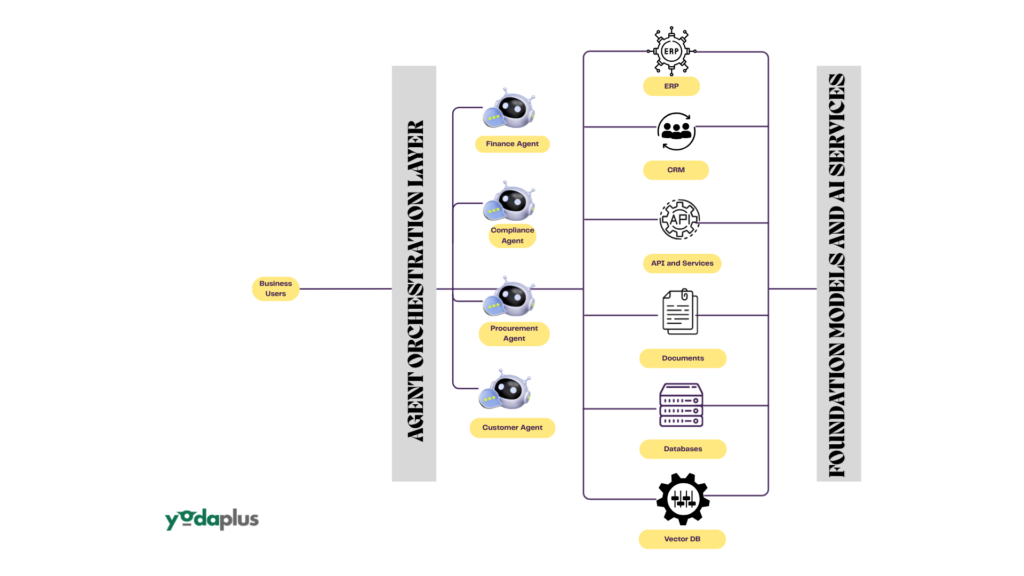
A modern enterprise AI solution usually combines:
- AI agents
- Large Language Models (LLMs)
- Memory
- Enterprise APIs
- Vector databases
- Workflow orchestration
- Security
- Monitoring
Together, these components allow AI-powered workflows to operate reliably across business systems.
Features Every Enterprise Buyer Should Look For
Every vendor claims to offer intelligent AI, but not every platform supports enterprise-scale deployments.
Before choosing a platform, evaluate whether it provides:
- Multi-agent orchestration
- Persistent memory
- Human approval workflows
- Enterprise integrations
- MCP support
- Security and access controls
- Workflow monitoring
- Audit trails
- API connectivity
- Flexible deployment options
These capabilities often matter more than model performance during production deployments.
LangGraph
LangGraph is one of the most popular frameworks for developers building sophisticated multi-agent AI systems.
It excels at:
- Stateful workflows
- Long-running processes
- Complex branching logic
- Human approvals
- Agent collaboration
It is ideal for engineering teams that want complete flexibility and are comfortable building custom applications.
CrewAI
CrewAI focuses on making multiple AI agents work together.
It is commonly used for:
- Research automation
- Report generation
- Content operations
- Business assistants
- Task delegation
Its lightweight architecture makes it popular for prototypes and production deployments alike.
Microsoft Copilot Studio
Microsoft Copilot Studio is designed for organisations already invested in Microsoft technologies.
Key strengths include:
- Microsoft 365 integration
- Power Platform
- Low-code development
- Enterprise security
- Workflow automation
It fits businesses looking for quick deployment inside the Microsoft ecosystem.
Salesforce Agentforce
Agentforce extends Salesforce CRM with intelligent AI agents.
It supports:
- Customer service
- Sales automation
- Case management
- CRM workflows
- Employee productivity
For Salesforce customers, it reduces the need for separate AI tools.
OpenAI Agents SDK
OpenAI’s Agents SDK gives developers the flexibility to build custom AI agents using OpenAI models.
It supports:
- Tool calling
- Memory
- Agent collaboration
- Function execution
- API integrations
It works well for organisations building bespoke enterprise applications.
Google Agent Development Kit
Google’s Agent Development Kit integrates with Vertex AI and Google’s cloud ecosystem.
It offers:
- Enterprise scalability
- Cloud-native deployment
- AI orchestration
- Search capabilities
- Machine learning infrastructure
It is best suited for businesses already running workloads on Google Cloud.
Amazon Bedrock Agents
Amazon Bedrock enables organisations to build AI agents using managed foundation models within AWS.
Features include:
- Secure enterprise deployment
- Knowledge base integration
- Workflow automation
- AWS services integration
- Enterprise scalability
It is a strong choice for AWS-first organisations.
IBM watsonx
IBM focuses heavily on governance and regulated industries.
Its platform provides:
- AI governance
- Compliance
- Model management
- Enterprise security
- Responsible AI
Banks, insurers, and healthcare organisations commonly choose IBM for its governance capabilities.
Yodaplus
Yodaplus focuses on delivering Agentic AI Services that solve real business problems rather than simply providing AI development frameworks.
Its capabilities include:
- Enterprise AI solutions
- AI workflow automation
- Multi-agent AI
- Intelligent document processing
- Financial operations
- Supply chain automation
- Retail automation
- Enterprise integrations
Rather than asking customers to build everything from scratch, Yodaplus develops production-ready solutions for BFSI, retail, supply chain, and enterprise operations using enterprise agentic AI.
Framework or Enterprise Platform?
Many buyers compare frameworks and enterprise platforms as though they are direct competitors.
They are not.
Frameworks are designed for developers.
They provide flexibility but require significant engineering effort.
Enterprise platforms are designed for business deployment.
They typically include:
- Governance
- User management
- Security
- Monitoring
- Workflow orchestration
- Business integrations
The right choice depends on your team’s technical expertise and business goals.
Build, Buy, or Combine Both?
Some organisations prefer building everything internally.
Others purchase commercial platforms.
A growing number take a hybrid approach.
Building offers:
- Complete flexibility
- Full architectural control
- Custom workflows
Buying offers:
- Faster deployment
- Lower implementation risk
- Vendor support
- Proven enterprise integrations
Many enterprises customise commercial platforms instead of starting from zero.
Common Buying Mistakes
Many AI platform decisions fail because buyers evaluate demonstrations rather than production capabilities.
Some of the biggest mistakes include:
- Choosing based only on the underlying LLM
- Ignoring governance
- Overlooking integrations
- Underestimating maintenance
- Focusing only on licence costs
- Forgetting observability
- Not involving business teams
- Ignoring scalability
These issues often become apparent only after deployment.
How to Evaluate an Agentic AI Vendor
Instead of asking which platform has the smartest AI, ask which platform best supports your business.
Evaluate vendors based on:
- Workflow automation capabilities
- Enterprise integrations
- Security
- Governance
- Multi-agent support
- Memory
- Observability
- Scalability
- Vendor expertise
- Implementation support
A platform should fit both your current operations and your long-term AI strategy.
What’s Next for Agentic AI Platforms?
The next generation of platforms will place greater emphasis on:
- Model Context Protocol (MCP)
- Agent-to-Agent (A2A) communication
- Persistent memory
- Multimodal AI
- Autonomous AI agents
- Enterprise AI governance
- AI process automation
- Self-improving workflows
Rather than acting as assistants, AI agents will increasingly coordinate business operations across multiple enterprise systems.
Conclusion
Choosing an Agentic AI platform is not about selecting the most advanced language model. It is about choosing a platform that can automate your workflows, integrate with enterprise systems, support governance, and scale with your business. Organisations that evaluate platforms based on operational needs rather than demonstrations are far more likely to achieve measurable business outcomes.
Yodaplus Agentic AI Services help enterprises deploy production-ready enterprise AI, AI workflow automation, multi-agent AI, and intelligent automation across financial services, supply chain, retail, and enterprise operations. By combining advanced AI agents with secure enterprise integrations, Yodaplus enables organisations to move beyond AI experimentation and build scalable, business-ready AI solutions.
FAQs
An Agentic AI platform enables organisations to build, deploy, and manage intelligent AI agents capable of automating complex business workflows.
Key features include multi-agent orchestration, memory, enterprise integrations, governance, observability, security, and workflow automation.
It depends on internal expertise. Building offers greater flexibility, while buying provides faster deployment and lower implementation risk. Many enterprises adopt a hybrid approach.
Banking, financial services, healthcare, retail, manufacturing, logistics, insurance, and customer service organisations are among the biggest adopters.
Governance ensures AI systems remain secure, compliant, transparent, and reliable while operating across critical business workflows.