E-Procurement Platforms and Catalog Management Automation
August 3, 2026 By Yodaplus
Procurement has moved far beyond paper purchase orders and email approvals. Modern organisations manage hundreds or even thousands of suppliers, products, contracts, and pricing agreements across multiple locations. Without a centralised procurement system, buyers often struggle with inconsistent pricing, duplicate suppliers, off-contract purchases, and manual approval delays.
E-procurement platforms solve these challenges by digitising the purchasing process, while catalog management automation ensures employees buy approved products at negotiated prices. Together, these technologies improve purchasing accuracy, reduce procurement costs, strengthen supplier relationships, and streamline the entire procure to pay process.
According to Deloitte, digital procurement technologies help organisations improve spend visibility, supplier collaboration, and operational efficiency while reducing manual purchasing activities.
What Is an E-Procurement Platform?
An e-procurement platform is a digital system that manages purchasing activities from supplier selection to purchase order creation and payment.
Instead of relying on emails, spreadsheets, or paper documents, procurement teams use one platform to manage purchasing requests, approvals, suppliers, contracts, and invoices.
Most platforms support:
- Vendor onboarding
- Supplier catalogs
- Purchase requisitions
- Purchase order automation
- Approval workflows
- Invoice processing
- Three-way matching
- Payment tracking
- Procurement analytics
By connecting procurement and finance, businesses gain greater visibility and control over organisational spending.
What Is Catalog Management?
Catalog management involves organising supplier products and services into a searchable digital catalog that employees can use during purchasing.
A catalog typically includes:
- Product descriptions
- Images
- Item codes
- Pricing
- Supplier information
- Contract details
- Availability
- Delivery timelines
Instead of requesting quotes for routine purchases, employees select approved products directly from digital catalogs.
This simplifies purchasing while improving compliance with procurement policies.
Why Manual Catalog Management Creates Problems
Managing catalogs manually becomes difficult as suppliers and product lines grow.
Common challenges include:
- Outdated pricing
- Duplicate products
- Incorrect product information
- Off-contract purchasing
- Multiple supplier versions
- Manual updates
- Inconsistent product classifications
These issues increase purchasing errors while making spend analysis more difficult.
How Catalog Management Automation Works
Catalog management automation keeps supplier information accurate without requiring constant manual updates.
Modern systems automatically:
- Synchronise supplier catalogs
- Update pricing
- Remove discontinued products
- Add new inventory
- Validate product information
- Standardise product categories
- Flag duplicate items
This ensures buyers always access the latest approved purchasing information.
AI Improves Catalog Management
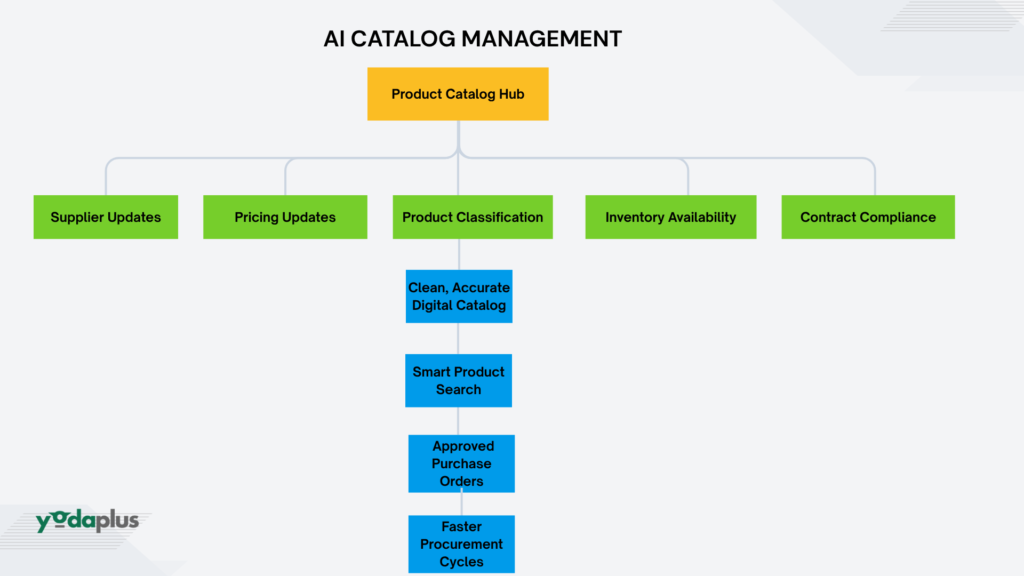
AI makes catalog management significantly more intelligent.
Instead of relying only on manual categorisation, AI can:
- Classify products automatically
- Identify duplicate products
- Recommend preferred suppliers
- Detect unusual pricing
- Suggest product alternatives
- Predict purchasing demand
- Improve search accuracy
These capabilities reduce procurement effort while helping employees make better purchasing decisions.
Purchase Order Automation
Once users select products from the catalog, the platform automatically creates purchase orders.
Purchase order automation reduces manual document preparation by populating:
- Supplier details
- Product information
- Pricing
- Quantities
- Delivery locations
- Payment terms
Purchase orders are then routed through predefined approval workflows before being sent to suppliers.
This shortens purchasing cycles while improving data accuracy.
Vendor Management and Supplier Collaboration
Effective vendor management extends beyond maintaining supplier records.
Modern e-procurement platforms allow organisations to monitor:
- Supplier performance
- Delivery reliability
- Pricing consistency
- Contract compliance
- Product quality
- Response times
Integrated vendor onboarding ensures supplier information remains accurate throughout the procurement lifecycle.
Better supplier collaboration also reduces purchasing delays and invoice exceptions.
Integration with Procure-to-Pay
E-procurement platforms become even more valuable when connected to broader procure-to-pay automation.
Information flows automatically between:
- Purchase requisitions
- Supplier catalogs
- Purchase orders
- Goods receipt
- Invoice processing automation
- Invoice reconciliation
- Accounts payable automation
Instead of re-entering information across multiple systems, procurement and finance share one connected workflow.
Better Compliance and Spend Control
Centralised purchasing helps organisations enforce procurement policies more effectively.
Employees purchase approved products from approved suppliers using negotiated contracts.
This reduces:
- Maverick spending
- Duplicate purchases
- Contract violations
- Pricing inconsistencies
- Unauthorised suppliers
Automated approval workflows also maintain complete audit trails for every transaction.
Procurement Analytics
Modern procurement platforms generate valuable business insights.
Dashboards help procurement leaders monitor:
- Supplier performance
- Procurement spending
- Purchase order cycle times
- Contract utilisation
- Catalog usage
- Approval bottlenecks
- Invoice exceptions
- Procurement savings
These insights support continuous procurement improvement.
Benefits of E-Procurement Platforms
Organisations implementing e-procurement and catalog automation typically experience:
- Faster purchasing
- Better spend visibility
- Lower procurement costs
- Improved supplier collaboration
- Reduced manual work
- Better contract compliance
- More accurate purchase orders
- Improved procurement reporting
- Stronger financial controls
- Better employee purchasing experience
These improvements benefit procurement, finance, suppliers, and internal stakeholders alike.
Best Practices for Implementation
To maximise the value of e-procurement platforms, organisations should:
- Standardise supplier data.
- Strengthen vendor onboarding.
- Maintain accurate product catalogs.
- Automate catalog synchronisation.
- Integrate procurement with ERP systems.
- Deploy purchase order automation.
- Configure approval workflows.
- Monitor supplier performance regularly.
- Track procurement KPIs continuously.
- Review catalog quality frequently.
These practices improve both procurement efficiency and long-term business value.
Conclusion
E-procurement platforms and catalog management automation are becoming essential for organisations seeking greater purchasing efficiency and financial control. By centralising supplier information, automating catalogs, streamlining purchase order automation, and integrating procurement with finance, businesses reduce manual effort while improving compliance and spend visibility. When combined with vendor management, invoice processing automation, and end-to-end procure-to-pay automation, these platforms create faster, more intelligent procurement operations.
Yodaplus Agentic AI Supply Chain and Retail Operations help organisations modernise procurement through intelligent e-procurement platforms, AI-powered catalog management, vendor onboarding, vendor management, purchase order automation, and end-to-end procure-to-pay automation. By integrating AI agents with enterprise systems, Yodaplus enables businesses to automate procurement workflows, improve supplier collaboration, and build more efficient purchasing operations.
FAQs
An e-procurement platform is a digital solution that manages purchasing activities, supplier collaboration, approvals, purchase orders, invoices, and procurement analytics within a single system.
Catalog management automation keeps supplier catalogs up to date by automatically synchronising product information, pricing, availability, and classifications.
AI automatically classifies products, identifies duplicates, recommends preferred suppliers, detects pricing anomalies, improves search results, and predicts purchasing demand.
Purchase order automation reduces manual document creation, improves data accuracy, speeds up approvals, and strengthens procurement compliance.
They connect purchasing, supplier catalogs, approvals, invoice processing, three-way matching, payment processing, and procurement analytics into one integrated workflow.