
Which Sectors Show the Strongest Agentic AI ROI So Far?
August 3, 2026 By Yodaplus
Agentic AI is delivering measurable returns across industries, but not every sector is seeing the same level of impact. The strongest return on investment (ROI) is generally found in industries with high volumes of repetitive work, complex decision-making, strict compliance requirements, and large amounts of structured and unstructured data.
Unlike traditional automation, Agentic AI can understand objectives, coordinate multiple tasks, interact with enterprise systems, and adapt when conditions change. This allows organisations to automate entire workflows rather than isolated activities, leading to greater efficiency and cost savings.
According to Deloitte, organisations adopting generative and agent-based AI are increasingly focusing on operational efficiency, productivity improvements, and workflow automation as key business outcomes. McKinsey also estimates that generative AI could add between $2.6 trillion and $4.4 trillion annually across industries, with banking, retail, customer operations, and software engineering among the biggest beneficiaries.
What Determines Agentic AI ROI?
The return on investment depends on several factors, including:
- Volume of repetitive processes
- Number of manual decisions
- Availability of enterprise data
- Process complexity
- Compliance requirements
- Customer interaction volume
- Integration across business systems
Industries with these characteristics usually see faster adoption and quicker returns.
Financial Services
Financial institutions are among the strongest adopters of Agentic AI.
Banks, insurers, investment firms, and FinTech companies manage thousands of repetitive but high-value processes every day.
Common applications include:
- Customer onboarding
- KYC verification
- AML monitoring
- Loan processing
- Investment research
- Regulatory reporting
- Fraud detection
- Financial reconciliation
AI agents reduce manual work while improving compliance and decision speed.
For many financial institutions, the largest ROI comes from reducing operational costs while increasing processing capacity without adding staff.
Healthcare
Healthcare organisations manage enormous volumes of documentation and administrative work.
Agentic AI helps automate:
- Patient scheduling
- Medical documentation
- Insurance verification
- Clinical coding
- Claims processing
- Medical record retrieval
- Prior authorisations
Healthcare professionals spend less time on administration and more time delivering patient care.
Improved operational efficiency also helps reduce treatment delays.
Retail and E-commerce
Retail businesses generate large amounts of operational data across sales, inventory, logistics, and customer service.
Agentic AI supports:
- Demand forecasting
- Inventory replenishment
- Dynamic pricing
- Customer support
- Order management
- Promotion planning
- Product recommendations
Instead of reacting to business events, retailers can make faster operational decisions based on real-time information.
Manufacturing
Manufacturers increasingly use Agentic AI to optimise production and maintenance.
Applications include:
- Predictive maintenance
- Production scheduling
- Quality inspection
- Supply planning
- Equipment monitoring
- Procurement optimisation
- Workforce scheduling
AI agents analyse factory data continuously, allowing businesses to reduce downtime and improve equipment utilisation.
Supply Chain and Logistics
Supply chains involve constant coordination between suppliers, warehouses, transport providers, and customers.
Agentic AI helps automate:
- Procurement workflows
- Shipment planning
- Route optimisation
- Inventory management
- Supplier communication
- Customs documentation
- Warehouse operations
By responding automatically to disruptions, AI agents improve operational resilience while reducing delays.
Insurance
Insurance companies process large volumes of claims and policy documents.
Agentic AI assists with:
- Claims assessment
- Fraud detection
- Policy servicing
- Risk analysis
- Customer support
- Document verification
- Underwriting assistance
This improves both customer experience and internal efficiency.
Telecommunications
Telecom providers operate complex customer service and network operations.
Agentic AI improves:
- Customer issue resolution
- Service provisioning
- Network monitoring
- Incident management
- Billing support
- Technical troubleshooting
AI agents can resolve many issues without requiring human intervention.
Energy and Utilities
Energy providers increasingly use AI agents to optimise operations.
Common applications include:
- Asset monitoring
- Predictive maintenance
- Demand forecasting
- Grid management
- Field service coordination
- Regulatory reporting
These improvements help reduce operational costs while improving service reliability.
Public Sector
Government agencies manage large volumes of citizen requests and regulatory documentation.
Agentic AI supports:
- Citizen service automation
- Permit processing
- Case management
- Document verification
- Internal knowledge retrieval
- Compliance monitoring
Although adoption is often slower due to governance requirements, the long-term efficiency gains can be substantial.
Why Finance Often Leads
Financial services consistently rank among the strongest sectors for AI ROI because they combine:
- High transaction volumes
- Data-rich environments
- Strict compliance
- Repetitive workflows
- Significant documentation
- Multiple enterprise systems
Even small efficiency improvements generate substantial financial returns when applied across millions of transactions.
Challenges That Affect ROI
Although Agentic AI offers significant potential, several factors influence implementation success.
Common challenges include:
- Poor data quality
- Legacy systems
- Security concerns
- Regulatory compliance
- Change management
- Skills shortages
- Integration complexity
Organisations that address these challenges early usually realise ROI faster.
How Businesses Can Maximise ROI
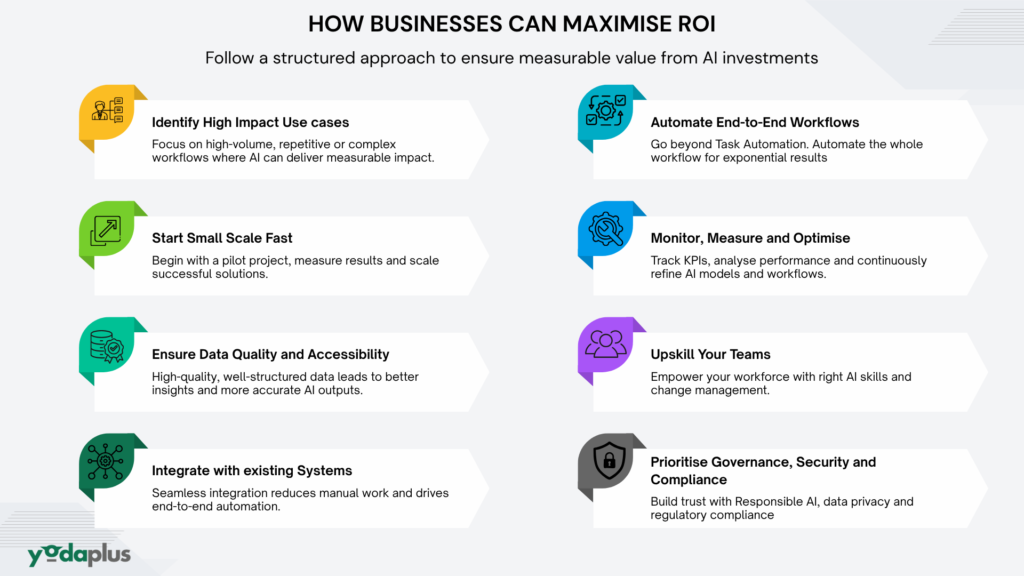
Businesses should focus on processes that are:
- High volume
- Rule-intensive
- Document-heavy
- Repetitive
- Cross-functional
- Data-driven
Instead of trying to automate every activity at once, organisations often achieve better results by starting with one workflow, measuring improvements, and expanding gradually.
Conclusion
The strongest Agentic AI ROI is currently being seen in financial services, healthcare, retail, manufacturing, supply chain, insurance, telecommunications, energy, and the public sector. These industries share common characteristics such as complex workflows, large data volumes, and repetitive operational tasks that benefit from intelligent automation. As Agentic AI continues to mature, organisations that focus on measurable business outcomes rather than technology alone are likely to see the greatest long-term value.
Yodaplus Agentic AI Services help organisations across finance, retail, supply chain, maritime, and enterprise operations deploy AI agents that automate workflows, improve decision-making, strengthen compliance, and deliver measurable operational improvements. By combining intelligent automation with secure enterprise integration, Yodaplus helps businesses realise the full ROI of Agentic AI.
FAQs
Financial services currently rank among the strongest sectors because of high transaction volumes, regulatory requirements, and document-intensive workflows.
Retailers use AI agents for inventory management, demand forecasting, customer service, pricing, and supply chain optimisation, improving efficiency and customer experience.
Yes. Manufacturers use Agentic AI for predictive maintenance, production scheduling, quality inspection, procurement, and equipment monitoring.
Key factors include process volume, data quality, workflow complexity, system integration, regulatory requirements, and organisational readiness.
Start with high-volume, repetitive workflows where automation can deliver measurable improvements, then expand based on performance and business priorities.