How Does Agentic AI Adoption Differ Between Finance and Retail?
July 29, 2026 By Yodaplus
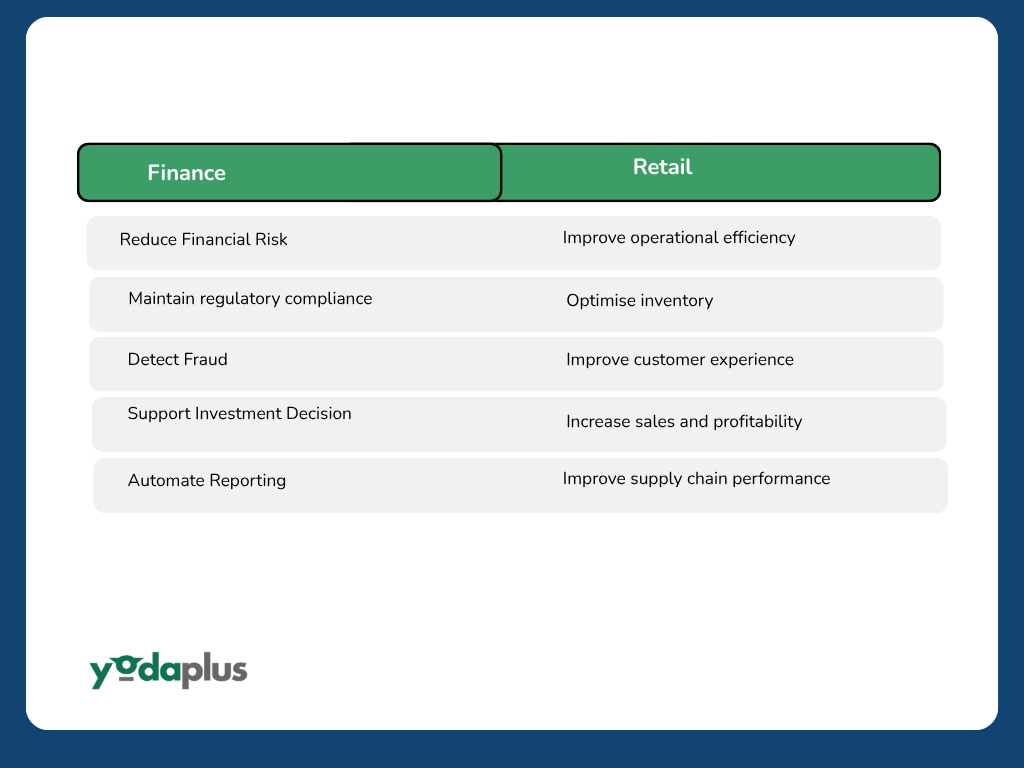
Agentic AI adoption differs between finance and retail because the two industries solve very different business problems. Financial institutions focus on managing risk, regulatory compliance, and high-value decisions, while retailers prioritise inventory management, customer experience, pricing, and supply chain efficiency. Although both industries use autonomous AI agents, the objectives, data, and workflows they automate are fundamentally different.
According to McKinsey’s State of AI report, 78% of organisations now use AI in at least one business function, with financial services and retail among the sectors making the largest investments in enterprise AI. The difference lies in where that investment delivers the greatest value.
Why Finance and Retail Need Agentic AI
Both industries process enormous amounts of data every day.
Banks analyse millions of financial transactions, customer records, loan applications, and regulatory reports. Retailers manage product catalogues, inventory levels, supplier information, pricing data, customer purchases, and fulfilment operations.
Traditional automation helps complete repetitive tasks, but Agentic AI goes further by analysing situations, making decisions, coordinating systems, and completing multi-step workflows with minimal human intervention.
The business objective, however, is different for each industry.
How Finance Uses Agentic AI
Financial services operate in one of the most regulated business environments.
Every decision must be accurate, auditable, and compliant with regulatory requirements.
This makes Agentic AI particularly valuable for managing complex operational workflows rather than replacing financial professionals.
Common applications include:
Fraud Detection
AI agents continuously monitor transactions, identify suspicious activity, collect supporting evidence, and escalate only high-risk cases for investigation.
Regulatory Compliance
Banks generate thousands of compliance reports every year.
Instead of collecting information manually, AI agents gather data across multiple systems, prepare documentation, and verify reporting requirements before submission.
Investment Research
Agentic AI can analyse company filings, financial statements, earnings transcripts, news, and macroeconomic data to prepare investment research faster than traditional manual processes.
Credit Assessment
Rather than reviewing applications individually, AI agents evaluate financial information, risk indicators, historical behaviour, and supporting documentation before recommending approval or rejection.
According to IBM’s Global AI Adoption Index, financial services remain one of the fastest-growing enterprise AI sectors because of the potential to improve compliance and operational efficiency.
How Retail Uses Agentic AI
Retail organisations operate in a much faster and more dynamic environment.
Demand changes daily.
Product availability changes hourly.
Customer preferences constantly evolve.
Instead of reducing regulatory workload, retailers use Agentic AI to improve operational agility.
Typical applications include:
Demand Forecasting
AI agents analyse historical sales, promotions, weather patterns, seasonal demand, and regional buying behaviour to improve inventory planning.
Inventory Optimisation
Rather than maintaining static stock levels, AI continuously recommends replenishment quantities based on real-time demand.
Dynamic Pricing
Retailers use AI agents to monitor competitors, customer demand, inventory levels, and promotional campaigns before recommending price adjustments.
Supplier Coordination
AI agents monitor supplier performance, compare quotations, evaluate delivery schedules, and recommend procurement decisions that reduce delays and inventory shortages.
According to Deloitte, AI adoption in retail continues to accelerate as organisations seek better customer experiences and more efficient operations.
Shared Benefits Across Both Industries
Despite their differences, both sectors benefit from Agentic AI in similar ways.
These include:
- Reduced manual work
- Faster decision-making
- Better operational visibility
- Improved data accuracy
- Higher productivity
- Lower operating costs
- Better customer experiences
- Smarter resource allocation
The difference lies in where these benefits are realised.
Finance improves governance and risk management.
Retail improves speed and operational efficiency.
Which Industry Will Adopt Faster?
Financial services will continue investing heavily because of the value AI creates in compliance, investment research, fraud detection, and risk analysis.
Retail, however, is likely to expand deployment across a broader range of operational workflows because customer demand, supply chain management, and pricing decisions change continuously.
Rather than one industry replacing the other, both are expected to increase adoption, each focusing on the business processes where Agentic AI delivers the greatest measurable impact.
Conclusion
Finance and retail demonstrate that Agentic AI is not a one-size-fits-all technology. Financial institutions use autonomous AI to improve compliance, manage risk, and support complex analytical decisions, while retailers focus on inventory optimisation, customer experience, pricing, and supply chain coordination. Although the implementation differs, both industries are moving beyond isolated automation towards intelligent systems that can analyse information, coordinate workflows, and make business decisions with minimal human intervention.
Yodaplus Agentic AI Services help organisations across finance, retail, supply chain, and enterprise operations build intelligent AI solutions tailored to their industry. By combining autonomous agents with enterprise integrations and workflow orchestration, Yodaplus enables businesses to automate complex processes, improve operational visibility, and scale AI adoption with confidence.
FAQs
Finance prioritises compliance, fraud detection, and risk management, while retail focuses on inventory optimisation, pricing, customer experience, and supply chain efficiency.
Both industries benefit significantly, but they measure success differently. Finance focuses on reducing risk and improving compliance, while retail measures improvements in sales, inventory accuracy, and operational efficiency.
Yes. The underlying technology is similar, but the AI agents, workflows, enterprise integrations, and business goals are customised for each industry’s requirements.
Financial institutions operate under strict regulatory frameworks, making governance, explainability, auditability, and security essential before deploying autonomous AI systems.
It helps retailers forecast demand, optimise inventory, automate procurement, adjust pricing, coordinate suppliers, and improve customer experiences through intelligent decision-making.