
Industry-Specific Agentic AI Adoption Patterns
July 29, 2026 By Yodaplus
Agentic AI adoption patterns differ across industries because every business is trying to solve a different problem. Banks are using AI agents to strengthen fraud detection and regulatory compliance. Retailers are improving demand forecasting and inventory planning. Manufacturers are optimising production schedules and equipment maintenance, while logistics companies are coordinating procurement, warehousing, and transportation. The technology may be the same, but the way organisations apply it depends on their business priorities, existing systems, and operational challenges.
This is why there is no universal adoption strategy. Rather than deploying Agentic AI across every department, enterprises are focusing on the areas where autonomous decision-making can deliver the highest return. According to McKinsey’s The State of AI report, 78% of organisations now use AI in at least one business function, highlighting how quickly AI has become part of day-to-day operations rather than an experimental technology.
The next stage of enterprise AI goes beyond generating content or answering questions. Agentic AI systems can understand business goals, access enterprise tools, analyse large volumes of data, collaborate with other AI agents, and execute multi-step workflows with minimal human intervention. Gartner predicts that by 2028, 15% of day-to-day work decisions will be made autonomously through Agentic AI, compared with virtually none in 2024.
However, adoption is not progressing at the same pace everywhere. Industries with structured data, repetitive processes, and mature digital infrastructure are implementing Agentic AI faster than sectors where decisions rely heavily on human judgement or strict regulatory oversight. Factors such as data quality, technology investments, compliance requirements, and expected return on investment all influence how quickly organisations move from AI pilots to enterprise-wide deployment.
Understanding these adoption patterns is becoming increasingly important for business leaders. Knowing how organisations in the same industry are applying Agentic AI helps identify practical use cases, benchmark digital maturity, and prioritise investments that deliver measurable business value. It also provides insight into where the technology is creating competitive advantages and where adoption is likely to accelerate over the next few years.
In this guide, we’ll examine how Agentic AI adoption differs across banking and financial services, healthcare, retail, manufacturing, logistics, maritime, and other industries. We’ll also explore the business drivers behind adoption, the challenges each sector faces, emerging enterprise trends, and what these patterns reveal about the future of autonomous business operations.
Why Agentic AI Adoption Varies Across Industries
Although the core capabilities of Agentic AI remain the same, adoption looks very different across industries. The biggest reason is that every sector operates with different objectives, regulations, workflows, and levels of digital maturity.
A financial institution processes millions of transactions every day and must comply with strict regulations. A manufacturer focuses on production efficiency and equipment reliability. A retailer needs to respond quickly to changing customer demand, while a logistics company coordinates suppliers, warehouses, carriers, and customers across multiple locations.
As a result, organisations are introducing AI agents where they can solve the biggest operational bottlenecks first.
The common business drivers include:
- Improving operational efficiency
- Reducing manual work
- Faster decision-making
- Better customer experience
- Lower operating costs
- Increased resilience
- Higher productivity
However, the priority attached to each objective varies by industry.
Banking and Financial Services: Leading Enterprise Adoption
Banking has consistently been one of the earliest adopters of enterprise AI because financial institutions already generate large volumes of structured digital data. Combined with strict regulatory requirements and high operational costs, this creates strong incentives to automate repetitive decision-making.
Today, Agentic AI is being introduced across several business functions, including:
- Customer onboarding
- Anti-money laundering (AML)
- Fraud investigation
- Credit underwriting
- Regulatory reporting
- Investment research
- Portfolio monitoring
Rather than analysing transactions one by one, AI agents can investigate unusual activity, collect supporting evidence, prepare compliance reports, and escalate only high-risk cases for human review.
This significantly reduces manual effort while improving consistency.
According to IBM’s Global AI Adoption Index, financial services remain among the industries with the highest enterprise AI adoption due to automation opportunities and regulatory demands.
Why BFSI Is Moving Faster
Several characteristics make banking well suited for Agentic AI.
- Highly structured enterprise data
- Mature digital infrastructure
- Large compliance workloads
- Clearly defined business rules
- Strong return on automation investments
These factors allow financial institutions to deploy autonomous AI with relatively lower operational risk than many other industries.
Healthcare Is Prioritising Administrative Automation
Healthcare organisations face a different challenge.
Clinical decisions cannot simply be automated. Every recommendation directly affects patient care, meaning regulatory oversight and human supervision remain essential.
As a result, healthcare providers are focusing on administrative workflows where AI can reduce workload without replacing clinical expertise.
Current applications include:
- Clinical documentation
- Medical coding
- Insurance verification
- Appointment scheduling
- Patient communication
- Prior authorisation
- Care coordination
Instead of replacing healthcare professionals, Agentic AI acts as an operational assistant that gathers information, prepares documentation, and coordinates activities across multiple systems.
The World Economic Forum estimates that AI has significant potential to reduce administrative burdens across healthcare while improving operational efficiency and access to care.
Healthcare adoption is therefore growing steadily, but with greater emphasis on governance, transparency, and human oversight.
Retail Is Using Agentic AI to Respond Faster
Retail operates in an environment where customer demand changes constantly.
Product availability.
Promotional campaigns.
Seasonal buying patterns.
Supplier performance.
Inventory movement.
Traditional planning systems struggle to respond quickly enough.
Agentic AI enables retailers to coordinate decisions across merchandising, procurement, inventory, pricing, and fulfilment instead of treating each function independently.
Some of the fastest-growing use cases include:
- Demand forecasting
- Inventory optimisation
- Dynamic pricing
- Automated replenishment
- Personalised recommendations
- Supplier coordination
Rather than producing static forecasts, AI agents continuously monitor new information and adjust recommendations throughout the day.
According to Deloitte, retailers increasingly see AI as a strategic capability for improving operational efficiency while enhancing customer experience.
Manufacturing Is Expanding Beyond Predictive Maintenance
Manufacturing has used automation for decades, but Agentic AI is helping factories move beyond isolated machine intelligence. Instead of monitoring a single production line or predicting when equipment might fail, AI agents can coordinate decisions across procurement, production planning, inventory, maintenance, quality control, and logistics.
For example, if a critical machine unexpectedly goes offline, an AI agent can identify the issue, estimate the production impact, check raw material availability, reschedule manufacturing orders, notify suppliers, and update delivery timelines without waiting for manual intervention.
Common manufacturing use cases include:
- Predictive maintenance
- Production scheduling
- Factory resource planning
- Inventory optimisation
- Quality inspection
- Procurement planning
- Energy management
According to PwC, AI could contribute up to US$15.7 trillion to the global economy by 2030, with manufacturing expected to capture one of the largest productivity gains through automation and intelligent decision-making.
Why Manufacturing Is Accelerating Adoption
Manufacturers often operate with structured operational data collected from ERP systems, Industrial IoT sensors, MES platforms, and supply chain applications. This provides the data foundation AI agents need to make informed operational decisions.
Instead of optimising one production process at a time, manufacturers are beginning to optimise the entire factory.
Logistics Is Building Autonomous Supply Chains
Few industries generate as much operational complexity as logistics.
A single shipment may involve suppliers, warehouses, customs authorities, ports, carriers, trucking companies, distribution centres, and customers.
Managing these activities manually often leads to delays, poor visibility, and higher operational costs.
Agentic AI helps logistics providers coordinate these interconnected workflows.
Instead of simply notifying managers about problems, AI agents can recommend or execute corrective actions automatically.
Examples include:
- Selecting alternative carriers
- Reallocating warehouse inventory
- Replanning delivery routes
- Updating procurement schedules
- Managing transportation capacity
- Prioritising customer orders
This shifts logistics from reactive operations to proactive decision-making.
According to McKinsey, companies with digitally enabled supply chains can improve service levels while reducing operational costs through better planning and visibility.
Why Logistics Is an Ideal Candidate
Logistics involves thousands of repetitive operational decisions every day.
These include:
- Route selection
- Carrier assignment
- Procurement approvals
- Inventory allocation
- Shipment tracking
- Warehouse scheduling
Many of these decisions follow clear business objectives, making them well suited for autonomous AI agents.
Maritime Is Using Agentic AI to Modernise Operations
Although maritime has traditionally adopted new technology more slowly than other industries, this is beginning to change.
Shipping companies now face increasing documentation requirements, stricter environmental regulations, complex compliance frameworks, and rising operational costs.
Agentic AI is helping maritime organisations automate many of these administrative and operational workflows.
Current applications include:
- Vessel document intelligence
- Regulatory compliance
- Voyage planning
- Fleet maintenance coordination
- Port documentation
- Safety management
- Crew knowledge assistance
Instead of searching hundreds of manuals or compliance documents manually, crews can ask AI agents questions that return accurate, cited answers within seconds.
Shipping companies are also using AI agents to monitor vessel performance, optimise routes, and support emissions reporting.
As international regulations continue to evolve, document-heavy maritime operations are expected to become one of the strongest long-term applications of Agentic AI.
Industry Adoption Maturity Looks Very Different
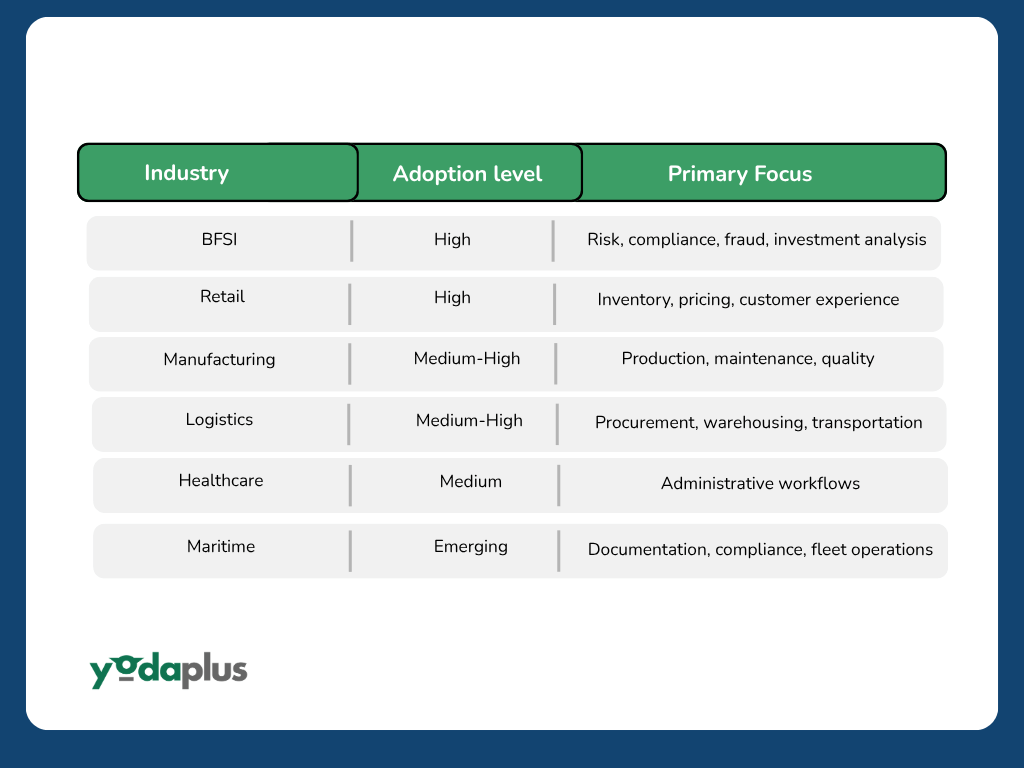
Although every industry is investing in Agentic AI, not every sector has reached the same level of maturity.
Some industries already have structured enterprise data, cloud-based infrastructure, and clearly defined digital workflows. Others are still modernising legacy systems before autonomous AI can be deployed at scale.
A simplified maturity comparison looks like this:
What Will Industry Adoption Look Like by 2030?
The next few years will likely see Agentic AI move from isolated deployments to enterprise-wide orchestration.
Rather than introducing individual AI agents for specific departments, organisations will build networks of specialised agents that collaborate across business functions.
For example, a customer order could automatically trigger:
- A procurement agent to source inventory
- A finance agent to approve spending
- A logistics agent to schedule transportation
- A warehouse agent to prepare fulfilment
- A customer service agent to provide updates
All without manual coordination.
This level of orchestration is expected to become one of the defining characteristics of enterprise AI adoption over the coming decade.
Gartner predicts that autonomous decision-making will continue expanding as organisations gain confidence in AI governance, security, and enterprise integration.
Conclusion
Agentic AI adoption is no longer following a single path. Each industry is applying autonomous AI where it solves the most valuable business problems, whether that means reducing financial risk, improving patient administration, optimising manufacturing schedules, managing complex logistics networks, or simplifying maritime compliance. The pace of adoption depends on digital maturity, data availability, regulatory requirements, and operational priorities, but the direction is clear. Enterprises are moving beyond isolated AI tools towards intelligent systems that can coordinate work, make decisions, and continuously improve business operations.
As these adoption patterns mature, organisations will shift their focus from automating individual tasks to orchestrating complete workflows across departments. Businesses that establish strong data foundations, governance frameworks, and enterprise integrations today will be better positioned to scale Agentic AI tomorrow.
Yodaplus Agentic AI Services help enterprises build intelligent, goal-driven AI solutions that integrate seamlessly with existing business systems. From financial operations and supply chain management to retail and maritime workflows, Yodaplus develops Agentic AI solutions that automate complex processes, improve operational visibility, and enable organisations to scale enterprise AI with confidence.
FAQs
Banking, financial services, retail, manufacturing, and logistics are among the fastest adopters because they have structured data, repetitive workflows, and clear opportunities for automation and operational improvement.
Each industry has different regulations, business goals, data maturity, and operational challenges. These factors influence where AI agents can deliver the greatest value and how quickly organisations can deploy them.
Healthcare, logistics, maritime, manufacturing, and public sector organisations are expected to see significant growth as enterprise AI platforms become more capable and easier to integrate with existing systems.
Common challenges include legacy technology, poor data quality, regulatory requirements, governance concerns, integration complexity, and the need for human oversight in critical business decisions.
Most organisations start with one high-impact workflow, such as procurement, compliance, customer support, or supply chain planning. Once measurable value is demonstrated, AI agents can be expanded across additional business functions.